From payments to media: What Razorpay’s ChatGPT ads play really changes
Razorpay’s entry into ChatGPT Ads raises questions about the growing overlap between advertising, payments and commerce, and its implications for agencies and ad budgets
 by
by
Published: Oct 9, 2026 9:03 AM | 5 min read
 Follow Us

- Razorpay has partnered with OpenAI to introduce ChatGPT Ads for Indian brands through its platform, Razorpay Engage, which assists in campaign management and performance tracking.
- The Indian digital advertising market is rapidly growing, with projections indicating it will account for approximately 68% of total advertising spend by 2026, driven by commerce-led formats.
- Experts note that while Razorpay's advertising service may not be technically novel, it signifies a shift in operational roles, with payment companies taking on functions traditionally held by marketing agencies.
- The convergence of advertising, commerce, and payment systems is evolving, as AI platforms increasingly facilitate product discovery and transactions, blurring the lines between media, commerce, and agency roles.
The revolution will no longer be televised. We've known that for a while now, ever since the ascendancy of YouTube, Instagram Reels, and the verticalisation of content. But a new kind of revolution may be beginning to brew on a fairly unexpected screen near you.
Not the television. Not even the search bar or social feed. The payments dashboard.
On October 5, Razorpay partnered with OpenAI to bring ChatGPT Ads to Indian brands through Razorpay Engage. But Engage is not merely collecting advertisers’ money. It is helping prepare product catalogues, set up campaigns, manage them and track performance.
Looked at one way, this appears to be a payments company wandering rather far up the advertising value chain.
Rahul Vengalil, CEO and co-founder of tgthr, thinks that interpretation gets ahead of the facts.
“This is not something path-breaking or new, it has been there for a very long time,” he says. Google and Meta already work with payment gateways in India, particularly to enable advertisers without credit lines to access their self-serve platforms. In that sense, Razorpay helping Indian businesses buy ChatGPT Ads could simply be familiar infrastructure meeting another global advertising platform.
He may be right about the mechanism. What is changing much faster is the market around it.
Also Read: Apple Pay wont beat UPI in India
Why India is a stress test for agentic commerce
Google turns 28: Searching for answers in a world it helped create
Everyone wants to be a media company. McDonald’s just made it obvious
Money matters
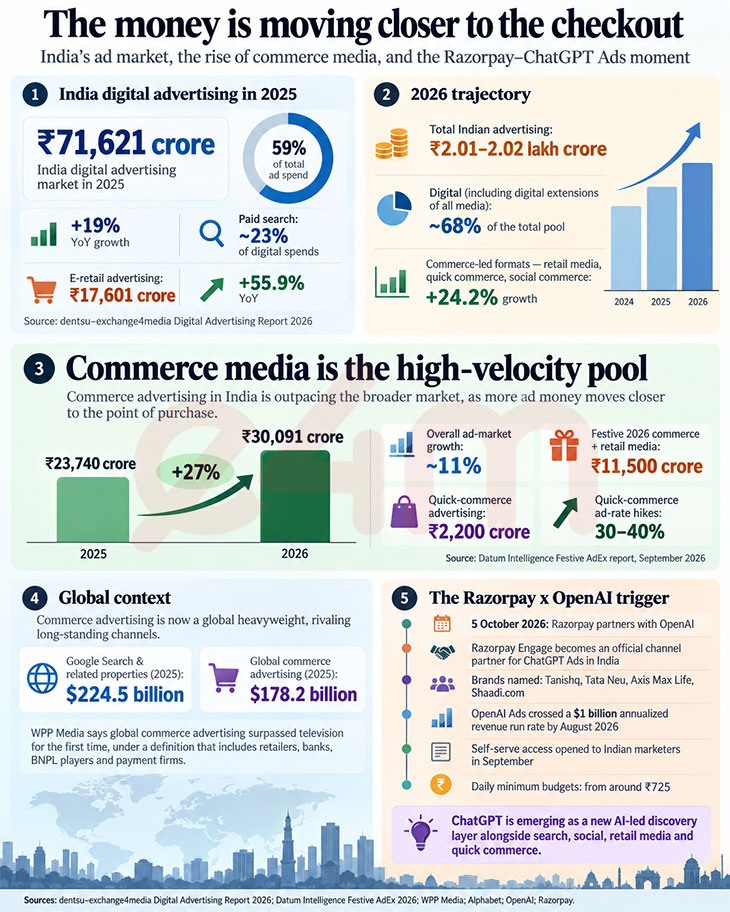
India’s digital advertising market hit ₹71,621 crore in 2025, accounting for 59% of total ad spend and growing 19% year-on-year, according to the dentsu–exchange4media Digital Advertising Report 2026. Paid search contributed around 23% of digital spends, while e-retail advertising surged 55.9% to ₹17,601 crore, or almost a quarter of all digital ad revenue.
The trajectory has only steepened in 2026: industry estimates now put total Indian advertising at ₹2.01–2.02 lakh crore, with digital (including digital extensions of all media) at roughly 68% of that pool, and commerce-led formats (retail media, quick commerce and social commerce) growing at 24.2%, far ahead of the overall market.
Datum Intelligence estimates India’s commerce-advertising market will grow 27% this year, from Rs 23,740 crore in 2025 to Rs 30,091 crore in 2026, against roughly 11% growth for the wider advertising market. During the festive period alone, commerce and retail media are expected to attract Rs 11,500 crore, including around Rs 2,200 crore on quick-commerce platforms.
The money, increasingly, is moving closer to the transaction.
Globally, the same convergence is already much larger. WPP Media estimates commerce advertising reached $178.2 billion in 2025, overtaking television, under a definition that includes not just retailers but banks, BNPL providers and payment companies such as PayPal and Alipay. Meanwhile, Google Search and related properties generated an estimated $224.5 billion last year, a reminder of just how valuable owning commercial intent can become.
That is what makes Razorpay more interesting than the mechanics of another self-serve partnership might suggest.
Subjects matter
Viren Inaniyan, co-founder and CEO of Tru Commerce, also sees “limited demonstrated technical novelty” in the advertising service itself. Catalogue-based campaigns and self-serve access already exist.
The distinction, he says, is operational. Razorpay is offering campaign execution and optimisation, “taking on functions typically associated with a marketing agency”.
That matters because Razorpay and OpenAI were already working together further down the funnel. Their earlier collaborations around agentic payments and ChatGPT storefronts were aimed at allowing an AI interface to participate not only in discovery, but eventually in the transaction itself.
For Prabhvir Sahmey, CEO and co-founder of Stratpulse Labs, the progression resembles something he expected while building Feedbridge.AI.
Sahmey says capabilities designed to make products and services more discoverable to AI agents were always likely to be absorbed by larger commerce or payments platforms. Razorpay’s moves into agentic payments and now advertising, he argues, begin to validate that thesis.
His next bet is on paid-search money.
“ChatGPT is a lot like search; just that it changes from keywords to conversation,” Sahmey says. If AI interfaces increasingly combine discovery with merchant and payment integrations, they can shorten the distance between asking for a product and actually purchasing it.
For conversion-heavy categories, he expects advertisers to begin moving portions of paid-search budgets into ChatGPT Ads as consumer traffic and transactions migrate there.
That migration is by no means assured. Vengalil points out that ChatGPT advertising remains expensive compared with established platforms like Meta and Google, meaning early adoption may remain concentrated among advertisers testing another channel rather than reallocating serious budgets.
Nor does commerce infrastructure moving upstream necessarily mean agencies move out.
Ambika Sharma, Founder and Chief Strategist at Pulp Strategy, argues that budgets will follow high-intent behaviour, but cautions against seeing this merely as search advertising shifting to another screen.
“The media value chain changes when discovery, comparison, recommendation, and transaction begin sitting inside the same conversation,” she says.
For agencies, that could broaden the job beyond media buying into product data, AI discoverability, paid visibility, recommendation intelligence, conversion signals and the eventual handoff into commerce and payments. They do not have to own those payment rails, Sharma says, but increasingly need to understand and orchestrate them.
And there remains one boundary even a tightly integrated commercial stack cannot simply buy through.
“An ad can buy presence, but it cannot buy the AI recommendation,” Sharma says.
Razorpay selling ChatGPT Ads, then, is probably not the revolution.
What really matters
The more consequential shift is already underway around it. Commerce advertising is growing faster than the wider ad market. Retailers have become media owners. Payment and commerce companies are creeping further into marketing execution, while AI platforms are beginning to sit between product discovery and purchase.
The revolution, if there is one, may be quieter than expected: the closer advertising gets to the checkout, the harder it becomes to tell where the media platform ends, the commerce platform begins, and the agency sits between them.
OpenAI directed us to their partner for this story, while Razorpay had not responded to queries at the time of publication.
Read more news about Digital Media, Internet Advertising, Marketing News, Television Media, Radio Media
For more updates, be socially connected with us onInstagram, LinkedIn, Twitter, Facebook, YouTube & Google News