India gave ChatGPT users. Can it now give OpenAI ad revenue?
Populations of countries where previous roll outs happened pale in comparison to India’s; so advertising built around interpreting conversation matters more than it would for a conventional banner ad
 by
by
Published: Aug 27, 2026 9:23 AM | 6 min read
 Follow Us

- **Launch Timing**: OpenAI has rolled out ChatGPT Ads in India, marking it as the fifth market after initial launches in the US and several other countries, raising questions about the timing given India's significance as a tech hub.
- **Market Complexity**: India is characterized by its vast diversity, with 28 states and 8 union territories, 22 official languages, and various socioeconomic groups, making the implementation of a localized advertising system particularly challenging.
- **Advertising Landscape**: The Indian market presents difficulties for advertisers due to its fragmented nature, requiring OpenAI to navigate regional targeting, language nuances, and brand safety, complicating the rollout of ChatGPT Ads.
- **Revenue Considerations**: While India offers a large user base, its low average revenue per user (ARPU) poses challenges for monetization, suggesting that OpenAI's delay in launching ads may stem from the need to ensure a viable advertising ecosystem before proceeding.
While the headline is “ChatGPT Ads rolls out in India”, there are a multitude of stories it can tell. About market forces, the evolution of digital advertising, the influx of AI into our everyday lives, and how it is all expressed in an increasingly media-filled world.
And while we’ll tell those stories as well, given the immediacy, let’s begin with the timing of this rollout, which could be seen as slightly odd. Because it is.
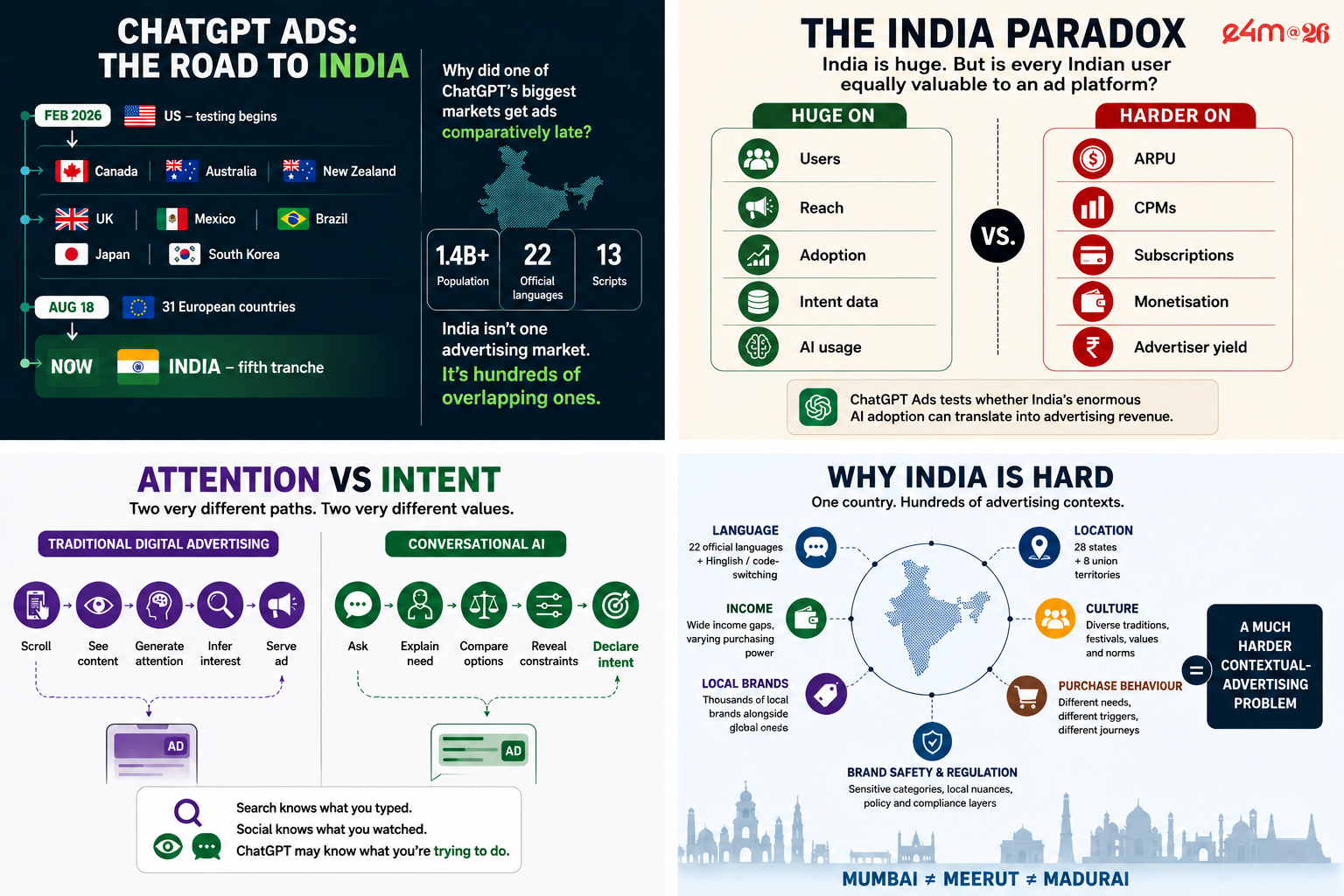
India is in the fifth tranche of markets to get ChatGPT Ads, following testing in the US beginning in February. The company subsequently expanded advertising to Canada, Australia and New Zealand, followed by markets including the UK, Mexico, Brazil, Japan and South Korea and, most recently, 31 countries in Europe on August 18.
And now India.
And that’s pretty singular.
Global tech giants have long treated India as a critical “India-first, world-next” innovation hub. Google built Two-Wheeler Mode for Maps here, developed offline products such as YouTube and Maps around Indian connectivity constraints, and, most significantly, launched Tez, its first digital payments platform, built on UPI before its payments products were unified globally under the Google Pay name. Meta turned India into a major proving ground for WhatsApp Business and conversational commerce.
And OpenAI itself chose India to debut ChatGPT Go, its affordable subscription tier with native UPI payments, before subsequently expanding it internationally to 170 countries.
And when it comes to advertising, the examples become even more relevant. Meta’s Click-to-WhatsApp Ads turned an ad impression on Facebook or Instagram into the beginning of a business conversation, a format particularly suited to India’s enormous WhatsApp merchant ecosystem. Google has increasingly pushed AI-led products such as Performance Max, AI Max for Search campaigns and Asset Studio first to Indian advertisers, with its 2026 India announcements explicitly positioning Gemini-powered creative generation and campaign automation for local businesses. Amazon Ads, meanwhile, has expanded commerce-led formats built around the purchase signals generated inside Amazon’s Indian marketplace.
And given the narrative that every business wants to be in the India business (broadly told but should be more narrowly viewed), it’s slightly weird for such a comparatively late entry here, right?
Why wouldn’t you roll out your hopefully main monetizable product at least second in your second largest market?
As with so many questions (and headlines), there could be many of them. Here are possibly two of them.
India: Many markets, many borders
India isn’t exactly a monolith. It’s, if we want to get technical, a massive, hyper-fragmented matrix of 28 states and 8 union territories encompassing over 1.4 billion users, who speak 22 official languages written in 13 distinct scripts, partitioned into distinct socioeconomic, cultural, and geographic cohorts.
It’s complex, and a pan-India roll out is no mean feat, and not one to be attempted lightly. The populations of all the countries where the previous roll outs happened pale in comparison to India’s not just in shades of Pantone, but in sheer number.
And for an advertising system built around interpreting a conversation, that complexity matters more than it would for a conventional banner ad.
ChatGPT Ads are supposed to infer commercial relevance from what somebody is actually discussing: what they are researching, comparing or considering buying. In India, those signals can arrive in English, Hindi, Hinglish or code-switched combinations of several languages; contain local brands and colloquialisms; and imply completely different purchasing power depending on whether the user is in Mumbai, Meerut or Madurai.
That makes localisation more than a translation problem. OpenAI has to determine whether an ad is relevant, appropriate and commercially useful while simultaneously handling language, geography, context and brand-safety restrictions. Its own advertising rules exclude sensitive categories and conversations, adding another classification layer before an advertisement can even be eligible to appear.
Then there is the advertiser side: regional targeting, billing, measurement, moderation and enough local demand to fill that inventory without turning every eligible conversation into the same handful of ads.
Put together, India is less one advertising market than several hundred overlapping ones. Launching late may therefore say less about India’s importance than about how much harder India is to get right.
India: Better bazaar than market
As previously established, India is a massive, hyper-fragmented matrix of 28 states and 8 union territories encompassing over 1.4 billion users, who speak 22 official languages written in 13 distinct scripts, partitioned into distinct socioeconomic, cultural, and geographic cohorts.
Which is precisely why companies chasing India’s enormous user base have repeatedly rewritten their usual pricing playbooks. Google famously subsidised internet access through railway-station Wi-Fi and has since bundled premium AI services through telecom partnerships. Perplexity partnered with Airtel to give hundreds of millions of subscribers free access to Perplexity Pro. Netflix created a low-cost mobile plan for India, while Amazon has repeatedly experimented with cheaper Prime configurations.
India is therefore tremendously valuable if the objective is users. The harder question is what those users are worth once the objective becomes revenue.
So, India has always been a great data mine, as we’ve written previously. It’s a huge market. It’s just not a particularly lucrative one. India’s ARPUs across services and apps routinely rank among the lowest in the world. Subscription tiers are cheaper, services are bundled aggressively, and advertisers generally pay less to reach an Indian user than one in wealthier markets.
That doesn’t make India unimportant. Quite the opposite. It makes it enormously valuable for reach, adoption and behavioural data, just less straightforward when the bill finally comes due.
Ironically, our greatest strength is also what renders us a relatively weaker market for certain businesses.
Google and Meta thrive in India because their business model is attention, and their product is you. OpenAI’s has historically been different. It already has your attention because you’re on ChatGPT. Not to kill time on YouTube or Instagram, or to curse at a meeting reminder on Gmail or a birthday reminder on Facebook.
People generally open ChatGPT because they want something done: choose between two phones, plan a holiday, understand an insurance policy, find a restaurant, compare software or solve a problem. That is not merely attention. It is declared intent, expressed conversationally and often in considerably greater detail than a search keyword could contain.
That potentially makes each eligible interaction unusually valuable. But it also changes the India equation. OpenAI does not simply need hundreds of millions of Indian users. It needs enough Indian advertisers willing to pay meaningful amounts to appear beside those moments of intent.
And that may explain the apparent paradox: India was important enough to launch ChatGPT Go first, but advertising may have required waiting until the market, and OpenAI’s machinery for monetising it, was ready.
Read more news about Digital Media, Internet Advertising, Marketing News, Television Media, Radio Media
For more updates, be socially connected with us onInstagram, LinkedIn, Twitter, Facebook, YouTube & Google News