The new sci-fi adworld: The tigers tail and what comes after
Ajay Gupte, senior media industry leader, in conversation with Shripad Kulkarni on the performance trap, the ad stock that quietly disappeared —and why what is coming next is, in his own words, sci-fi
 by
by
Published: Apr 23, 2026 8:22 AM | 7 min read
 Follow Us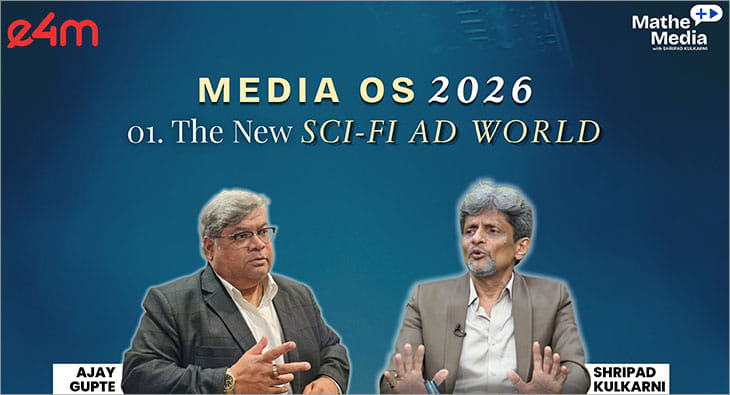

- Ajay Gupte, a seasoned media industry leader, warns that many Indian brands are falling into a trap by over-relying on performance marketing, which initially shows promising results but leads to stagnation in sales growth.
- He identifies a critical issue where brands continue to invest heavily in performance marketing, resulting in diminishing returns and a depletion of brand equity, or "ad stock," which is essential for long-term consumer pull.
- Gupte outlines a solution involving three pillars for brands to break free from this cycle: leveraging first-party data, creating adaptable and modular creative assets, and customizing marketing efforts based on real-time consumer insights.
- He emphasizes the need for a new talent pool in marketing agencies, including data scientists and AI specialists, to adapt to the evolving landscape where marketing and sales functions are increasingly intertwined.
The Entry Looks Like Success
Ajay Gupte has a gift for the uncomfortable truth delivered with complete calm. As a seasoned Media Industry Leader, he has worked with the most sophisticated marketing organisations in the country — and what he has been watching happen over the years is something he describes, without drama, as a trap.
Not a strategic mistake. Not a bad bet. A trap. The kind you walk into willingly, because the entry looks exactly like success.
The entry point is performance marketing. And for most Indian brands that discovered it in the post-pandemic years, the early results were extraordinary. Accountability. Measurability. Every rupee tracked to an outcome. After decades of brand advertising that was beautiful and unfalsifiable, here was something that told you exactly what you got for what you spent.
"There are a lot of performance-first brands and digital-first brands which come in and are able to build a substantial amount of sale," Ajay says. "But what I've noticed is that, that sale, after a point, there is a cut-off — beyond which it does not grow."
Where the Trap Closes
The cut-off is the first sign. Most brands respond by spending more on performance. Because that is what has worked. Because the data supports it. Because the quarterly numbers require it.
This is where the trap closes.
"You spend 100, you get 10. You spend 90, you get nine. And that 10 doesn't increase. So they keep spending 100 and keep getting 10. And they're worried that if they take out 40 from that and put it into brand building, their 60 will go to six."
The logic is airtight. And it is exactly wrong.
What makes this a trap — and not merely a problem — is that the exit route requires doing the thing that looks most dangerous. Ajay is direct about what he has seen:
"When a brand chases performance, it's like catching a tiger's tail. You are just stuck there. Leave the tail, your sales drop."
The tail, in this case, is the performance loop itself.
The Ad Stock That Disappeared
What has been silently depleting while the loop ran is what Ajay calls ad stock — the accumulated equity of a brand in the consumer's mind. It does not appear on a ROAS report. But it is what creates pull — the reason a consumer, faced with a choice, reaches for your brand without needing to be persuaded in the moment.
Performance marketing, by design, creates push. Every sale requires a spend. The moment you stop, the sale stops.
"The minute you stop your performance, you drop straight down to zero. There is hardly any ad stock built. If you're not making your brand investments and it's purely running on performance, there is an immediate drop. You just cannot turn the tap off."
To break out, a brand must reduce performance spend and absorb a short-term revenue hit while brand building restores the stock. In a world of quarterly accountability and 32-month CMO tenures, that is an almost impossible sell.
"50% reduction in bottom funnel translates to 50% reduction in sale for the short term. And it's such a trap. I have seen brand managers, heads of business, move so far ahead under this era of efficiency and ROI — and then get stuck in this vicious cycle and not be able to break out to start focusing on the brand."
The brands that escape are the ones with a leader willing to explain a bad quarter in service of a better year. The brands that don't optimise their way into irrelevance — spending efficiently on a diminishing asset.
The Three Pillars
So what does the way out look like? Ajay is clear on the architecture. There are three pillars, and a brand that has all three in place can break the cycle and build beyond it.
"Data, creative and customisation — I think these are the three absolute pillars. Beyond these, it will all work within this framework."
He is precise about what each pillar requires. Data means first-party data — collected, cleaned, and enhanced through collaboration with other sources in clean room formats that give a 360-degree view of the consumer's journey across media. This is no longer optional for large advertisers; most of them have already adopted it. The challenge now is making sense of what has been collected.
Creative means building assets designed from the outset to travel — across formats, languages, durations, platforms. The old paradigm was one approved film, then versions. Today, when a TVC is being made, it is a modular system: a six-seconder, a 15-seconder, a social cut, a regional version. The media planner now has a seat at the creative table, not just at the buying table.
Customisation is where data and creative combine. And this is where Ajay's language becomes most vivid.
"We are truly getting into sci-fi."
He says this not as hyperbole but as the most accurate description available. The scenario he lays out is already technically achievable: real-time data about a consumer's motivations, desires and immediate environment, feeding a system that predicts purchase intent in that specific moment — and dynamically generates the right creative to meet that consumer exactly where they are.
"You could customise creative for someone who is heading out for a party and say, hey, why don't you pick up this shirt? Or you could customise the creative for a person who is getting ready for an interview — why don't you look at this white shirt? It's mad. And that is the excitement of it."
This Is Not Science Fiction Anymore
He gives a case study that brings this from concept to practice. A brand called Luminous — UPS providers. The insight: nobody thinks about buying a UPS unless the power has gone. Like a dentist, you only remember them when it hurts. The question became: how do you catch that exact moment of truth?
“We connected with Urja Mitra — a service that tracks power outages pincode by pincode. The moment a pincode lost electricity, it triggered communication to every device within it. Bijli gayi. Luminous hai. Real-time impulse. Real-time motivation. Real-time purchase. I thought this was a brilliant idea. And manifestations of this are happening across the board."
The Alexa version of this future, which Ajay described in a separate conversation, is a media planner speaking to a voice interface: "Alexa, create a media plan for markets with an objective of maximising reach.
"The system generates a background briefing, builds the plan, outputs a presentation. "It is sci-fi at a different level," he says.
That conversation happened six months ago. It is not science fiction anymore.
The Talent Equation
There is a structural consequence of all this that Ajay flags — one that most agency leaders are only beginning to grapple with. The new architecture requires a new kind of person. Not media planners in the traditional sense. Data scientists. Generative AI specialists. Dynamic creative optimisation engineers.
"The landscape has totally changed. We are hiring people from these industries. The challenge is how do you keep them engaged — because they are entering an ecosystem that is, in a very small portion, a total left-brained media math kind of world."
Attracting them is one problem. Keeping them — in an agency culture built around TV buying and brand planning — is another. The agencies that solve this talent equation soonest will have a structural advantage that no media budget can replicate.
And through all of it — the trap, the three pillars, the sci-fi, the talent question — Ajay returns to the same boundary that he believes has already shifted beneath everyone's feet, whether they have noticed or not.
The Boundary Has Already Moved
Marketing and sales are no longer separate functions. The retail store is both a branding surface and a conversion surface. The influencer post is both a brand statement and a purchase trigger. The boundary collapsed. The brands still organised around the old separation are, in his observation, struggling.
"I'm building my brand while I'm selling. How do marketers actually get the twain together and make it work?"
That question — unresolved, live, pressing — is the one that will define Indian marketing leadership in FY27. The trap has a beautiful entry. The exit requires a different kind of thinking entirely.
Read more news about Marketing News, Advertising News, PR and Corporate Communication News, Digital News, People Movement News
For more updates, be socially connected with us onInstagram, LinkedIn, Twitter, Facebook, YouTube & Google News