Is the new marketing problem more content, less clarity?
At the Pitch CMO Summit 2026, marketers from across industries debated the formats, tools, and fundamentals shaping brand building today
 by
by
Published: Jun 9, 2026 8:13 AM | 11 min read
 Follow Us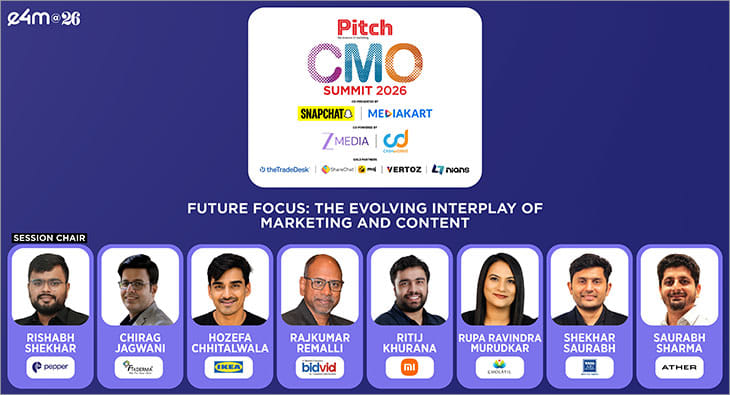

- At the Pitch CMO Summit 2026, marketing leaders discussed the evolving dynamics between marketing and content, emphasizing the relevance of the 30-second TV spot in a digital landscape, with varying opinions on its effectiveness across different brands and contexts.
- Panelists highlighted the importance of understanding content performance, noting that successful marketing strategies often involve a mix of in-house and creator-generated content, with a focus on authenticity and emotional connection.
- The discussion also addressed the impact of AI on marketing, with differing views on its role; some panelists see it as a tool for efficiency, while others emphasize the continued need for human creativity and judgment in advertising.
- The conversation concluded with insights on brand-building challenges, the significance of maintaining consumer awareness, and the necessity for brands to adapt to changing market conditions to remain relevant.
If the previous decade was about finding consumers online, the current one is about making sense of what to do once you find them. At the Pitch CMO Summit 2026, a panel of seven marketing leaders sat down to examine the evolving relationship between marketing and content, from the fate of the 30-second TV spot to the creeping influence of AI on every layer of the advertising stack.
Moderated by Rishabh Shekhar, Co-Founder and COO of Pepper, the session had insights from Chirag Jagwani, Chief Marketing Officer at Fixderma; Huzefa Chhitalwala, Marketing Communication Manager at IKEA India; Rajkumar Remalli, Founder and Director at BidVid; Ritij Khurana, Associate Director – Marketing at Xiaomi; Rupa Ravindra Murudkar, Vice President – Marketing at Cholayil; Shekhar Saurabh, Head of Marketing at Tata AIG General Insurance; and Saurabh Sharma, Head of Marketing at Ather Energy.
Rishabh Shekhar asked, “Is the 30-second TV spot dead or alive?”
Murudkar answered with a metaphor. "It is like a Bollywood film that has evolved. Earlier, a film was carried entirely by one superstar. Now you have ensemble casts, like in Brahmastra or Dhurandhar. The 30-second spot has not disappeared; it has simply been de-centred, like one instrument in a larger orchestra."
Saurabh Sharma took the view that the format itself remains very much alive, even if the medium around it has shifted. "Thirty-second video storytelling is alive and will remain relevant for a long time. The medium has moved to digital, but the ability to tell a compelling story in 30 seconds is still a skill that matters, regardless of where it runs. TV continues to be an important medium for a large part of the country."
However, Jagwani was more categorical about his own context. For a brand like Fixderma, distributed primarily through dermatologist recommendations rather than mass retail, the TV spot was simply not the right vehicle. "The dermatologist is the influencer, the storyteller, the prescriber. For us, the 30-second format is alive in the digital sense, but a TV spot? Not relevant at this stage."
The conversation next moved to where the content was actually working and Rishabh Shekhar asked the panel what the best-performing piece of content from the past year was for them and if it came from the brand's own team or from a creator.
Saurabh Sharma was candid that no single piece stood out above the rest, which was itself telling. "Every company is producing far more content today than it was five or ten years ago, and for us it has genuinely been a mixed bag." He described a Father's Day film made entirely in-house that resonated deeply because the intent was to reach fathers in a way that felt warm and authentic.
At the other end of the spectrum, integrating with a large regional television show delivered scale of a different kind. Celebrity collaborations, including work with Sonakshi Sinha and Farah Khan, served their own purpose. "The key is understanding what your objective is, whether a creator adds the right value or the right reach, or whether the story can only be told well by your own team. There is no single solution that fits everything."
In Xiaomi's case, the standout moment was the brand’s first five-episode micro-drama series, which generated several million organic views on the brand's own handle. "That is genuinely difficult to achieve. Getting that kind of traction without paid push is rare," Khurana said.
Alongside it, he pointed to something the brand had not engineered at all, Xiaomi consumers spontaneously creating content about how they use their devices, with individual posts regularly crossing two to three million views and a hundred thousand shares. "Those are the two content types that have really worked for us. One we built deliberately, and one we had almost nothing to do with."
As the discussion broadened beyond formats and performance, it also turned to the mechanics behind marketing effectiveness. Remalli, who works with brands on the agency and planning side, was asked where most marketing budgets are actually wasted. His answer redirected the question. "I do not think it is the brands or the CMOs who are wasting money. Their job is to get the message across. The responsibility for efficiency and optimisation lies with the agencies and the people doing the planning and execution."
The problem, in his observation, was the gap where there is skill, integrity is often lacking, and where there is integrity, the skill falls short. "That is where the wastage happens. Brands are fairly straightforward about what they need."
From executional efficiency, the conversation moved into how organisational context shapes marketing decisions. Chhitalwala brought the perspective of someone who had moved from the high-velocity startup world into a company as deliberate and process-driven as IKEA. The most significant shift, he said, was learning to respect institutional processes rather than treat them as obstacles.
"Coming from fast-paced startup environments, the appreciation for how processes work came to me quite early at IKEA. For a company operating across so many markets and having solved so many problems over decades, there is a great deal to learn. We tend to shy away from processes, but there is genuine merit in understanding why they exist and how they help, rather than seeing them purely as something standing in your way."
This question of context extended further into where and how brands show up. Making the case for an offline-first approach, a position that can feel almost contrarian in a room full of digital marketers, Murudkar’s argued that there are products where the physical and sensorial dimensions of the purchase are simply irreducible, like fabrics, certain foods, or financial services.
"For a brand like Medimix, we have over 80% weighted distribution in general trade, and our consumers are predominantly in rural areas, tier 2, tier 3. That is where the volumes live, and that is where our strategy has to be anchored." She also observed that many D2C brands that built themselves on digital are now opening retail distribution precisely because cracking India at scale still requires it.
This naturally led to a broader question of how brands are built in the first place. She was asked whether it was more difficult to build a new brand from scratch or to reinvent a heritage one. Murudkar argued that legacy brands win on salience and awareness is not the problem. "The challenge for a brand like Medimix is higher up in the brand equity pyramid where we have to build resonance and relevance with younger consumers who want Ayurveda but in faster, newer formats. That is where the real work is."
Saurabh Sharma, who had worked at Mahindra before Ather, offered both sides. At Mahindra, the challenge was defending and redefining a category leadership position as the very definition of an SUV was being stretched and diluted by new entrants. "They had to reinvent the brand to stay relevant to a market that was changing around them. That is a particular kind of difficulty."
At Ather, the problem was a blank page and the task of building every element of brand identity from nothing. "Brick by brick, with no inherited equity, no existing mental availability. Six years in, we have built something that I think stands up. I genuinely cannot say if it was harder than Mahindra. But it was exciting, and it has been fulfilling."
From brand-building challenges, the panel moved to category-specific realities. Shekhar Saurabh tackled what is arguably the most structurally difficult category on the panel, i.e. insurance. The core challenge is that most consumers do not feel they need it until the moment they do and by then, the marketing conversation is over. "The task is building the category, not just the brand. The approach has been to connect to the human emotion behind the need, that your loved ones are protected. All our communication was built around that insight."
He noted that TV had been central to this effort, drawing a parallel with how the mutual funds industry had successfully used mass media to normalise a category that had previously felt abstract and remote.
Next Rishabh Shekhar asked Jagwani about his take on performance marketing versus brand building, Jagwani made the case that the line between the two had effectively dissolved. "They now run together. Awareness, brand, and performance are in the same motion, often on the same platform."
The distinction still has some validity at the level of brand maturity, he argued. Early-stage brands need to build awareness before conversion becomes meaningful, while established brands can lean more heavily on performance. "But increasingly, it is an overlap rather than a sequence."
Khurana then talked about how Xiaomi squares the tension between entertainment-led content and the functional realities of selling phones on specs and price. His view was that price was effectively a settled variable by the time most consumers reached a brand. "People have largely made up their minds on price before they even engage with us. What we are actually selling is a feeling, the sense that choosing a Xiaomi product makes you the smarter person in the room and we are consistently building towards that emotion." He added that the brand had recently put out content directly challenging the performance claims of higher-priced legacy devices, framing Xiaomi not as the more rational choice.
The panel's penultimate stretch turned to an AI question. What happens when algorithms, AI systems, and LLM-powered search engines increasingly mediate the relationship between brands and buyers?
Jagwani was measured about AI's current role in Fixderma's strategy. He said that it was useful in places, but covered perhaps five percent of their actual communication effort. "We are trying to build something more authentic and personally driven. AI is there in certain areas and evolving, but we are not leaning heavily on it."
On the other hand, Saurabh Sharma argued that the anxiety around algorithms was somewhat misplaced. "We are building brands and feeding algorithms simultaneously and that is fine, as long as the algorithms are improving the ecosystem for everyone." He made the point that Ather's connected scooters generate behavioural data at cohort level that feeds back into product and software development. "The same logic applies to AI and LLM search. If it helps consumers find the right information more easily, that is a positive development."
His more pointed observation was that the shift toward AI-driven discovery actually raises the stakes for brand fundamentals like trustworthiness, clear positioning, and well-structured information. "That is what good brands do anyway. LLMs just make it more consequential."
Adding more nuance to the discussion, Remalli pushed that the human element in advertising would not disappear. "There is already enough mechanism emerging to credit or discredit AI-generated content. You cannot take the human out of it." His confidence came from running a creative agency alongside his other work. "I see people depending more on human creativity, not less. The risk with AI output is that if no one gives it a final look, things can go very wrong, very quickly."
Disagreeing, Khurana said, "Meta's AI tools are honestly about 80 to 90 percent there. We use them every single day, to track which campaigns are scaling, which creatives are working, and what to switch off. It is taking over a significant portion of what used to be human judgment."
His conclusion was pragmatic. "What we need to get better at is writing prompts. Context is still something humans bring more of but AI does tasks faster and more efficiently, and it is only going to improve."
The content conversation was closed by Chhitalwala. He shared that IKEA had tried a micro-series on Instagram, six short episodes, that failed to land. The Pune store launch, on the other hand, featured a piece of content built around the city's distinctive cultural identity, created with the CEO, and it significantly outperformed expectations.
But the content bucket that consistently beat everything else, month after month, was the hashtag called Life at Home, under which consumers share how they actually live with IKEA products. "Every month, for as long as I have been here, that bucket outperforms anything we produce ourselves." It was a reminder, perhaps, that the most durable content strategies are often the ones that get out of the consumer's way.
Lastly, Shekhar Saurabh offered what marketing actually does when everything else is stripped away. Physical availability and mental availability, he said, are the two conditions that must coexist for a purchase to happen. "What marketing does is maintain a continuous share of the consumer's mind, so that when they are ready to buy, your brand is at least in the consideration. It protects your share."
The erosion, when it comes, is rarely immediate. Legacy brands can coast on past investment for months or even years, but it is inevitable. "The impact on share will eventually be visible. Not necessarily a collapse, but a slow fade. We have seen it happen to enough brands to know that is how it works."
Read more news about Marketing News, Advertising News, PR and Corporate Communication News, Digital News, People Movement News
For more updates, be socially connected with us onInstagram, LinkedIn, Twitter, Facebook, YouTube & Google News