What it takes to navigate the omnichannel maze
Journeys are seamless for consumers, fragmented for brands. The gap lies in consistency, context, and what brands actually do with data
 by
by
Published: Jun 8, 2026 12:11 PM | 14 min read
 Follow Us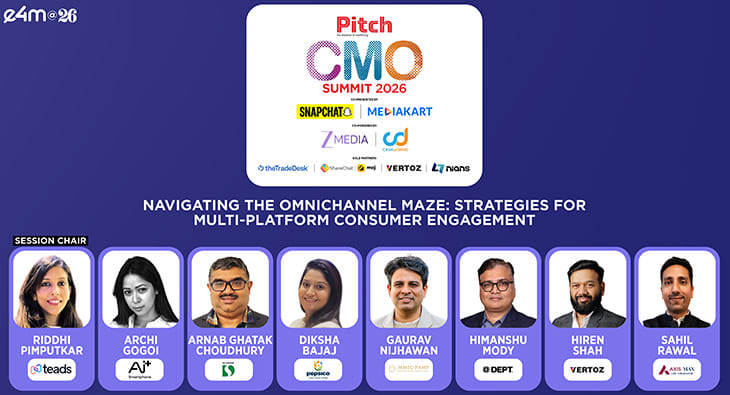

- The Pitch CMO Summit's session on omnichannel strategy highlighted the challenges brands face in creating a cohesive consumer experience across multiple platforms, emphasizing the need for consistency in messaging and engagement strategies.
- Brand leaders from various sectors discussed the importance of maintaining a unified core message while adapting to different platforms, and the necessity of designing consumer journeys that integrate both digital and physical experiences.
- The panel addressed the significance of trust and verification in categories like gold and life insurance, stressing the need for seamless context carry-forward in consumer interactions to enhance the overall experience.
- Experts noted that personalization should focus on relevance rather than intrusive targeting, and emphasized the importance of listening to consumer feedback to reduce friction in the purchasing process and drive innovation.
In a world where a consumer can discover a product on social media, research it on a website, and pick it up from a neighbourhood store, all before lunch, can brands make it feel like one place?
That was the central question at the Pitch CMO Summit's session on omnichannel strategy - Navigating the Omnichannel Maze: Strategies for Multi-Platform Consumer Engagement – where brand leaders from insurance, FMCG, real estate, gold, and consumer technology came together to examine the gap between omnichannel ambition and omnichannel reality.
Moderated by Riddhi Pimputkar, Director, Enterprise Solutions – India, Teads, the discussion featured Archi Gogoi, Head of Brand, Marketing & Growth, AI+ Smartphone; Arnab Ghatak Choudhury, Senior General Manager – Marketing, DS Foods; Diksha Bajaj, Category Head – Energy Portfolio, PepsiCo India; Gaurav Nijhawan, Head of Marketing, MMTC-PAMP; Himanshu Mody, Partner & Head – India, DEPT; Hiren Shah, Founder & Managing Director, Vertoz; and Sahil Rawal, Corporate Vice President & Head – Brand and Media, Axis Max Life Insurance.
Pimputkar opened, "How many times have you felt, after looking at a campaign report, that I wonder which channel truly deserves the credit for this conversion?" A decade ago marketing was largely about reaching consumers through a handful of established channels. Today, new channels are emerging at an unprecedented pace, and the challenge is not presence but coherence.
One Message, Many Channels
For Choudhury the omnichannel challenge in the spices category is fixed in how planned purchases now happen. Spices have traditionally been a considered buy, something added to a weekly shopping list. But that rhythm is being disrupted. "If something is missing at home, someone can get it at the press of a button within 10 minutes," he said. The category has expanded across channels accordingly.
What matters now, Choudhury argued, is consistency, a common thread that builds salience with the consumer wherever they encounter the brand. "The nudge that gets them to our product should speak to the same thread we build salience with," he said. "So that there is a commonality in how the consumer views our product, whether it's e-commerce, modern trade, or retail."
Bajaj brought a similar argument to the question. "These exciting times lend themselves to a consumer journey that is simple and right at their fingertips," she said. A consumer might watch something on social media, click through to an e-commerce site, and then order something the very next day. The brand's job in all of this is twofold.
First, maintain a consistent core message regardless of platform, even as the format adapts. "You will obviously custom-make it to the platform in the way most acceptable to the consumer, but your common thread or key message should not change," she said. Second, design for the journey as a whole rather than optimising individual channels in isolation.
Consistency across channels is a brand exercise, but for Nijhawan of MMTC-PAMP it is also an exercise in trust. In a category like gold, where trust is earned through verification, the coherence between what a brand says digitally and what a consumer experiences in-store is everything. "Whether your store says the same thing as your website or not, communication is the real important factor here," he said.
When the Physical Has to Do What Digital Cannot
Pimputkar pressed Nijhawan on the challenge that gold purchases in India have traditionally been trust-driven and offline-led. How does the digital ecosystem influence discovery, research, and purchase behaviour in such a category?
The answer, it turned out, was in flipping the model rather than forcing a digital-first one. "For gold, verification comes first and trust follows," Nijhawan explained. “A consumer who can physically verify that a coin or bar meets 99.99 purity at a store is a consumer who is far more likely to buy.”
But the insight MMTC-PAMP acted on was that the digital journey and the physical experience need not be sequential. They could be parallel. "You can buy online but collect offline," he said. "You've already made the purchase online, you've already locked in the offer but you also have the option to visit your nearest store to collect it." This buy-online, pick-up-in-store model resolved the specific anxiety around receiving high-value commodities through courier.
Beyond logistics, the brand also recognised that bringing a consumer into a store creates its own sales opportunity. Nijhawan gave the example of a silver coin shaped like a bouquet of flowers. "The insight was that we give our loved ones bouquets on occasions like anniversaries or Valentine's Day. But flowers fade. What if you could give something that will not fade, but will grow?" Once a consumer visiting for something else sees the coin in person, the sale often follows naturally. It is a reminder that the physical channel, done well, does things digital simply cannot.
Context Carry-Forward: The Omnichannel Gap Nobody Talks About
In financial services, the stakes of a fragmented consumer journey are considerably higher. Rawal talked about how trust is not just a brand value but the product. "Life insurance lasts for almost 30 to 40 years," he said wryly. "Some marriages don't last that long."
Beyond message consistency, Rawal identified that context should carry-forward. "Assume you've met a life insurance agent or advisor who knows something about you," he said. "You've shared certain details. You've shown disinterest in certain products. Now, if you go back to research that product online and the context isn't being carried forward that becomes an inferior journey."
The omnichannel experience must be able to carry context seamlessly from one touchpoint to the next. "Have we reached there? The answer is no. It's a journey and all of us are trying to build."
Where the brand has made progress is in applying what Rawal called a "never ask again" policy for consumers with known digital footprints. "If you've told me 10 data points about yourself and you come back to our journey, I will start from exactly where you left off," he said.
He described using personalised video messages from celebrity Rohit Sharma to reach out to consumers on their birthdays, informing them of their policy options and potential savings. "Those are the kinds of experiences you can only build if you have seamless omnichannel journeys and context carry-forward working well," he said.
Born Omnichannel
AI+ Smartphone entered a different kind of conversation. As a brand launched barely a year ago, it never had a linear media journey to unlearn. Gogoi described the brand's founding purpose as bridging the digital divide. Starting as a sub-₹5,000 brand, AI+ has since expanded its portfolio into smartwatches and earbuds, building what Gogoi described as a 360-degree brand experience across product touchpoints as well as communication ones.
For a brand without a conventional media playbook, seamlessness becomes part of the design principle. "Communication has to be so seamless that every touchpoint feels like it is speaking the exact same message," Gogoi said. But she was equally emphatic about what happens after purchase. "After-sales plays a massively important role in the entire experience," she said.
On building awareness without a traditional brand ambassador, Gogoi spoke about moment marketing and being present where India's emotional attention is concentrated. The brand partnered with Mumbai Indians and KKR as their official smartphone partner during the IPL to build cultural resonance. "We had behind-the-scenes content, meet-and-greets with players, and match experiences, delivered through the AI+ Smartphone experience," she said. More such partnerships, Gogoi added, are in the pipeline.
The Experience Bar Is Set Everywhere
For Mody of DEPT, the most important and most uncomfortable truth about omnichannel is that consumers are not comparing brands within a category. They are comparing every experience to the best experience they have ever had, anywhere. "If I visit an Apple Store and have a particular kind of experience, and then I encounter your brand and the experience is different, that's the bar I'm holding you to," he said.
Mody used Vijay Sales as an example of a brand that gets this right in the offline channel. In stores where staff wear category-specific uniforms, a consumer asking about a product gets pointed in the right direction without awkwardness because the signal is already visible that the person being redirected is not the category specialist. "These small things matter in how you create an experience," Mody said.
He also pointed to the obsessiveness required to maintain this standard at scale. Even a brief website slowdown triggers an internal escalation at DEPT. "The idea is that your experience is going to get compared regardless of category, and the question is how obsessed you are about continuously improving it."
However, Mody flagged that the bigger shift is in how brands think about communication itself. "The era of the campaign is over," he said. "The mindset of a few brands launching one big campaign per quarter or per year is going to die very soon." In a world of continuous social media, discoverability through AI-powered search, and always-on consumer attention, brands need to be in continuous conversation. "The campaign-campaign way of thinking is not going to last."
Personalisation Without Intrusion
Next, Pimputkar asked the panel where personalisation is headed amid tightening privacy regulations. Shah of Vertoz drew on more than a decade in ad tech to trace the arc. He recalled a time when campaigns ran using individual-level data with few guardrails. "At that point, data privacy regulations weren't clearly in place," he said. “The landscape has since matured considerably, moving from third-party cookies to first-party data, and from individual-level targeting to cohort and ID-based approaches.”
But the underlying opportunity has grown rather than shrunk because the tools available to act on data have improved. He gave the example of running geographically contextualised campaigns simultaneously in Delhi, where the creative references heat, and in Kerala, where it references monsoon.
"If you use AI in the right way," he said, "you can gauge an individual's mood or situation at a particular moment, and the results can be far higher than what you're expecting from a one-size-fits-all approach."
The gap now remains in execution. Too many brands still run campaigns for the sake of it, driven by FOMO rather than intent, without connecting their CRM data to their campaign infrastructure.
Bajaj reframed the personalisation conversation from targeting to relevance. "You can either get drowned in the vast expanse of information available today, or you can go back to what the job of a marketeer is, which is simplicity," she said. Personalisation, in her view, is not about reaching 1.4 billion Indians in 1.4 billion ways. "It's about identifying tribes and cohorts, and realising the same message is relevant to a cohort because this is how their lifestyle is, or this is what they engage with," she said. The goal is customisation that feels considered, not intrusive.
Choudhury added a ground-level example of what this looks like in practice for DS Foods. In eastern India, particularly Bengal, a festival like Jamai Shashti carries deep cultural meaning. If a consumer is reached with a brand communication tied to that occasion and lands on an e-commerce page that mirrors the same festival context, the effect is personalisation as well as relevance at the moment of purchase. "It will not only build brand relevance but also get them to try our brand at the right moment," he said.
For mass categories like spices, hyper-personalisation at the individual level may be impractical, but finding the right cultural or contextual hook and marrying it to the right touchpoint is where the work lies.
Friction as Signal
On the question of reducing friction across the consumer journey, the panel offered perspectives that were less about technology and more about listening.
Nijhawan framed it in terms of the hook with which a consumer enters a journey. "If you're running an ad for a digital lending loan, the consumer should not end up on a generic homepage," he said, drawing from his earlier time in BFSI.
He cited that in India, 70 per cent of shopping carts are abandoned. "That's a massive investment by the brand to get the consumer to the last leg of the journey and it ends there, maybe because the product wasn't right, the pricing wasn't clear, or the documentation was excessive."
Rawal classified friction in life insurance into three distinct types. The first is demand friction, the fact that no one wakes up planning to buy a life insurance policy, making the identification of genuinely willing buyers a challenge in itself.
The second is effort friction. Historically, buying a life insurance policy required filling over a hundred form fields. Through back-end integrations with government portals and third-party systems, Axis Max Life has reduced this to 25–30 fields.
The third, and perhaps least discussed, is post-purchase friction. It is the underwriting stage, where a consumer who has already paid and submitted documents may still be declined, or offered a different cover than expected. "We've used AI and predictive models to speed up this processing considerably," Rawal said. “And throughout all three stages, the strategy is to build specific, relevant hooks at every point that give the consumer a reason to return and continue.
The most common and least glamorous friction point in FMCG, Bajaj observed, is simple product unavailability. "We've all clicked on an ad, landed on a quick-commerce page, and found the product out of stock," she said. The consumer experience that results from that moment is actively negative.
Widening the lens, she argued that friction is data. A drop-off is a signal to be decoded. “Was the consumer looking for a benefit the brand wasn't offering? A SKU that wasn't stocked? A flavour that was absent from the range? Identifying that insight or pain point is what friction means for our categories," she said. "And it can lead from a problem to an innovation because every big innovation comes from someone listening to the right consumer insight."
Gogoi echoed the importance of listening but added that listening should not lead to over-marketing. "The moment you interrupt the consumer experience with in-your-face advertising," he said, "that consumer is not coming back." The data gathered from consumer interactions must inform communication, not amplify it indiscriminately.
From Data to Outcomes
The closing thread of the discussion turned to the question of whether brands are actually converting the enormous amounts of data available into measurable business outcomes.
Gogoi answered, "We're all still trying, figuring it out. We live in a world now where follower counts and impressions are not going to translate into business ROI. What matters is the depth of engagement, which includes the reshares, the reposts, the actual interactions."
She acknowledged that the influx of data from multiple third-party sources has outpaced most brands' ability to make sense of it coherently.
Nijhawan described the practical approach MMTC-PAMP has taken to separate brand campaign measurement from performance campaign measurement. On the performance side, he credited the evolution of Meta and Google's algorithm-based targeting, where the brief to the platform is simply to find buyers, and the system does the rest. On the brand side, the proxy metric being used increasingly is brand search volume.
"When we run brand campaigns, we measure the brand searches that follow. Then we look at whether those searches are converting organically, or converting when we layer performance marketing on top," he said.
Giving an example, Nijhawan shared how MMTC-PAMP noticed unusually high gold and silver purchases from Jammu and Kashmir. When the team visited, they found that consumers were not wearing the coins as jewellery in the conventional sense. They were framing them and displaying them as badges of prestige. "Their use case had completely changed," Nijhawan said. "Once you hear that from the market and then use that insight to build the right products, that's when data actually becomes useful."
Across categories, the most valuable data is what the consumer reveals when someone is paying close enough attention.
Read more news about Marketing News, Advertising News, PR and Corporate Communication News, Digital News, People Movement News
For more updates, be socially connected with us onInstagram, LinkedIn, Twitter, Facebook, YouTube & Google News