India has moved from opportunity market to influence market: Sunita Rajan
Sunita Rajan, MD – APAC Media Sales, Bloomberg Media, talks about the shift towards premium influence-led advertising and more
 by
by
Published: May 14, 2026 9:19 AM | 14 min read
 Follow Us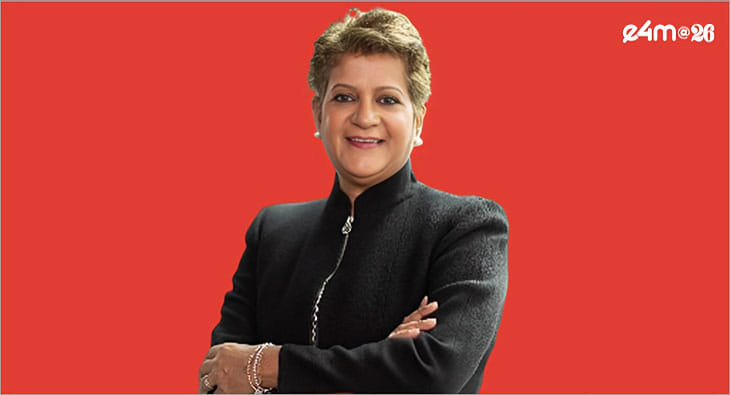

- Bloomberg Media celebrates 30 years in India, highlighting the country's emergence as a key market, now the second largest for Bloomberg.com and a top subscription market, with a 250% increase in paying subscribers since 2020.
- The company is expanding its India newsroom and enhancing its media offerings, including launching a daily newsletter and hosting the Bloomberg New Economy Forum in New Delhi, aiming to connect Indian brands with global decision-makers.
- Bloomberg Media emphasizes a shift from traditional advertising to premium, influence-led solutions, leveraging data-driven storytelling and multi-platform engagement to connect brands with high-intent audiences.
- The firm recognizes India's rapid evolution in digital consumption and advertiser sophistication, positioning itself as a vital partner in India's economic growth and global influence.
As Bloomberg Media marks 30 years in India, Sunita Rajan, MD – APAC Media Sales, discusses India’s rise as one of Bloomberg’s most important global markets, the shift toward premium influence-led advertising, the growing role of Bloomberg LIVE experiences, and how Indian brands are using global platforms to shape international business conversations.
As Bloomberg Media marks three decades in India, what has structurally changed in how you view the Indian market from a distribution outpost to a strategic revenue and influence hub?
Today, India stands as the second largest market globally for Bloomberg.com audience, and Bloomberg TV viewership on Connected TV devices, as well as the third largest market for YouTube viewership. A 250% increase in paying subscribers since 2020 has also catapulted India into Bloomberg’s top subscription markets worldwide.
A key structural change is that India has become increasingly central to global economic flows and geopolitical discourse, a reflection of its rising position and international relevance. We have seen a surge in global audiences seeking to engage with India and a new generation of domestic entrepreneurs and brands looking for a more sophisticated worldview. This has created intense demand for an "inside-out" perspective, the ability to explain India to the world and the world to India, in a language both sides fully understand. Bloomberg Media is uniquely positioned to bridge that gap.
We are meeting this momentum by expanding our India newsroom to its largest scale ever. We launched an upgraded television studio in Mumbai last year, moved our flagship India Edition newsletter to a daily cadence, and relaunched our dedicated India segment on Bloomberg TV. To top it off, we are bringing the Bloomberg New Economy Forum to New Delhi this October for the first time, where we will convene the world’s most influential private and public sector leaders to chart a common path forward.
Throughout our thirty-year legacy in India, Bloomberg has been a proud partner in the evolution of India’s financial markets, and in helping domestic brands translate local success into global influence. We are at an extraordinary moment now and we are eager to continue supporting our clients and partners in the next chapter of India’s economic growth story.
In a market like India where scale often trumps depth, how do you defend premium pricing while still expanding advertiser adoption?
For us, it’s never about just chasing “eyeballs”. At Bloomberg Media, our premium value lies in our ability to move the people who shape what’s next. That means driving tangible outcomes, influencing where capital flows, what infrastructure is built, and what priorities leaders set.
As you noted, our core strength is our high-intent, high-value audience. When markets shift or policy changes, these global decision-makers, executives, investors and policymakers, turn to Bloomberg for speed, authority, and neutrality.
That is what makes Bloomberg essential. And when we are essential to decision-makers, we become the most powerful environment for brands trying to reach them. You can see this momentum in our numbers: Bloomberg.com now exceeds 720,000 paying subscribers. Video hours watched grew 25% YoY, across linear, digital and streaming in 2025, and we finished the year averaging 55 million unique monthly viewers. For an advertiser, this means their message isn't just being seen, it’s being consumed by an elusive, high-intent audience in a high-trust setting.
Another incredibly powerful component of our business is the ability to connect in person, as we will showcase through the first-ever Bloomberg New Economy Forum in New Delhi later this year. From global forums to bespoke roundtables, we create curated spaces where brands can engage directly with the people shaping the global agenda through the lens of our authoritative journalism.
Ultimately, in a market as vast as India, scale without influence is just noise. We provide the decision-maker density and access that transforms a brand's presence from mere visibility into strategic impact.
With products spanning Bloomberg TV, digital, events and platforms like Bloomberg Quicktake, how are you re-architecting cross-platform sales to move from inventory selling to integrated influence solutions?
At Bloomberg Media, we have fundamentally re-imagined the relationship between our platforms and our partners by moving away from the traditional concept of selling inventory and toward helping brands solve the challenges they face.
By leveraging the strengths of our nine media platforms such as Bloomberg TV, digital, video, and live events, we ensure that a brand’s narrative can meet busy decision makers wherever they are.
This strategy of multi-platform storytelling is best illustrated by how we pair high-level editorial context with deep-funnel engagement. For instance, with Nokia, we moved beyond standard placement, through a sponsorship of the Bloomberg Originals editorial show The Future with Hannah Fry, placing them directly within the conversation of advanced technology. We then deepened that impact with a custom branded series, The Exponential Era, where Hannah brought Nokia's network expertise to life. Editorial and custom content run side by side across our video ecosystem in a way that felt natural and credible.
Similarly, for partners like Mastercard and Google who wanted to drive real demand among elite decision-makers, we combined the power of storytelling with live, bespoke experiences. Whether it’s curating a room of CIOs and CTOs for Mastercard to elevate their cybersecurity business or integrating Google’s Android OS into our Bloomberg Invest summit in New York to capture insights from financial leaders, we ensure that the impact is scaled through content amplification. By blending these live interactions with multi-platform media, we go beyond capturing an audience, we build the real relationships that drive growth.
Indian brands today are increasingly global in ambition. How effectively are they leveraging Bloomberg’s international ecosystem to reach policymakers, sovereign funds, and global C-suite leaders and where are they still underutilising the platform?
Indian brands are no longer just seeking a seat at the global table, they are looking to lead the conversation. They are increasingly leveraging Bloomberg’s global Media platforms to build reputational equity, moving beyond basic visibility to align with critical global themes like AI sovereignty, digital infrastructure and the energy transition.
This shift in ambition is backed by a powerful surge in global market sentiment. According to the seventh wave of Bloomberg Media’s Global FDI Outlook published last year, India holds strong investment appeal when compared with other emerging markets, with 93% of investors considering India expressing their interest as high, and 61% agreeing that trade tensions have increased their trust in India as an FDI destination. This data underscores India’s growing importance as a strategic global investment destination.
At the same time, I believe there is still a significant opportunity that is largely untapped: the full scale of Bloomberg’s global reach and audience strength. Many brands are currently underutilizing our ability to engage and influence a more than 100 million-strong global audience, including over 720,000 subscribers and the highest concentration of global CEOs and policy makers. This underutilization represents a lost opportunity to maximize the impact of their communications across our nine integrated platforms, from digital and social to video and print.
To move from presence to influence, I urge domestic brands and marketers to more aggressively leverage this multi-platform reach to engage our high-intent audiences. The goal isn't just to be part of the global conversation, but to shape it.
How are you packaging data-driven storytelling and insights into marketing solutions that go beyond traditional media buys?
We are a media company inside a data company, allowing us to move beyond the transactional nature of traditional media buys toward a consultative, insight-led partnership.
Our biggest differentiator is our robust suite of proprietary data tools, including Bloomberg Intelligence, Brand Accelerator and Bloomberg AIQ, which allow us to move beyond guesswork to understand precisely what business decision makers consume and care about. Rather than simply delivering impressions, we use this data to identify specific perception gaps and then craft custom content strategies designed to solve those precise business challenges.
By comparing a brand’s perception against its peers and identifying unique white space for storytelling, we create a virtuous cycle: using deep audience insights to inform campaign strategy, optimizing performance in real-time, and delivering measurable brand lift. This data-driven approach ensures that every creative execution is rooted in authentic audience behavior, allowing us to serve our partners with unparalleled precision and scale.
Our in-house creative agency, Bloomberg Media Studios, functions as a data-first consultancy that utilizes audience intelligence to build creative campaign solutions that transform a brand’s message into a professional resource for decision-makers. This ensures that storytelling is grounded in economic reality rather than just creative flair.
Furthermore, we leverage AI-driven audience science to move past broad demographics, instead targeting high-intent segments based on real-time engagement with market-moving news. By integrating this first-party contextual intelligence with rigorous post-campaign brand-lift analytics, we are able to transform a standard media placement into a measurable investment in corporate reputation and executive influence.
We believe that in a fragmented media landscape, data-driven authority in brand-suitable environments is the most effective way to earn the attention of the world’s most influential audience.
There’s a visible shift toward experience-led engagement. How critical are Bloomberg LIVE events in India becoming, not just as a revenue stream but as a strategic influence platform?
In an era of profound transformation, leaders aren’t looking for more noise, they're seeking clarity, credibility, and genuine human connection.
Our Bloomberg Live business sits at the intersection of our news, media, and financial-data businesses, allowing us to create convenings that translate disruption into opportunity. Our strong business growth underscoring that our events business is not just a revenue stream, but a critical response to this demand for intelligence-led convening. And because ideas don’t live in isolation, our convenings are amplified through multi-platform storytelling across Bloomberg’s global media ecosystem - television, radio, podcasts, newsletters and digital.
What truly sets us apart is the quality of the conversation. Our programs are research-led, driven by editorial priorities and animated by the people who move markets. These are not spectators, they are peers, collaborators, and decision-makers shaping the global agenda.
Take our Bloomberg New Economy Forum for example. With delegates comprising of 75% global CEOs and 25% public-sector leaders, the Forum is a workshop for the global agenda, turning critical dialogue into tangible action, evidenced by the hundreds of bilateral meetings and dozens of partnerships formed at our convenings.
Our success is also built on intentional design and global scale. From flagship forums like the Bloomberg New Economy Forum to vertical platforms like Invest, Tech, Green, ScreenTime and Power Players, Bloomberg Live’s portfolio delivers both substance and reach.
The arrival of this year’s Forum in New Delhi signals our expanding commitment to the region. We see significant opportunities to further scale experience-led engagement in India, building a bridge between Indian enterprise and global investment through future summits and bespoke programs.
What are the biggest misconceptions Indian marketers have when they evaluate global platforms like Bloomberg?
The most common misconception is that “premium” equals “niche.” With over 100 million cross-platform users, more than 720,000 subscribers and 55 million average monthly video viewers, we provide an expansive reach. More importantly, we offer reach to elusive global decision-makers that are often unreachable through mass-media channels.
Another misconception is that we are only a finance platform. Today, tech decision-makers are one of our fastest-growing audiences. We cover the entire business of life, from tech and climate to luxury and policy, making us relevant for any brand that wants to reach an influential, high-spending consumer.
Finally, we are not just a foreign media looking in. Bloomberg has a thirty-year legacy of partnership in India. We are deeply committed to the evolution of India’s financial markets and to helping domestic champions translate their local success into global influence.
The proof is in the numbers: India is now our second largest market globally for Bloomberg.com audience and Bloomberg TV viewership on Connected TV devices, the third-largest market for YouTube viewership, and is among our top subscription markets worldwide. This is a clear signal that the Indian market recognizes, and is willing to invest in, the premium value we deliver.
From your vantage point across APAC, how does India compare with markets like Singapore or Japan in terms of advertiser sophistication and demand for high-value audiences?
From where I sit, India is one of the most dynamic and high-velocity markets globally. While Singapore and Japan are mature, established hubs with deeply entrenched media ecosystems, India is experiencing a unique leapfrog effect in digital consumption and brand ambition that is truly unparalleled in the region.
Indian advertisers are moving at lightning speed. They are quickly pivoting away from broad-reach metrics toward first-party data, measurable brand lift, and advanced contextual targeting, models that are on par with the most advanced strategies in the West, reflecting a marketplace that is maturing in real-time.
We’re also seeing a strong demand for global context. Indian brands and marketers recognize that to compete on a global stage, they need to engage with the world’s most influential decision-makers. This shift from volume-first to value-first is what makes India one of the most exciting markets for us today.
With AI reshaping content, targeting, and measurement, how is Bloomberg Media integrating AI into both editorial products and commercial offerings without diluting trust?
At Bloomberg, we are AI early adopters, and we will continue to invest in products and solutions that reflect the needs of both our consumers and advertisers. Transparency is essential. While we are moving with the moment, we are doing so responsibly and maintaining quality by keeping human insight at the center.
On the editorial side, we use AI to create article summaries and enhance our search capabilities to help busy decision-makers find insights faster, but every piece of content, either generated with or without AI's help, is vetted by human editors.
On the commercial side, many elements of our business strategy, whether that’s investment in paid subscriptions and engagement or our vast video inventory as a differentiator for scale and advertising, can be enhanced by AI in smart ways that accelerates our audience-first strategy.
For example, our live contextual video ad targeting and AdService products make us more nimble with our buyers and clients. By using AI to analyze our editorial video and text feeds in seconds, we can instantly align a brand’s message with the specific, high-intent topics our audience is consuming. This creates a marketing experience that feels like a seamless extension of the user’s information journey rather than a disruption.
By prioritizing these first-party signals and maintaining strict human oversight, we are using AI to deepen the trust our audience places in us.
Finally, if you had to define Bloomberg Media’s India roadmap for the next five years in one sharp strategic pivot, what would that be, and what will success look like in measurable terms?
Our five-year roadmap for India is not about a pivot away from our core, but rather a deepening of our commitment to be an indispensable partner in India’s economic growth story.
Success in measurable terms will be defined by the strength of these partnerships and our ability to drive impact with the people who define what’s next. We will measure our growth by the expansion of our high-intent executive audience in India and the evolution of our commercial relationships into long-term, mutually beneficial partnerships.
As India continues its journey as a global powerhouse, Bloomberg is committed to providing a premier channel where that growth is narrated, and where the critical engagements between India’s brands and the world’s most influential decision-makers are facilitated.
Read more news about Television Media, Digital Media, Advertising India, Marketing News, PR and Corporate Communication News
For more updates, be socially connected with us onInstagram, LinkedIn, Twitter, Facebook YouTube & Google News