Sam Balsara on Madison stake sale: ‘I don’t think you will see a deal soon’
In a conversation with Dr Annurag Batra, Chairman and Editor-in-Chief of e4m Group & BW Businessworld, Sam Balsara shares insights on the evolution and future direction of India’s advertising industry
 by
by
Published: Apr 4, 2026 8:23 AM | 13 min read
 Follow Us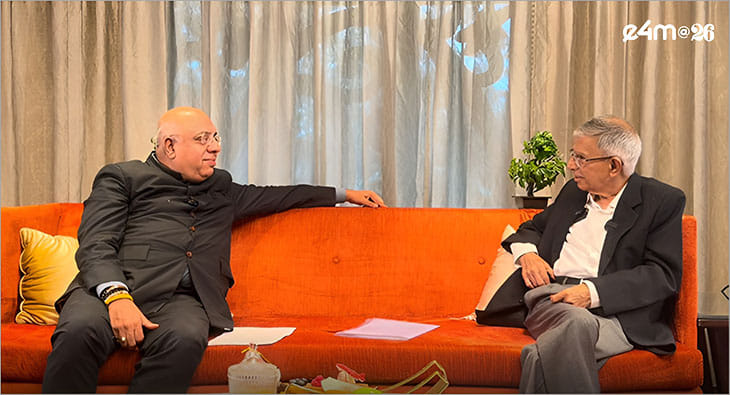

- Sam Balsara, Chairman of Madison World, discussed the evolution of India's advertising industry, emphasizing the importance of discipline, brand-building, and long-term value amidst digital disruption and changing client expectations.
- Madison's strategic pivot towards media specialization arose from recognizing talent gaps and the underdevelopment of media as a discipline, leading to the creation of distinct verticals within the agency.
- Balsara noted a shift back towards integrated agency models, moving away from extreme specialization, as advertisers seek consistency in brand execution across platforms.
- He highlighted challenges in agency economics, including margin pressures and the need for adaptability, while advocating for a focus on long-term sustainability and a more collaborative approach to agency-client relationships.
In a rapidly evolving advertising landscape marked by digital disruption, shifting client expectations, and structural realignments, few voices offer as much institutional perspective as Sam Balsara, Chairman of Madison World. In a candid, wide-ranging conversation with Dr. Annurag Batra, Chairman and Editor-in-Chief of exchange4media Group and BW Businessworld, Balsara offered a rare inside view into how India’s advertising industry has evolved, and where it may be headed next.
Across nearly four decades, Balsara has built Madison into one of the country’s largest independent agency networks, navigating an ecosystem dominated by global conglomerates, multiple structural shifts, and now, a digital-first reality. But if there is one thread that runs through his thinking, it is a consistent return to fundamentals: discipline, brand-building, and long-term value over short-term gains.
An inflection point
Madison’s pivot towards media was not a premeditated strategy, but one shaped by circumstance. In its early years, the agency’s association with Godrej placed it at the centre of a critical transition when the brand entered into an association with Procter & Gamble.
“At that time, there was an all-round concern at Madison that if Godrej tied up with P&G, where does that leave us?” Balsara recalled, underscoring the uncertainty that typically accompanied global alignments, which often resulted in local agencies being edged out.
The trajectory shifted when Balsara received a call from P&G, expressing appreciation for Madison’s work on Godrej and extending an opportunity to handle some of its brands.
The engagement, however, came with a condition: Madison would need to partner with a global agency. After nearly a year of discussions, the agency entered into an arrangement with an agency called DMBNB. The partnership, however, was short-lived and lasted only a few years, with alignment challenges limiting its longevity.
Despite the split, P&G continued its association with Madison as a media client, a development that ultimately steered the agency towards media specialisation, laying the foundation for what would become its core strength.
Why specialisation worked
Balsara’s decision to focus on media stemmed from a clear understanding of talent and capability gaps within agencies at the time.
“The skill sets required in media are totally different from what is required of a creative person,” he said. “There are two types of people - those who are creative-oriented and those who are media-oriented.”
In a market where creative talent was already established and highly visible, media emerged as a relatively underdeveloped discipline, presenting a clear opportunity. At the time, media was not widely recognised as a specialised function, which allowed agencies like Madison World to attract strong talent into the space.
This approach shaped Madison’s early structure, leading to the creation of distinct verticals across media, public relations and rural marketing, each built with specialised capabilities. For a significant period, this model delivered both scale and differentiation.
Over time, however, the limits of extreme specialisation became apparent. The proliferation of multiple specialised units made it increasingly complex for clients to navigate agency relationships, often requiring them to engage with numerous partners for a single brand.
This shift also reflects a broader change in how advertisers are approaching agency partnerships, with advertisers now seeking more integrated solutions. The emphasis has moved towards working with partners who can ensure consistency in brand thinking and execution across platforms and functions.
As a result, the industry appears to be moving back towards a more consolidated model, signalling a reversal of the earlier unbundling trend.
From unbundling to rebundling: A structural reset
Having been one of the early proponents of unbundling in India, Balsara now sees a return to bundled models as inevitable. He points to global developments, such as Coca-Cola consolidating its mandate under a single agency for most functions, as early signals of this shift.
The move, he suggests, is driven not just by efficiency but by the need for coherence. Increasing fragmentation has, over time, diluted both accountability and consistency in brand building.
In that context, the return to integrated models appears less like a passing trend and more like a structural correction within the industry.
A philosophy rooted in restraint and consistency
If Madison’s growth appears measured compared to network agencies, it is by design.
“It’s important for a growing organisation not to chase money. You have to chase your product,” Balsara said.
This philosophy translated into what he describes as internal “laws”, principles that guided decision-making. Among them, the “law of conservation” emphasised financial discipline.
Madison’s approach prioritised financial discipline over visible excess, avoiding flashy offices and high-cost conferences in favour of long-term sustainability.
Equally central is the idea of consistency. “Anything that I do, I want to be able to do it for 20 years,” he said, arguing that sustained effort compounds value over time.
This emphasis on consistency also reflects a broader belief in sustained effort over constant reinvention, with a preference for building initiatives that endure rather than frequently starting and discontinuing them.
An early insight from his time at Cadbury played a defining role in shaping Balsara’s thinking on brand perception. While the company was, in reality, a relatively small business at the time, its public image suggested otherwise.
A significant portion of its sales was concentrated in limited urban pockets, yet the brand carried the perception of being far larger and more widespread. This contrast underscored the power of perception in brand-building, shaping his belief in the importance of creating a strong public persona that can amplify scale beyond actual size.
“It is very important for an agency to have a public persona - a brand,” he said.
This belief drove Madison’s consistent investment in thought leadership and industry presence, not as marketing, but as positioning.
Digital disruption: A delayed but eventual integration
Among the few areas where Balsara admits misjudgment is digital.
“I would say clearly it is digital,” he said when asked what he underestimated.
His hesitation was structural, not ideological. “My thinking was that digital is one medium. If I create a separate digital unit, what are my media people going to do?” he said.
Underlying this hesitation was also a concern that creating a separate digital vertical could dilute the core media offering, potentially “taking the meat away” from the agency’s primary capabilities, a trade-off that informed the pace of adoption.
Over time, however, this approach was recalibrated as digital became central to planning and execution.
This approach delayed Madison’s entry into digital as a standalone capability, initially placing it behind the curve. However, the eventual integration aligned with the industry’s evolution, where, as Balsara observed, professionals today are required to function as both media planners and digital planners.
Media dominance vs creative decline
One of Balsara’s sharper critiques is the growing imbalance between media and creative.
“For the last 10 years, all discussions are only on media,” he said, referring to industry forums. “Not many creative people attend those meetings because there is no discussion on how to improve creative.”
At the same time, a shift on the client side has meant that more marketers have begun to see themselves as experts in creative, often leading to blurred lines in decision-making. This, in turn, creates a degree of tension around whose view takes precedence, and gradually chips away at the agency’s creative mandate - a concern that appears structural rather than temporary.
This has also led to a deeper conflict within decision-making structures, where the agency’s creative perspective increasingly competes with that of senior client stakeholders, raising questions around ownership of brand thinking.
He also pointed out that, unlike earlier years when creative development was at least featured in industry conversations, the focus today has become disproportionately skewed towards media, with limited attention given to improving creative output.
At the same time, the process itself remains inherently flexible, with multiple ways to arrive at a solution, reinforcing the need for alignment rather than rigidity in agency-client relationships.
‘Advertising is a craft’, not a business
Balsara’s advice to newcomers is rooted in this belief.
“Please don’t enter advertising as a business. Treat it like a profession, it is a craft,” he said.
He also flagged a growing disconnect within media roles. “Many media people are very good in media, but increasingly disinterested in advertising, which is a concern,” he said.
Founder-led businesses vs corporate structures
Another insight shaping Madison’s approach is a clear preference for working with founders, a model Balsara associates with greater satisfaction and closer alignment in decision-making.
The reason, he explained, lies in decision-making structures. “In a professional organisation, many people have the power to say no, but only one person has the power to say yes.”
“That means everything has to go to that one person eventually. So why not deal with that person directly?” he added.
He also expressed a preference for independent agency builders globally, suggesting that some of the most meaningful work continues to emerge from founder-led organisations rather than large network structures.
Agency economics: A broken equation
Balsara’s assessment of agency economics is blunt.
“The current situation is inevitable. It is brought about because of the desire to pay less and less to the agency partner for more and more,” he said.
At the same time, he pushed back against a simplistic view of pricing. “A client who pays more does not necessarily benefit more,” he said.
The tension, he acknowledged, leaves agencies squeezed - expected to deliver more with shrinking margins.
The impact of this model is visible in talent.
A key attribute for surviving in advertising, in Balsara’s view, is the ability to set aside personal ego, underscoring the importance of adaptability in a client-driven business.
He also pointed to a candid internal experiment, hiring trainees from top institutes at salaries of Rs 20–22 lakh, which did not deliver the expected results. The experience suggested that the challenge lies not just in compensation, but in alignment with the nature and demands of the business.
Viewed through the lens of industry churn, the current phase presents both challenges and opportunities, with margin pressures and structural shifts acting as headwinds, while evolution, consolidation, and the emergence of new models offer a path forward.
Professionalisation and stepping back
Within Madison, a shift is underway, with growing emphasis on professionalising the organisation, a transition shaped in part by senior leadership and their push towards more structured, process-driven management.
He was candid about what that entails. “When they say professionalising, what they actually mean is less interference from me.”
For him, that is a positive sign. “If the company can run without the founder, that means it has longevity,” he said.
Partnerships: Alignment over valuation
On a potential stake sale, Balsara struck a cautious note.
“I don’t think you will see a deal soon,” he said.
More importantly, he reframed the criteria. “We are not looking at valuation as the critical factor. There has to be a meeting of minds.”
“The partner has to recognise where the industry is going, and be more future-ready than us,” he added.
The evaluation, therefore, extends beyond ownership structures to the ability to actively add value, support growth, and help navigate the next phase of the industry’s evolution.
At the same time, the process remains deliberate and measured, reflecting Balsara’s broader approach of prioritising long-term sustainability over speed or opportunism.
AI, structure, and the future of roles
On AI, Balsara acknowledged both speed and uncertainty.
“The way AI is progressing, it could be even earlier,” he said, referring to structural shifts.
However, the outlook stops short of predicting wholesale disruption, with the transition expected to remain uneven, a mix of faster adopters and laggards across the ecosystem.
Rethinking the agency structure itself
One of his more radical suggestions relates to structure.
“It’s a misnomer to call it client service,” he said. “Originally, that role was meant to be strategic planning.”
He advocates a more direct model. “The creative person and the media person must go as one team without any intermediary,” he said.
Missed opportunities in smaller markets
Balsara also highlighted a gap in how agencies approach emerging advertisers.
“These businesses know their customers very well and are getting some kind of service locally at a reasonable price,” he said.
The challenge, in this context, lies less in awareness and more in access, with a need to find ways to help these businesses upgrade to more structured, higher-quality solutions.
Measurement: A governance failure
On measurement, Balsara was unequivocal.
“This problem can easily be solved if advertisers fund the research,” he said.
“Today, the measurement is controlled by the media owner. What kind of governance is that?” he added.
Given the scale of the industry, the investment required to build an independent and credible measurement system remains relatively small, a fraction of overall ad spends, yet the absence of such a model continues to persist.
Political campaigns: A different level of rigour
Speaking about handling BJP campaigns since 2014, Balsara highlighted the scale and sophistication involved.
“These guys are exceptionally smart, focused, driven and detail-oriented, from top to bottom,” he said.
He also pointed to evolving talent structures within the ecosystem, with the ability to attract top-tier talent at competitive compensation levels reflecting a shift in how these operations are being built.
Over successive campaigns, this has translated into a rapid build-up of expertise, with the ecosystem evolving into a far more informed and data-driven operation over time.
A philosophy shaped over time
Beyond structural shifts and industry critique, Balsara’s responses also reflected a broader personal philosophy shaped over decades in the business. His approach leans towards consistency over constant reinvention, substance over optics, and long-term value over short-term wins.
There is a clear preference for measured decision-making, with an emphasis on staying grounded in fundamentals rather than chasing scale or visibility for its own sake. This outlook, built through years of navigating change and recalibrating assumptions, continues to inform both his view of the industry and the way he approaches business today.
From ‘cool’ to challenged: Changing perception of agencies
Balsara acknowledged a sharp shift in how agencies are perceived, noting that the term “agency” has increasingly become a “bad word” on the stock market, in contrast to an earlier phase when it was seen as a “cool thing” both in business and investor circles.
Despite multiple pressures including digital disruption, margin compression and talent challenges, Balsara remains optimistic.
“The agency model is going to evolve for the better,” he said.
He expects a recalibration across stakeholders. “There will be a new balance between advertiser, media owner and agency,” he said.
Even as tools and platforms continue to evolve, his core belief remains unchanged. At the same time, the shifts underway reflect a broader evolution in Balsara’s own thinking, shaped by decades of navigating change, recalibrating assumptions, and adapting to new realities. “Big ideas work harder than big budgets,” Balsara concluded.
Read more news about Internet Advertising India, Marketing News, PR and Corporate Communication News, Digital Media News, Television Media News
For more updates, be socially connected with us onInstagram, LinkedIn, Twitter, Facebook YouTube & Google News