The Creative Question: Could culture be agencies’ key competitive advantage in 2026?
Black Cab, a creative agency co-founded by Siddhartha Singh and Aayush Bansal, on building integrated agencies, investing in people, and why India’s next breakout brands will thrive on community
 by
by
Published: Jan 15, 2026 8:56 AM | 7 min read
 Follow Us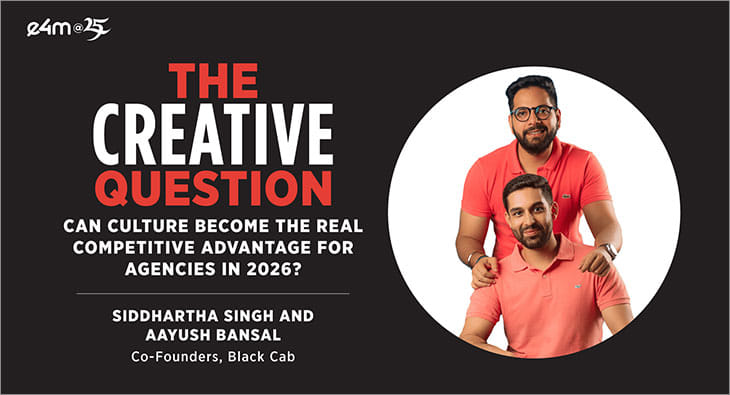

What began in 2017 as a three-person social media consultancy has since evolved into something far more ambitious: a network of five specialised agencies operating under a single system. Black Cab, a brand strategy, design, digital marketing & production agency, now boasts a team of over 100 professionals, working with marquee clients such as Kolkata Knight Riders, Marriott Bonvoy, ITC Hotels, Indri Single Malt, and JioSaavn.
At a time when most agencies were promising 360-degree solutions, co-founders Siddhartha Singh and Aayush Bansal chose depth over breadth, creating an integrated model in which each agency operates as a specialist powerhouse while maintaining centralised operational clarity.
Headquartered in Mumbai, with expansions into Delhi and Bangalore, Black Cab’s network includes Ottoman, the design atelier crafting brand identities and visual merchandising, and Secret Sauce, the content engine driving visual-first narratives and high-impact collaborations. Together, they exemplify a new blueprint for creative agencies, one that pairs cultural fluency with strategic creativity, and operational efficiency with genuine care for the people who bring it all to life.
The integrated network vs the 360° promise
"Very early on, we asked ourselves a simple question: Can one agency truly do everything equally well? The honest answer was no," Singh begins. "As brand problems became more layered, depth started to matter far more than scale."
That insight led them to build Black Cab as an integrated agency network for the digital world of creative, strategy, and marketing, supported by specialised units such as Ottoman, which focuses on brand creation across alco-bev, F&B, consumer goods, and retail experiences, and Secret Sauce!, which brings together meticulous styling, evocative photography, and cinematic videography.
"Instead of forcing all capabilities into one structure, we created a system where each unit thinks independently but executes together," Singh explains. "This allows us to plug in the right expertise at the right moment in a brand's journey, while staying fast, aligned, and deeply accountable."
When pitching becomes partnership
Black Cab participates in around three to four pitches each month, but as Bansal notes, the nature of these conversations has shifted fundamentally.
"What's really changed is how those pitches happen. As our reputation has grown, pitches have shifted from being speculative creative exercises to more strategic, outcome-driven discussions," he observes.
"Today, clients come to us not just for ideas but for clarity on growth, structure, and long-term brand building. So, while pitching doesn't disappear, it becomes far more collaborative, focused, and rooted in real business problems rather than just presentations."
The categories that demand always-on excellence
Over the past year, hospitality and alcohol have continued to dominate their portfolio, and Singh is clear about why this focus makes strategic sense.
"These categories demand always-on storytelling, cultural relevance, and high-quality content that performs natively on social platforms," he says. "Our strength lies in blending content, community, and performance within a single retainer model, which makes us particularly effective as long-term partners in these fast-moving, culture-driven sectors."
Scaling without losing soul
The journey from a three-person team to over 100 has not been without its challenges. Growth is every agency’s goal, but scaling without losing the entrepreneurial spirit is where most organisations stumble.
"The biggest challenge wasn't growing fast – it was growing right," Bansal reflects. "As teams scale, speed can drop, and silos can form if you're not careful. We had to be extremely intentional about building shared values, strong leadership layers, and clear processes early on."
The focus became maintaining what he calls a "builder mindset" across the entire organization. "Our focus was simple: even as we crossed 100+ people, everyone should still think like a builder, curious, accountable, and invested in the outcome. Protecting that mindset has been critical to sustaining both culture and performance."
From ‘talking at’ to ‘building with’
Indri, the single malt whisky brand, surpassed 100,000 followers organically, a milestone that required a fundamental strategic shift in approach.
"The real shift happened when we stopped talking to the audience and started building with them," Singh explains. "Instead of leading with brand messaging, we pivoted to community-led storytelling, content that felt culturally relevant, conversational, and native to the platform."
"We moved away from short-term campaign spikes and invested in consistent formats, rooted narratives, and everyday moments that reflected how the community actually lives, drinks, and celebrates," he continues. "Once the audience began seeing themselves in the content, engagement deepened naturally, and the organic growth followed. Consistency, cultural context, and genuine participation became the engine behind Indri's growth curve."
Culture as competitive advantage
Perhaps the most contrarian aspect of Black Cab’s approach is its investment in cultural initiatives such as MindCab and CabEd. MindCab champions mental health in the workplace by providing certified therapy sessions, access to licensed professionals, and monthly support groups. CabEd institutionalises skill-sharing through regular peer-led knowledge sessions. In an industry obsessed with billable hours, one might ask: does this ever conflict with business objectives?
"If anything, it's done the opposite; it's fuelled our business goals," Bansal counters. "We've always believed that culture isn't a side project; it's the operating system. Initiatives like MindCab and CabEd create spaces where people can think better, learn faster, and grow with intent."
"While the returns may not always be immediate or measurable on a spreadsheet, the impact shows up in sharper ideas, stronger leadership, lower attrition, and teams that genuinely care about the work," he adds. "Over time, these cultural investments have compounded into one of our biggest competitive advantages because when people grow, the business grows with them."
The skills that will matter tomorrow
As Black Cab gears up to pioneer innovation in AI-led content, AR, and vertical videography, what should today's creatives start learning immediately?
"The most important skill today is learning how to think creatively with technology, not just use it," Singh emphasizes. "Tools like AI and AR will keep evolving, but what truly matters is how creatives use them to solve real problems and tell better stories."
He pushes creatives to move beyond aesthetics. "Creatives need to move beyond aesthetics and start asking sharper questions: What behaviour are we trying to influence? What action should this content drive? When storytelling is backed by data, tech, and intent, it stops being just content and starts delivering real business impact."
The next wave of breakout brands
"We're seeing immense opportunity in digital-first, lifestyle-driven consumer brands, especially in D2C food and beverage, wellness, experiential hospitality, and culturally rooted fashion," Bansal shares. "These categories thrive on community, identity, and participation, not just visibility."
"Indian consumers today don't just buy products; they buy into stories, values, and experiences," he observes. "When these brands are powered by strong cultural storytelling, community-building, and a full-funnel digital approach, they have the potential to become the next generation of iconic Indian brands, built online but rooted deeply in culture."
As agencies navigate an increasingly complex landscape of client demands, technological change, and talent challenges, Black Cab’s approach offers a compelling alternative. By prioritising depth over breadth, investing in culture as a form of infrastructure, and focusing on community-led storytelling rather than campaign-driven marketing, they have created a model that is both commercially successful and creatively fulfilling.
The answer to their original question remains no: one agency cannot do everything equally well. Yet by building an integrated network of specialised expertise, united by shared values and a commitment to cultural depth, they have found a way to deliver exceptional work without compromise. In 2026, that may well be the most valuable competitive advantage of all.
Read more news about Internet Advertising India, Marketing News, PR and Corporate Communication News, Digital Media News, Television Media News
For more updates, be socially connected with us onInstagram, LinkedIn, Twitter, Facebook YouTube & Google News
