Digital is now one of the three principles guiding Coca-Cola’s growth: Ambuj Deo Singh
Ambuj Deo Singh, Vice President, Digital Acceleration Office, Coca-Cola India & Southwest Asia, says the brand’s growth is being powered by expanding penetration while accelerating premiumisation
 by
by
Published: Jun 4, 2026 9:03 AM | 7 min read
 Follow Us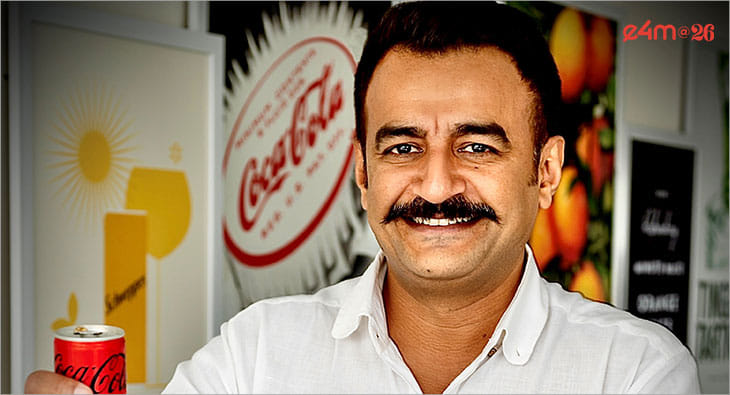

- Coca-Cola is advancing its digital transformation in India by creating a connected ecosystem involving consumers, retailers, distributors, and bottling partners, utilizing AI and data infrastructure to enhance market agility and efficiency.
- The company’s digital strategy focuses on four areas: contextual consumer engagement, retailer empowerment through AI, improved demand and supply planning, and digitization of manufacturing and distribution with bottling partners.
- Coca-Cola's Coke Buddy platform has successfully digitized interactions with over one million retailers, improving order management and product availability through AI-driven recommendations.
- The company is investing over Rs 25,760 crore with its bottling partners to modernize infrastructure and enhance digital capabilities, while also adapting to the rise of quick commerce and focusing on hyperlocal market strategies for growth.
As Coca-Cola accelerates its digital transformation efforts in India, the beverage giant is building a connected digital ecosystem spanning consumers, retailers, distributors and bottling partners, with artificial intelligence, data infrastructure and retailer digitisation increasingly shaping how the company drives growth.
Speaking to exchange4media, Ambuj Deo Singh, Vice President, Digital Acceleration Office, Coca-Cola India & Southwest Asia, said the company's digital ecosystem is focused on driving consumer intimacy, customer growth and enterprise efficiency.
"One of the biggest outcomes has been the creation of a far more connected, real-time network across consumers, retailers, distributors and bottling partners, giving us greater agility and precision in how we go to market. This end-to-end digital connectivity across key stakeholders is helping us build a connected digital value chain for future growth," Singh said.
At the consumer end, Coca-Cola is scaling what it calls a consumer data-to-value flywheel to drive contextual engagement, strengthen direct consumer relationships and enable transactions. The company is leveraging CRM capabilities to build direct brand-to-consumer connections at scale while also using digital capabilities such as Data Clean Rooms to drive transactions and improve engagement.
The company's Digital Acceleration Office has a mandate that extends well beyond performance marketing. According to Singh, Coca-Cola's digital strategy is focused on four key areas: driving contextualised consumer engagement powered by data and signals, enabling retailers through AI-led capabilities such as Coke Buddy, strengthening data and analytics for demand and supply planning, and working with bottling partners to digitise manufacturing and distribution operations.
"In India, we are focused on operationalising this at scale, using digital to drive faster decisions, better coordination, and stronger execution," he said.
AI moves beyond marketing
While AI is increasingly being used for consumer engagement, Singh said its most tangible impact is being felt across retail execution, forecasting and supply chain operations.
According to Singh, AI-powered recommended orders are helping retailers place purchases with greater confidence by reducing stockouts and improving product availability. In parallel, AI models are enabling near real-time forecasting and assortment optimisation at the outlet level.
Singh said Coca-Cola is also working with its digital partner ecosystem in India to build Agentic AI capabilities that can deliver high-priority business outcomes while enabling faster planning cycles and more precise assortment decisions.
"Architecturally, this intelligence flows through our AI Business Brain, built on LLM orchestration - working alongside our AI Business Agents to deliver business outcomes at scale," he said, adding, "Together, these capabilities are shifting us from reactive to predictive decision-making across both commercial and operational functions."
The company has also strengthened visibility across demand and supply touchpoints through deeper digitisation across retail, distribution and bottling operations. Backed by Coca-Cola's global digital infrastructure, cloud and AI capabilities are increasingly being embedded into demand forecasting, procurement and logistics planning.
"These are decisions that matter enormously in a market as complex and fast-moving as India," Singh noted.
According to him, the result is faster and more informed decision-making across the network, improving responsiveness, product availability and execution quality at scale.
Coke Buddy crosses one million retailers
A key pillar of Coca-Cola's digitisation efforts is Coke Buddy, the company's integrated phygital platform built for traditional trade partners.
The platform has digitised retailer interactions at scale, helping simplify ordering, improve assortment and promotional visibility, and respond faster to demand signals.
Singh said, "Since its launch, more than one million retailers have ordered on this platform, and we have seen industry-leading repeat order rates, reflecting genuine behavioral change, and not just platform adoption."
The platform's AI-powered Suggested Order feature analyses a retailer's purchase history while factoring in seasonality to recommend the right product mix at the right time.
According to Singh, this helps reduce stockouts, minimise over-ordering and improve working capital efficiency while giving retailers simple, always-on access to ordering and tracking Coca-Cola products.
"Digital empowerment is defining retail growth, and Coke Buddy is designed to give every retailer, whether a neighbourhood kirana or a local supermarket- simple, always-on access to ordering and tracking Coca-Cola products," he said.
Rs 25,760 crore investment to strengthen digital infrastructure
Coca-Cola's digital transformation is also being supported by large-scale investments from its bottling network.
The company is working closely with bottling partners to digitise manufacturing and distribution operations through an integrated digital tools framework powered by what Singh described as a system data engine that is interoperable, modular and always on.
"Three of our bottling partners in India have committed over Rs 25,760 crore across nine states to modernise infrastructure and embed digital capabilities across production and distribution. That level of alignment is what makes an end-to-end responsive supply chain possible," Singh said.
He added that digital has become a core strategic priority for the company globally. "Globally, digital is now one of the three strategic principles guiding the company's next phase of growth."
Quick commerce reshapes impulse consumption
The rise of quick commerce has also altered how Coca-Cola approaches visibility, assortment and shopper engagement.
Singh described quick commerce as an important addition for enabling immediate, impulse-led purchases through digital shelves, particularly in a category such as beverages where purchase decisions are often occasion-driven.
"The channel's growth has outpaced most forecasts. Gross order value for the segment reached approximately Rs 64,000 crore in FY25, more than doubling year-on-year," he said, adding, "When a consumer opens a quick commerce app at 9 pm, the decision is already formed. Our task is to be visible, available, and correctly packed for that moment."
To capitalise on this shift, Coca-Cola is focusing on occasion-relevant pack formats and pricing, shopper activations aimed at driving category recruitment and conversion, and ensuring that its traditional retail partners remain competitive as quick commerce expands.
Singh said Coke Buddy is central to this objective, giving retailers capabilities that help them operate alongside quick commerce platforms rather than be displaced by them.
Despite the rapid growth of quick commerce, Singh stressed that kirana stores remain the foundation of Coca-Cola's distribution strategy.
"Kirana retail continues to be the primary growth engine. Our scale, availability, and cooling infrastructure across neighbourhood stores remain critical to driving everyday consumption."
"Our strategy is therefore clear - strengthen and digitise kirana, while building a strong presence on quick commerce. The two are complementary, but kirana remains at the core of our go-to-market model," Singh explained.
Growth driven by penetration and premiumisation
According to Singh, Coca-Cola India's growth is being powered by a dual engine of expanding penetration while accelerating premiumisation.
The company continues to focus on expanding accessibility through affordable price packs and returnable glass bottles, particularly across Tier II, Tier III and rural markets where significant growth opportunities remain.
At the same time, urban consumers are increasingly gravitating towards premium offerings and zero-sugar variants, helping drive value growth across the portfolio.
This has resulted in a more segmented marketing and channel strategy, with metros requiring a stronger focus on premium occasions and evolving lifestyles, while emerging markets continue to prioritise affordability, availability and accessibility.
Hyperlocal targeting becomes increasingly important
As India evolves into a collection of highly differentiated micro-markets, Coca-Cola is moving beyond broad regional segmentation and toward hyperlocal execution.
"We are moving well beyond broad regional segmentation towards genuinely granular, micro-market-level execution," Singh said.
According to Singh, the company's system data engine and AI-powered tools are enabling micro-market-level targeting, helping tailor content, language and media investments to local contexts while maintaining consistent brand messaging.
"Our shift to a digital-first media model means we are tailoring content to local languages and contexts," Singh said, adding that the company is expanding into rural regions with content customised to local languages while keeping the core brand idea consistent.
The same granularity is influencing media allocation decisions, which are increasingly informed by regional demand signals and consumption occasion data.
Building a predictive enterprise
Looking ahead, Singh believes the next phase of digital acceleration will be defined not by standalone technologies but by embedding intelligence into everyday business workflows and decision-making.
He said, "the next phase of digital acceleration will be less about standalone tools and more about embedding intelligence into everyday decision-making & re-imagining workflows across the business.”
Singh said the next phase of digital acceleration would focus on enabling faster planning cycles, more adaptive execution and helping teams respond to consumer and marketplace signals in near real time. He added that the broader opportunity lies in building a system that is more connected, predictive and responsive at scale.
"The opportunity is to build a system that is more connected, predictive and responsive at scale," he concluded.
Read more news about Marketing News, Advertising News, PR and Corporate Communication News, Digital News, People Movement News
For more updates, be socially connected with us onInstagram, LinkedIn, Twitter, Facebook, YouTube & Google News