India’s streaming boom has a gender disparity: Far fewer women than men watching OTT
Comscore data shows nearly two-thirds of OTT users are male
 by
by
Published: Mar 9, 2026 9:16 AM | 9 min read
 Follow Us

India’s streaming market is expanding rapidly across languages, geographies and subscription tiers. Yet new audience data suggests that the country’s OTT boom remains sharply gender-skewed.
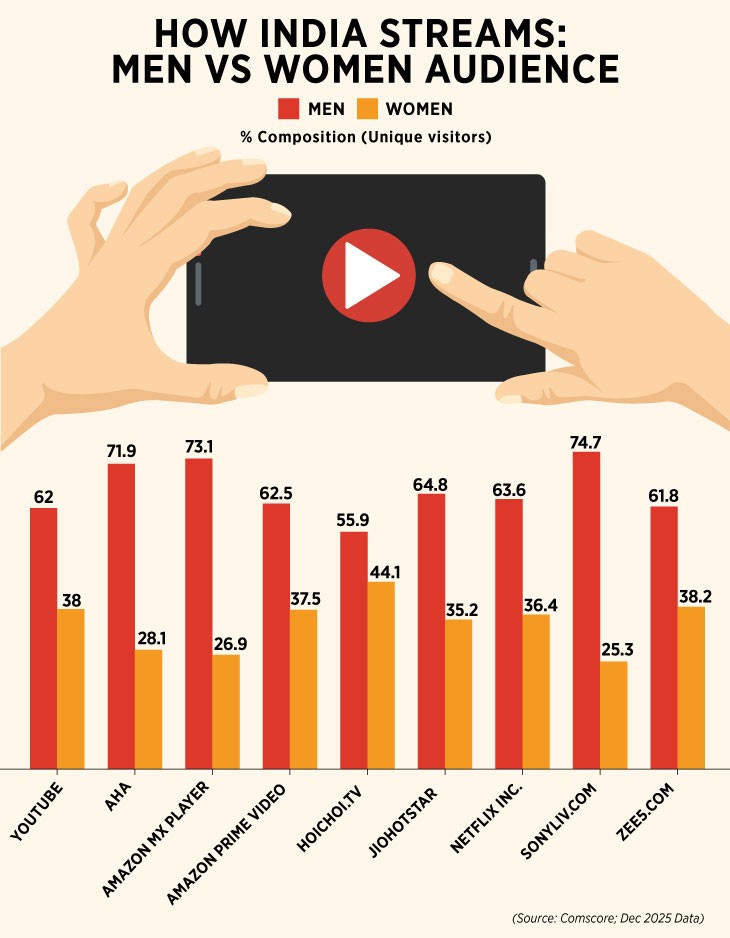
According to Comscore data for December 2025, obtained by e4m exclusively, male users significantly outnumber women on Indian OTT platforms.
The imbalance is most pronounced on platforms such as SonyLIV (75:25), Amazon MX Player (73:27) and regional service AHA (72:28). Large subscription platforms show a relatively narrower gap, with YouTube (62:38), JioHotstar (64.8:35.2), Netflix (64:36) and Prime Video (62:37) .
Among major services analysed, Hoichoi comes closest to parity at 55.9% male and 44.1% female.
Clearly, India’s OTT expansion is currently being driven far more by male audiences than female viewers.
The gender imbalance of the OTT audience comes at a time when advertisers are increasingly shifting budgets toward digital video. For brands targeting female consumers — across FMCG, beauty, fashion and household categories — the skew could mean OTT reach is less representative than often assumed.
Industry executives insist platforms have invested in diverse storytelling, but audience acquisition strategies still lean heavily on mass male traffic drivers such as sports rights and action-led franchises.
exchange4media reached out to all streaming platforms mentioned above seeking comment on the trend and their strategies to address it. Responses were awaited at the time of publication. Few players disputed the Comscore data, but declined to comment officially.
Karan Bedi, Director and Head of Amazon MX Player, said the platform maintains a relatively balanced 60:40 male-female audience mix, differing from Comscore estimates that suggest a wider 73:27 split.
"At Amazon MX Player we are seeing today a far more balanced and premium audience profile emerging. We now reach 250 million+ unique monthly viewers across metros as well as Tier 2 and Tier 3 markets, with nearly 50% of our viewership coming from metros and Tier-1 cities, alongside a healthy 60:40 male-female split and a strong 25+ audience base," Bedi claims.
He adds, "What’s particularly encouraging is the depth of engagement, watch-time has doubled year-on-year, CTV minutes per user have grown from 40 to 80 minutes, and mobile viewing now averages close to 50 minutes. These trends reinforce that audiences are not just discovering the service, but are spending meaningful time with high-quality storytelling across screens."
According to Kaveri Das, Chief Channel Officer &TV and Business Head Hindi ZEE5, the platform continue to invest in original series and films anchored by women protagonists, supported by narratives that explore relationships, family, identity, and empowerment — all delivered through content that carries strong emotional and cultural relevance.
"At ZEE5, we are a consumer-first platform, and our content strategy is built around serving a wide and diverse audience base across languages, genres and viewing preferences. We have achieved this by building a catalogue that spans high-concept originals, films, and television favourites. Within this ecosystem, we have seen strong engagement with stories that bring compelling female perspectives to the forefront. Titles such as Mrs., Tarla, Mithya, Mrs. Undercover, and Saali Mohabbat have resonated with audiences through their layered characters and emotionally grounded storytelling. We continue to invest in original series and films anchored by women protagonists, supported by narratives that explore relationships, family, identity, and empowerment — all delivered through content that carries strong emotional and cultural relevance, Das explained.
“In addition, television favourites, and daily soaps available on the platform, including shows like Ganga Mai Ki Betiyan, Tumm Se Tumm Tak, Vasudha and Bhabiji Ghar Par Hai, continue to attract loyal viewership and contribute to sustained engagement. While certain narratives or formats may naturally appeal more strongly to specific audience groups, our larger focus remains on offering a balanced and diverse content slate that caters to varied tastes and ensures that audiences across demographics can discover stories that feel relatable and engaging on ZEE5,” he said.
Also read: OTT, short-video platforms power India’s microdrama growth
How 2025 redefined streaming power, formats, policy and scale
India’s micro-drama market doubles in 2 months to $260M, but content fatigue looms
India’s sports economy to hit $8B by 2029 driven by streaming, gaming & ads
Content Gravity
India’s OTT market continues to expand rapidly. According to PwC’s Global Entertainment & Media Outlook 2025–29, the sector — currently valued at roughly $2.3 billion — is projected to almost double to $4 billion over the next five years.
Yet consumption patterns have long leaned male.
Veteran industry leader Divya Dixit, who is the CEO at Recz, explains, “Sports streaming, particularly events like the Indian Premier League, draws massive male audiences to platforms such as JioHotstar. At the same time, popular OTT titles like Code M, Apharan, Mirzapur and Sacred Games — which revolve around crime, action and thrillers — also tend to skew heavily male.”
Men are also more likely to consume OTT content solo on mobile devices, often late at night or during commute hours. Early adoption of smartphones, gaming and technology has also meant men entered the OTT ecosystem faster, Dixit Noted.
Content producer Yubraaj Bhattacharya argues that television historically catered more strongly to women viewers, leaving OTT as an alternative destination for male audiences. “Males have very little to watch on TV beyond cricket and films. Television storytelling across languages is heavily skewed towards female audiences. OTT becomes the natural alternative for men,” he said, adding that the proliferation of personal screens — particularly smartphones — has further enabled individualised male viewing.
“OTT consumption has historically skewed male, with viewership in certain high-intensity categories reaching ratios of nearly 85% male,” said Pep Figueiredo, COO at PTPL India and former SonyLIV executive.
He adds that male users typically enjoy greater discretionary screen time on personal devices, enabling deeper engagement with long-form digital storytelling.
Content trends reinforce this pattern. An Ormax Media study analysing series and direct-to-OTT films released between January 2022 and November 2025 found the male-to-female protagonist ratio has widened sharply — from 1.4x in 2022 to 3.5x today.
In effect, for every two female-anchored Hindi originals, roughly seven are now centred around male protagonists.
Genre distribution further amplifies the skew. Over 43% of Hindi fiction originals fall within the Action–Crime–Thriller (ACT) cluster, compared with 26% human drama, 20% feel-good stories and 11% Gen-Z-oriented narratives.
Within the ACT cluster, male protagonists dominate consistently. More strikingly, even outside this category, male-led titles have risen sharply — from 30% of non-ACT shows in 2022 to 52% in 2025, while female-led narratives have dropped from 31% to just 12%.
“Higher male consumption stems from structural and cultural factors. The dominance of action–crime–thriller storytelling reinforces a male-coded narrative template, and algorithms further amplify such content,” said Yogesh Pawar, Programme Director at Population First, an NGO which works for gender sensitivity.
Stickiness and Algorithm
Industry observers say platform strategies over the past five years have increasingly prioritised “stickiness” — subscriber acquisition and retention driven by high-engagement genres such as crime franchises and sports.
“Crime franchises and sports rights guarantee repeat viewing and advertiser comfort. Over time, platforms optimize around the audience segments that deliver those metrics,” an industry executive noted.
Recommendation algorithms may also be compounding the skew. “Once male-heavy genres start performing well, discovery engines keep pushing similar content loops. Women audiences may struggle to find relatable narratives unless they actively search for them,” the executive added.
Pawar notes that the sharp fall in female-led properties outside the ACT genre signals a deeper structural shift. “Even genres once considered neutral are drifting male. That may reflect subscription metrics, but it risks narrowing the imaginative bandwidth of the medium.”
Digital Divide
Beyond content choices, India’s gender imbalance in OTT consumption also reflects deeper digital access gaps.
While smartphone penetration has expanded across demographics, device ownership remains uneven. Industry and telecom studies suggest only about 56–57% of women own a personal mobile phone compared with roughly 74% of men. Women are also 30–35% less likely to actively use mobile internet, with usage often concentrated on communication or utility applications rather than entertainment discovery.
“Device ownership and data autonomy still skew male, enabling uninterrupted viewing,” Pawar explained. “Women often rely on shared screens and have less leisure time due to unpaid care work, making binge formats harder.”
Time Poverty
Researchers also highlight what economists describe as “time poverty.”
India’s Time Use Survey shows women spend close to five hours daily on unpaid domestic and caregiving work, compared with less than two hours for men. The imbalance significantly reduces discretionary leisure time needed for long-form streaming.
Interestingly, studies suggest that when women do access OTT platforms, their engagement levels — measured by minutes per visitor — can match or even exceed those of men, indicating latent demand rather than lack of interest.
The gender gap therefore reflects structural constraints more than audience preference.
The Next Phase of Growth
India remains one of the fastest-growing streaming markets globally, with expansion now extending into smaller towns and regional language ecosystems.
Yet the Comscore data suggests the next phase of growth may depend less on acquiring new users and more on broadening participation among underrepresented segments — particularly women.
Closing the gender gap will likely require a mix of content diversification, product innovation, and improved discovery mechanisms that better reflect how women engage with digital entertainment.
“For an industry built on the promise of personalised viewing, India’s OTT ecosystem still appears far from evenly distributed. The question for platforms now is not simply how many Indians are streaming — but who remains outside the frame”, Pawar opines.
Dixit advises platforms need to invest more in relatable, women-led stories such as Delhi Crime or Four More Shots Please!. According to her, there is also a big opportunity to expand beyond crime and action into genres like rom-coms, relationships and feel-good narratives, as seen with shows like Little Things.
"Shorter, lighter formats that fit into multitasking viewing habits could also help. Equally important is improving discovery of female-centric content through better curation and stronger community engagement on social platforms," Dixit noted.
Read more news about Digital Media, Internet Advertising, Marketing News, Television Media, Radio Media
For more updates, be socially connected with us onInstagram, LinkedIn, Twitter, Facebook, YouTube & Google News