News TV’s July slump: Seasonal lull or growing advertiser caution?
Exclusive TAM data accessed by e4m shows July 2026 recorded News TV's weakest advertising volumes in four years, with the genre's share of total TV advertising slipping to 9%
 by
by
Published: Aug 11, 2026 8:55 AM | 4 min read
 Follow Us

- July 2026 marked a significant decline in advertising volumes for news television in India, with a 38% drop compared to July 2023, reaching a year-low share of 9% in monthly TV ad volumes.
- The decline is attributed to several factors, including delayed monsoon activity, heightened political unrest from student-led protests, and a cautious approach from advertisers regarding news programming.
- Industry experts noted that while overall advertising budgets remain under pressure, many advertisers are redirecting their spending towards entertainment platforms, citing concerns over the editorial environment of news channels.
- The advertising landscape is further complicated by regulatory changes, such as TRAI's 12-minute-per-clock-hour cap on advertising, which has impacted broadcasters already facing challenges from digital migration and slowing ad growth.
For a medium that typically benefits from heightened political activity, July turned out to be an unexpectedly weak month for news television in India.
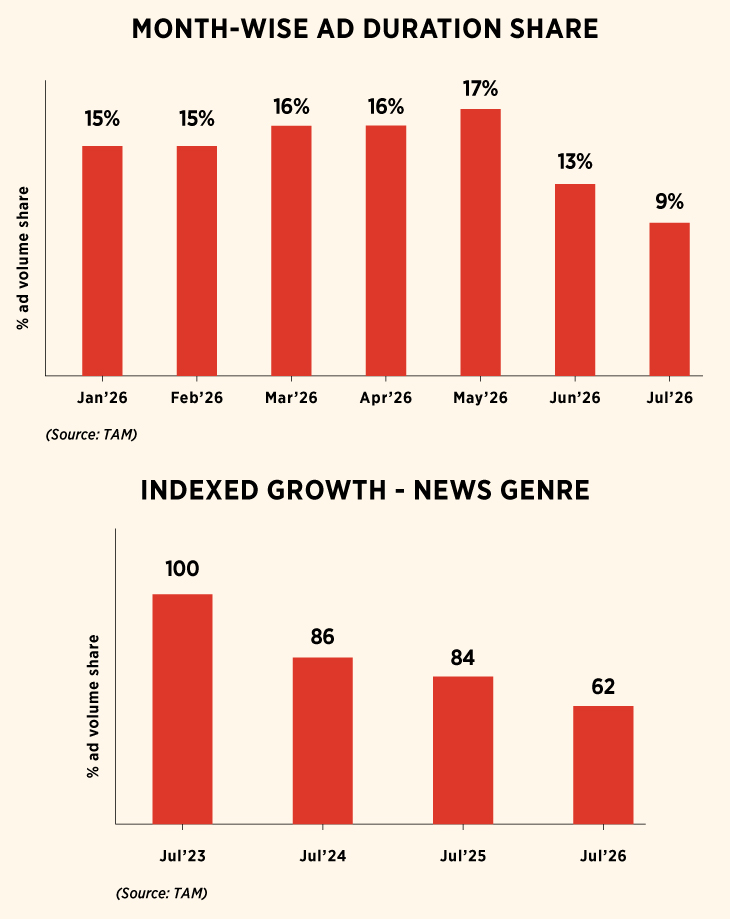
According to TAM AdEx data, accessed by e4m exclusively, News TV registered its lowest advertising volumes for the month of July in four years. Using July 2023 as the base year (100), ad volumes declined to an indexed 86 in July 2024, 84 in July 2025 and plunged further to 62 in July 2026—a 38% decline over the period.
The weakness was evident within 2026 itself. News TV's share of monthly TV ad volumes remained between 15% and 17% from January to May, declined to 13% in June and dropped further to a year-low of 9% in July, pointing to a significant moderation in advertiser activity during the month.
Although channel-by-channel data isn't available, the cut appears to span the entire news sector, including many regional platforms, insiders say.
The timing of this decline has triggered debate across the advertising and broadcasting industry. While marketers point to delayed monsoon activity and July being a lull period, they acknowledge becoming more cautious around news programming during the prolonged student-led protests at Delhi's Jantar Mantar in July which triggered unrest across social media and the country, culminating in the resignation of the education minister.
Additionally, observers also believe the government’s promotional campaigns on news channels became less visible during the protest period for obvious reasons. “The promotional advertising alongside sustained political coverage could have invited criticism for the government,” a marketing expert pointed out.
A Perfect Storm for News Advertising?
Unlike election periods, where heavy news consumption often attracts incremental advertising, July presented a more complicated environment.
Several advertisers indicated that they either reduced or temporarily paused campaigns on news channels, preferring entertainment properties that offered a less polarised environment for brands. The heightened political programming during the protests made some marketers uncomfortable with adjacency risks, even though overall television budgets were not necessarily reduced, observers said.
While broadcasters acknowledge softer government spending, they caution that no official data is yet available to quantify its contribution to the overall decline.
Mona Jain, President – Revenue Growth & Business Development, ABP Group, rejected the suggestions that the government ads were pulled back. "Advertising activity did slow around mid-July but the government spending remained steady, with no noticeable pullback.”
According to Jain, “July is typically a softer month for advertising, especially after the IPL, as FMCG and several other private-sector categories tend to moderate their spending. Advertisers also begin aligning larger campaigns with the festive season, which gathers momentum in August and September, leading many to defer significant spends to coincide with key consumption periods. I don't see this July as being materially different from previous years.”
She insists that the advertising momentum is expected to pick up in the coming weeks with the onset of the festive season–Raksha Bandhan and Onam.
Besides, TRAI's 12-minute-per-clock-hour advertising cap enforced in June is believed to have impacted the ad volumes of broadcasters who are already grappling with slowing advertising growth, migration of audiences to digital platforms and regulatory limits on subscription revenues, industry executives speculate.
e4m reached out to all leading news channels. The story will be updated when they respond.
Decline in consumption of News TV?
Industry executives say July's slowdown reflects a broader shift in how advertisers approach news TV.
“Heightened political programming, social unrest and prolonged issue-driven coverage can prompt brands to temporarily redirect budgets to general entertainment, sports or digital platforms, particularly when consumer sentiment is fragile,” said a marketer.
A TV executive pointed out, “Beyond seasonal factors, marketers are increasingly evaluating not just reach, but also the editorial environment in which their campaigns appear.”
The shift comes at a time when advertising budgets remain under pressure. Several large advertisers have already indicated tighter marketing spends amid slowing consumption and uncertain global demand.
That caution is reflected in the broader television market. According to PMAR, TV advertising expenditure declined 5% year-on-year to ₹32,855 crore in 2025 from ₹34,453 crore in 2024. TAM AdEx's 2025 Television Advertising Recap also showed TV ad volumes fell 11% year-on-year. General Entertainment Channels accounted for 30% of total TV ad volumes, while News TV's share stood at 16%.
“I am not surprised,” says veteran adman Dr Sandeep Goyal, MD of Rediffusion, attributing the decline to the news channels' own programming choices.
“Since most news channels were cautious and somewhat diffident in their coverage of the student protests, viewers likely turned to digital platforms and social media for updates. The decline is a clear indicator that today's consumers have multiple news options and are not hesitant to switch. This pattern could well repeat itself going forward,” Goyal says.
Read more news about Television Media, Digital Media, Advertising India, Marketing News, PR and Corporate Communication News
For more updates, be socially connected with us onInstagram, LinkedIn, Twitter, Facebook YouTube & Google News