Reliance Retail's Lalatendu Panda on why CTV is quick commerce's next frontier
At e4m Connected TV Conference 2026, the Senior VP and Business Head of Reliance Retail, made a compelling case for treating CTV not as a media novelty, but as a strategic brand-building engine
 by
by
Published: Jun 11, 2026 6:25 PM | 4 min read
 Follow Us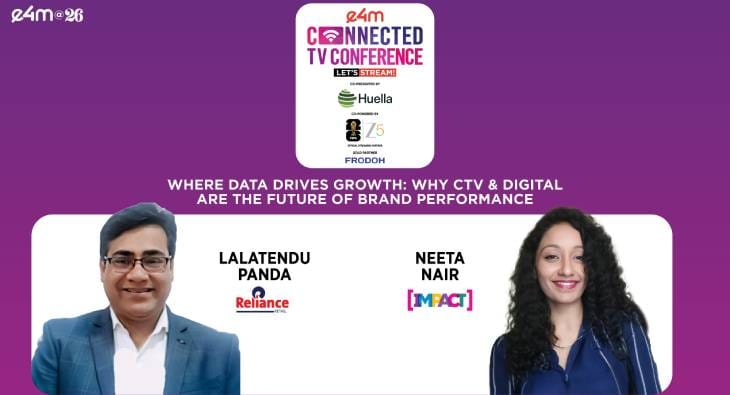

- The session featured Lalatendu Panda from Reliance Retail discussing the potential of Connected TV (CTV) to enhance quick commerce, particularly in the context of JioMart's transition to faster delivery services in 2024.
- Panda emphasized that quick commerce should not be viewed merely as a new channel but as an evolution of existing retail intelligence, leveraging JioMart's extensive consumer behavior data from over 4,000 stores.
- He outlined the importance of brand salience in grocery shopping, asserting that CTV can effectively build consumer awareness prior to search, combining the emotional appeal of traditional television with targeted digital capabilities.
- Despite challenges such as limited audience sizes in specific areas, Panda expressed optimism about CTV's growth potential, advocating for a strategic approach that integrates brand building with performance marketing rather than treating them as separate efforts.
The session titled 'From Screen to Doorstep: How CTV Can Power the Next Wave of Quick Commerce', brought together Lalatendu Panda, Senior VP and Business Head, Reliance Retail, and Neeta Nair, Editor, IMPACT, for a wide-ranging conversation that cut through the performance marketing noise to get at a more foundational question: can CTV do for quick commerce what television once did for FMCG brands, building the kind of mental availability that precedes and sustains purchase?
Panda began by addressing JioMart's much-discussed 2024 pivot from slotted deliveries to quick commerce. Rather than framing it as a catch-up exercise, he positioned it as a natural extension of Reliance Retail's long-standing retail intelligence. "We have been in the grocery business since 2006.
And in each and every catchment, we're very much aware about what the consumer is buying from us," he said. With over 4,000 stores across the country, JioMart's move into quick commerce came with a ready-made map of consumer behaviour at the hyperlocal level, something pure-play dark store operators, he argued, simply did not have. "Quick commerce was just a channel, but the consumer was not changing. We were already there in that market."
When the conversation turned to consumer loyalty in a space where most shoppers toggle between apps based on convenience and catalogue, Panda was direct. Quick commerce introduced speed as a new variable in retail, but it did not replace the fundamentals. "Assortment, availability, and pricing. If you do not have those, then delivering fast is not going to help you win the war." He added that while players are currently absorbing delivery costs to chase market share, the ones who will endure are those who can offer genuine pricing supremacy at scale, something Reliance's procurement muscle affords JioMart in ways that are difficult to replicate.
The pivot to Connected TV as a strategic tool was the heart of the session. Panda's argument was rooted in a specific insight into how quick-commerce consumers behave. Grocery, he noted, is predominantly a search category, meaning consumers come into an app knowing what they want. That means brand salience must be built before the search happens. "If you have not created the mental availability in her mind before she comes and searches, you've already lost," he said. CTV, in his framing, is precisely the medium that builds that availability, at a scale and in an environment that digital cannot replicate, but with the targeting precision that linear television never offered.
"Television was never a cheap medium. It always required a certain threshold of expenditure. CTV has solved this," Panda said. Through platforms like JioStar, JioMart can now target specific catchments, pinning campaigns to areas like Whitefield in Bangalore or Thane in Mumbai, combining the emotional impact of the large screen with the geography and cohort-based targeting of digital. "The storytelling and measurability will both come through that."
On measurement, Panda outlined a three-layer framework covering brand metrics, commerce metrics, and business metrics. At the brand level, he looks at search uplift and movement into the consumer's consideration set. At the commerce level, the question is whether category penetration is growing, whether CTV campaigns are actually expanding the pool of buyers for a given category, or merely reaching the same converted cohort. And at the business level, the test is ultimately customer acquisition cost.
"CTV is bringing the accountability of digital and the brand-building capability of television. But I will only put money there when I see performance metrics telling me this is working."
On the QR code question, whether viewers are actually scanning codes on screen to purchase in real time, he was candid: "Very low percentage of people actually use it." What the data does show, however, is a measurable spike in app installs following extended CTV campaign runs, alongside improvements in search uplift and brand lift scores.
Panda did not shy away from the sector's most significant structural constraint. With CTV monthly active users at roughly 13 crore, audience sizes in specific catchments can fall short of the threshold needed for campaigns to yield meaningful returns. "If the audience size in that geography is small, it is not going to yield any dividend for me." But he remained optimistic about the trajectory, pointing to rising purchasing power and the sustained growth of streaming as indicators that penetration will continue to climb.
His closing message was directed as much at fellow marketers as at the medium itself. "CTV is not an extension of linear television. They are two very different things," he said, cautioning against the common practice of repurposing television creatives for CTV. The future, he argued, lies in AI-powered audience segmentation, sequential targeting, and a full-funnel mindset that treats brand building and performance marketing not as competing priorities but as consecutive stages of the same consumer journey. "If you are just looking at this as an optional choice and not as a strategy, it is not going to work."
Read more news about Digital Media, Internet Advertising, Marketing News, Television Media, Radio Media
For more updates, be socially connected with us onInstagram, LinkedIn, Twitter, Facebook, YouTube & Google News