As cookies fade, ad tech must be rebuilt on neutrality not promises: Gowthaman Ragothaman
At e4m TechManch, the Saptharushi Founding CEO said India's DPDP era demands neutral data infrastructure, warning that the industry's future depends on who owns audience data, not just who buys media
 by
by
Published: Jul 24, 2026 6:35 PM | 5 min read
 Follow Us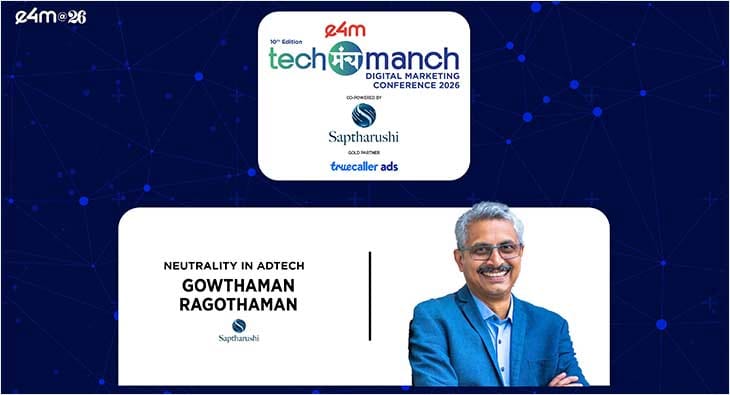

- India's advertising ecosystem is undergoing significant changes due to the phasing out of third-party cookies, consolidation of audience data by major holding companies, and the upcoming enforcement of the Digital Personal Data Protection (DPDP) Act, which will impact how media is bought, measured, and governed.
- Gowthaman Ragothaman, CEO of Saptharushi, emphasized that the industry's future will focus on data management architecture rather than just media buying efficiency, highlighting the need for privacy, neutrality, and interoperable infrastructure.
- The competitive landscape is shifting towards ownership of consumer data, with major advertising firms acquiring proprietary data ecosystems, raising concerns about data control and the implications for marketers when selecting technology partners.
- Ragothaman advocates for a collaborative data-sharing framework in the advertising industry and stresses that neutrality in data management should be built into the technology architecture, rather than treated as a compliance requirement, to enhance measurement and attribution across various channels.
India's advertising ecosystem is approaching an inflection point where the disappearance of third-party cookies, the rapid consolidation of audience data by global holding companies and the impending enforcement of the Digital Personal Data Protection (DPDP) Act will fundamentally reshape how marketers buy, measure and govern media.
Delivering a vision keynote at the 10th edition of e4m TechManch in Mumbai, Gowthaman Ragothaman, Founding CEO of Saptharushi, argued that the industry's next phase will be defined less by media buying efficiency and more by the architecture on which data is managed.
"The industry is going through a massive change in terms of data, technology and consent," Ragothaman said, setting the context for what he described as a transition from today's fragmented ecosystem to one built on privacy, neutrality and interoperable infrastructure.
According to him, every participant in the advertising value chain, from brands and agencies to DSPs, exchanges, SSPs and publishers, is ultimately connected through audience signals.
"The entire supply chain is connected by the audience signals. Individually they are all specialists in their own right. But what connects them is the audiences."
However, that ecosystem still relies heavily on third-party cookies, which he described as the weakest link in the chain. "A large part of our industry today is built on connecting the unconsented cookie across the supply chain. And when the cookies go away, the ability to identify, target and measure the very audience which is running through the supply chain is difficult, and therefore not able to measure reach."
The new battle is over data
Ragothaman suggested that the industry's competitive landscape is no longer centred solely on media capabilities but increasingly on ownership of consumer data. Referring to a series of global acquisitions, he said major advertising holding companies are racing to build proprietary data ecosystems.
"Publicis paid $2.2 billion to buy LiveRamp. WPP acquired InfoSum. Omnicom through IPG acquired Acxiom. And all the three holding companies together are all now grabbing data."
In his view, these acquisitions are creating another layer of closed ecosystems alongside platforms like Google and Meta. "We have Google, we have Meta. And then we have the holding companies with their own data sets. We are already building walls."
This raises a larger question for marketers evaluating agencies and technology partners. "In the context of the data being controlled across the gardens, you're choosing who your data answers to. If you're going to give the data to somebody, they own the data and they have the answers."
DPDP changes the conversation
Ragothaman believes India's DPDP framework will significantly accelerate this shift. Calling it "probably by far the best, far better than GDPR," he noted that the legislation introduces consent managers, stricter compliance obligations and penalties that could reshape how advertising organisations handle consumer information.
With compliance expected to become a major investment area, he argued that businesses can no longer rely on contractual assurances around privacy. Instead, neutrality itself must become part of the technology stack. "Neutrality is not a promise, it has to be an architecture, can't be something given as an entity."
"Neutrality has to be something which is built as a system. It can't be something that is a claim," he said.
He added that truly neutral infrastructure should ensure first-party data never leaves its original location, avoid centralised pooling of datasets and remain commercially independent of media buying outcomes.
Six questions for marketers
Rather than prescribing solutions, Ragothaman encouraged brands to rethink how they evaluate their advertising partners. Among the questions he urged marketers to ask were whether changing agencies would require changing technology platforms, what happens to campaign data after execution, who owns audience relationships, and what legal responsibilities vendors assume under DPDP.
He also challenged the industry to build a collaborative data-sharing framework similar to India's Account Aggregator ecosystem. "When FinTech can have something like Sahamati, through which banks seamlessly collaborate, what is our Sahamati equivalent for our industry?"
"When banks can share data, why can't our industry do the same?" Saptharushi, he said, is attempting to address this through what it calls the Atom Protocol, a federated architecture designed to enable data collaboration without moving raw consumer information out of native environments.
Neutrality beyond compliance
For Ragothaman, neutrality is not merely a regulatory requirement but a commercial advantage. He argued that an independent data layer could eliminate disputes around impression delivery, enable more credible cross-media measurement and improve attribution across fragmented channels.
"A neutral platform gives you a very independent, neutral measurement of the impression that has happened, therefore you can evaluate the investments a lot better."
He also believes consent management will become dynamic under DPDP, rendering static audience segments obsolete. "The consent revocation is becoming dynamic. Predefined segments collapse immediately."
"We have to have real-time composable identities which captures real-time consent," he added.
The next chapter for ad tech
Closing his keynote, Ragothaman urged the industry to move away from building more silos and instead adopt a layered technology architecture comprising infrastructure, analytics and applications. "It is not about horizontality and building silos. If you move it to a layered approach, industry will be in a much better place."
He concluded with what he described as the defining principle for the next era of advertising technology. "As the cookies decay, sovereignty should compound."
"In the next year or so, 80% of ad tech will be programmatic. And the AI onslaught is going to only accelerate it. High time those models are built on a neutral platform instead of being on somebody else's cloud service."
Read more news about Digital Media, Internet Advertising, Marketing News, Television Media, Radio Media
For more updates, be socially connected with us onInstagram, LinkedIn, Twitter, Facebook, YouTube & Google News