Algorithms can be kingmakers, but content remains king: Kotak Mahindra’s Kedar Ravangave
At the e4m CTV Conference 2026, Kedar Ravangave, Head of Marketing at Kotak Mahindra Bank, noted that although algorithms influence what audiences watch, content continues to drive engagement
 by
by
Published: Jun 12, 2026 9:12 AM | 7 min read
 Follow Us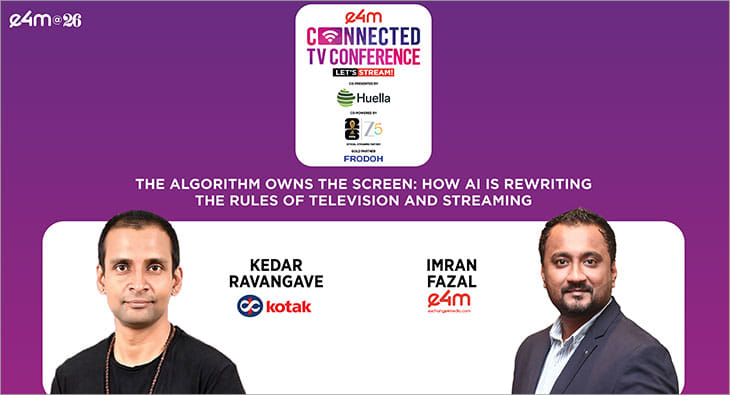

- Kedar Ravangave, Head of Marketing at Kotak Mahindra Bank, emphasized at the e4m CTV Conference 2026 that while AI and algorithms are transforming content distribution, content remains the core driver of audience engagement.
- The rise of Connected TV (CTV) is shifting media planning from traditional broadcast methods to outcome-driven strategies, allowing for more precise targeting and measurement of marketing campaigns.
- Ravangave criticized the industry's reliance on vanity metrics, urging marketers to connect media performance directly to business outcomes and invest in advanced measurement systems like Marketing Mix Modelling (MMM).
- He highlighted the potential of hyper-personalized advertising, driven by AI, to create tailored consumer experiences, while also noting that human judgment remains essential in decision-making processes despite AI's growing influence.
As artificial intelligence reshapes how audiences discover, consume and engage with content, marketers are being forced to rethink everything from media planning and attribution to content creation and customer journeys.
Speaking at the e4m CTV Conference 2026, Kedar Ravangave, Head of Marketing at Kotak Mahindra Bank, argued that while algorithms are increasingly influencing what consumers watch, content continues to remain the fundamental driver of engagement.
Participating in a session titled "The Algorithm Owns the Screen: How AI is Rewriting the Rules of Television and Streaming", Ravangave said the growing influence of AI and recommendation engines should not be viewed as a replacement for content but as a powerful force shaping its distribution.
"Content continues to be relevant. Content continues to be the king," he said. "Algorithms can be the kingmaker, but content is where you can force the consumer to watch something."
According to Ravangave, the biggest shift enabled by AI is not necessarily in content creation but in how content reaches audiences. Unlike the era of traditional television, where marketers had limited information about viewer behaviour, digital platforms now provide vast amounts of data and measurement capabilities, allowing brands to optimize campaigns based on outcomes rather than assumptions.
From Broadcast to Outcome-Driven Media
The rise of Connected TV (CTV) is fundamentally changing media planning, Ravangave noted.
Historically, television functioned largely as a broadcast medium, prioritising reach and awareness. Connected TV, however, is increasingly being viewed as an outcome-oriented channel that offers marketers greater precision and accountability.
"There was a time when connected TV was difficult to sell as a media proposition because the audience base was relatively small. But even then, what stood out was its ability to give marketers permission and measurement," he said.
As audiences migrate to streaming platforms, CTV is gradually occupying a central position in media planning, particularly for urban and metro audiences. Ravangave suggested that in many cases, connected TV is beginning to replace the role traditionally played by linear television in marketing plans.
"It is a lot more predictable. You are a lot more certain of what it can give you and what it cannot," he said.
The shift is also changing how brands approach creative development. Instead of relying on a single flagship campaign or television commercial throughout the year, marketers are increasingly adopting an always-on content strategy with multiple creative executions tailored for different audiences and objectives.
"The days of putting one spot and running it through the year are largely gone," he said.
Marketers Need to Move Beyond Vanity Metrics
One of the strongest critiques Ravangave offered during the discussion was aimed at the industry's overreliance on media metrics.
He argued that marketers often use measured media performance as a convenient response to boardroom scrutiny, even when those metrics do not adequately reflect business outcomes.
"Marketers have kind of leveraged measured media as a scapegoat to answer some of the questions that the boardroom asks," he said.
According to him, impressions, reach and other media indicators frequently become vanity metrics unless organisations connect them directly to business KPIs.
"If you're reporting media metrics as outcomes, then there is something wrong," he said.
Ravangave highlighted that many companies still do not invest sufficiently in Marketing Mix Modelling (MMM) and advanced measurement systems that can establish causal links between marketing investments and business performance.
While digital channels have made attribution easier through mechanisms such as last-click attribution, he acknowledged that establishing true causality remains one of marketing's most difficult challenges.
AI Is Transforming the Entire Marketing Workflow
Ravangave stressed that discussions around AI often become narrowly focused on content generation or media buying, whereas the technology's impact is far broader.
"AI is deepening its impact across all spectrums of marketing, be it research, media, customer journeys or partnerships," he said.
Rather than being viewed as a standalone tool, AI is creating what he described as a "systemic change" across marketing organisations.
The technology is influencing audience research, media planning, personalization, campaign execution, measurement and customer engagement, resulting in tighter integration across workflows.
He urged marketers to examine AI's impact holistically rather than limiting discussions to specific channels such as connected TV or streaming.
Hyper-Personalisation Will Define the Next Phase
Among emerging trends, Ravangave identified hyper-personalised advertising as one of the most underappreciated developments.
Pointing to LinkedIn's personalised advertising formats, he noted how users increasingly encounter creatives featuring their own names and customised messaging.
"You would freak out seeing your own name in an ad that appears to be talking only to you," he remarked.
The rapid decline in content production costs, combined with AI's ability to generate multiple creative variations, is making large-scale personalization increasingly viable.
According to Ravangave, the industry is moving towards a future where brands can understand individual consumers, create tailored content for each user and deliver those experiences at scale.
"Almost n equals one," he said, referring to a marketing model where every consumer receives a uniquely personalised experience.
He believes the next six to nine months could witness a significant acceleration in the adoption of hyper-personalised campaigns across digital and streaming ecosystems.
India's Growth Story Remains Distinct
While acknowledging the advances made in markets such as the United States and China, particularly in shoppable television and integrated commerce experiences, Ravangave argued that India's market realities remain different.
He recounted a conversation with a consumer goods marketer who highlighted that several regions still lack sufficient digital reach and distribution infrastructure.
"I have a certain part of the geography where I still don't have the digital reach or distribution," Ravangave recalled the executive saying.
As a result, traditional television continues to play an important role in many parts of the country, even as connected TV adoption accelerates in urban centres.
"We still don't have media that is as penetrated as one would assume sitting in a metro city," he said.
This uneven development means India's marketing ecosystem will likely evolve through a hybrid model where television, connected TV, digital media and commerce platforms coexist rather than one immediately replacing another.
No Fixed Formula for Media Allocation
Addressing questions around ideal media allocation between connected TV and traditional channels, Ravangave rejected the notion of a standard formula.
Instead, he argued that media investments should be determined entirely by campaign objectives.
"There are campaigns designed to drive transactional outcomes, while others are intended to create deeper equity impact," he said.
Connected TV increasingly occupies a unique position because it combines the storytelling capabilities of television with the targeting and attribution capabilities of digital media.
As digital platforms become more measurable and outcome-oriented, Ravangave said traditional distinctions between brand-building and performance marketing are beginning to blur.
Human Judgment Will Continue to Matter
Despite his optimism about AI's capabilities, Ravangave cautioned against overestimating the technology's ability to replace human decision-making.
The primary limitation, he argued, is the absence of common sense and contextual judgment.
Drawing on Kotak's own experimentation with AI-driven systems, Ravangave recounted instances where automated systems generated excessive noise while optimising narrowly defined objectives.
"AI lacks common sense," he said.
In environments that involve ambiguity, trade-offs and nuanced decision-making, human intervention remains indispensable.
"You risk a lot of optimisation being done on only certain goals that you give to your agents," he warned.
As brands increasingly deploy AI-powered workflows, he believes the competitive advantage will come not from removing humans from the process, but from combining machine efficiency with human judgment.
For marketers navigating the rapidly evolving streaming and connected TV ecosystem, Ravangave's message was clear: AI will increasingly shape discovery, personalization and distribution, but success will continue to depend on meaningful content, robust measurement frameworks and thoughtful human oversight.
Read more news about Digital Media, Internet Advertising, Marketing News, Television Media, Radio Media
For more updates, be socially connected with us onInstagram, LinkedIn, Twitter, Facebook, YouTube & Google News