Brands no longer own consumers. Trust is the only lasting advantage, say top marketers
At e4m TechManch 2026, marketing leaders from Reliance Retail, Sintex, DLF, Cipla Health, Digital Turbine and Truecaller debated how consumer relationships are changing
 by
by
Published: Jul 27, 2026 5:10 PM | 6 min read
 Follow Us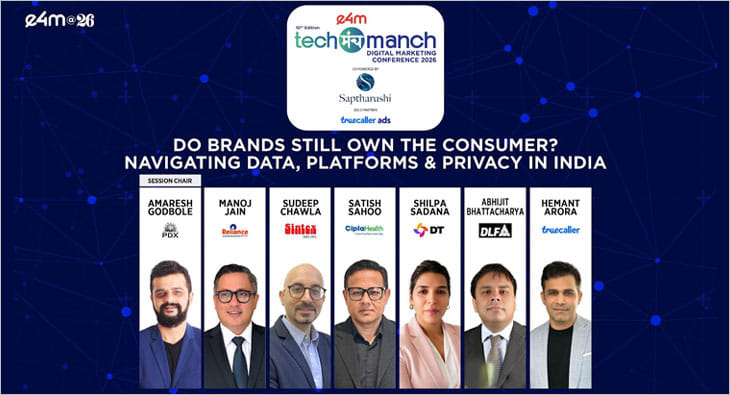

- Marketing leaders at the e4m TechManch 2026 session emphasized that brands no longer "own" consumers; instead, consumers control their relationships with brands, necessitating trust and consistent experiences.
- The discussion highlighted the importance of responsible data usage and transparency, with consumers willing to share information when it enhances their experience rather than for aggressive targeting.
- Panelists noted that AI and new digital platforms are reshaping consumer discovery, requiring brands to focus on solving meaningful problems rather than merely controlling channels.
- An emerging consensus across various industries indicated that brand success is now defined by trust and memorable experiences rather than access to customer data, with marketers needing to adapt to consumers' evolving preferences.
The era of brands believing they "own" consumers is over. As privacy regulations tighten, AI reshapes discovery and digital platforms increasingly sit between brands and buyers, marketers say the competitive edge now lies not in controlling consumer data, but in earning trust and delivering consistent experiences.
At the e4m TechManch 2026 session, "Do Brands Still Own the Consumer? Navigating Data, Platforms & Privacy in India," chaired by Amaresh Godbole, CEO, PDX India and Chief, AI Experiences & Solutions, Publicis Groupe India. Marketing leaders from Reliance Retail, Sintex, DLF, Cipla Health, Digital Turbine and Truecaller debated how consumer relationships are changing in an ecosystem where brands no longer control every touchpoint.
Rather than viewing first-party data as the ultimate asset, the discussion repeatedly returned to a different conclusion: consumers now decide who earns access to their attention, their preferences and, ultimately, their loyalty.
Manoj Jain, Sr Vice President & CMO, Reliance Retail (Electronics), when asked whether brands still own consumers said, "Today, I don't think any brand owns the consumer. Consumers are the people who own the relationship with any brand. The duty of the brand is to ensure that this trust is built in whatever aspect of business they do."
Jain argued that marketers often overestimate the value of collecting customer information while underestimating the importance of using it responsibly. Consumers, he said, are willing to share data when brands demonstrate transparency and use it to improve their experience instead of simply targeting them more aggressively. "Data is preference. All of us are comfortable sharing our data if it's not misused. The journey is never ending, so it becomes critical that we build trust, understand preferences and create personalisation."
He added that even in categories where retailers have access to significant customer information, data alone does not create loyalty. "Any competitor sells the same Apple mobile phone or Samsung mobile phone. Why consumers come to our store is all about experience."
For Sudeep Chawla, CMO, Sintex, the industry's vocabulary itself needs updating. Brands, he argued, do not own consumers. At best, they own a place in consumers' memory. "Today, I don't think any brand can claim that it owns the consumer. What it owns is the memory structure that allows the consumer to recall the brand, and the responsibility to keep it consistent over and over again."
Speaking from a category where purchase decisions happen only once or twice in a lifetime, Chawla said the challenge is less about influencing every transaction and more about ensuring the brand remains the preferred recommendation whenever consumers are ready to buy. "The task is to make sure consumer equity remains high so that if anybody proposes my brand, the consumer almost always says yes."
The conversation also highlighted how artificial intelligence and new discovery platforms are changing the consumer journey. Search engines are no longer the only gateway to information, and consumers increasingly discover brands through AI assistants, social platforms and recommendation engines.
Against that backdrop, Abhijit Bhattacharya, CMO & Senior VP, DLF Ltd, said brands should focus less on channels and more on solving meaningful consumer problems. "Brands exist in consumers' lives because they solve a specific problem better than anyone else. As long as brands understand that problem and continue solving it better than everyone else, they control that relationship very strongly."
He noted that the buying journey has become more fragmented than ever, requiring marketers to ensure consumers receive relevant answers wherever they search, whether through AI-powered discovery or traditional channels. However, in high-value categories such as real estate, the decisive moment still comes when consumers experience the product first-hand. "Consumers are no longer even coming to your website first. You need to create assets that answer their questions wherever discovery happens. But ultimately, building credibility and delivering the promised lifestyle remain fundamental."
Although panellists represented industries as varied as electronics, construction materials, real estate, healthcare and digital advertising, the discussion revealed an emerging consensus across sectors. Ownership is no longer defined by access to customer databases or digital platforms. Instead, brands compete by building trust, creating memorable experiences and giving consumers a compelling reason to choose them again.
As consumers gain more control over how they discover, evaluate and engage with brands, marketers appear to be redefining success itself. The winner may no longer be the brand with the most data, but the one consumers trust enough to share it with.
Satish Sahoo, Senior Marketing Director, Cipla Health said, “Our smoking-cessation brand Nicotex enjoys nearly 85% top-of-mind awareness among smokers. But that doesn’t mean we own the consumer. At best, it means consumers are considering us. The real challenge is moving them from consideration to usage, trust and ultimately loyalty.”
“When a brand reaches 85% top-of-mind awareness, it's easy to assume you've won. But consumers don't belong to brands. The task is to remain relevant enough that they continue choosing you over time.”
“There are very few truly iconic brands that consumers actively seek out. Most brands operate somewhere in the middle — 40%, 60% or halfway there. For those brands, how you present yourself, where you present yourself and how consistently you show up across channels becomes extremely important.”
“In categories like smoking cessation, consumers often come looking for us because awareness is high and choices are limited. But even then, the objective is not just awareness; it is building trust and creating long-term brand preference.”
“Cipla Health gives us a strong foundation of trust. But if we rely only on the parent brand, we risk becoming a commodity. We want consumers to trust our individual brands, not just the company behind them.”
Hemant Arora, VP & Global Head, Truecaller Ads Business said, “Before consumer acquisition cost comes the cost of understanding your consumer. We talk a lot about CAC, but we rarely talk about CUC. Understanding consumers should be the first responsibility of every marketer.”
Shilpa Sadana, Country Sales Manager, Digital Turbine explained, “Discovery is just one part of the consumer journey. What happens after discovery is equally important. The value, context and relevance that brands deliver ultimately determine whether consumers engage or convert.”
Read more news about Marketing News, Advertising News, PR and Corporate Communication News, Digital News, People Movement News
For more updates, be socially connected with us onInstagram, LinkedIn, Twitter, Facebook, YouTube & Google News