Goafest 2026: Dr. Annurag Batra predicts the industry crossing ₹2,00,000 crore next year
Dr. Annurag Batra, Chairman & Editor-in-Chief of BW Businessworld Group and e4m, spoke to Dheeraj Sinha, CEO-McCann Group, on key opportunities and challenges reshaping the Indian ad industry
 by
by
Published: May 21, 2026 3:21 PM | 8 min read
 Follow Us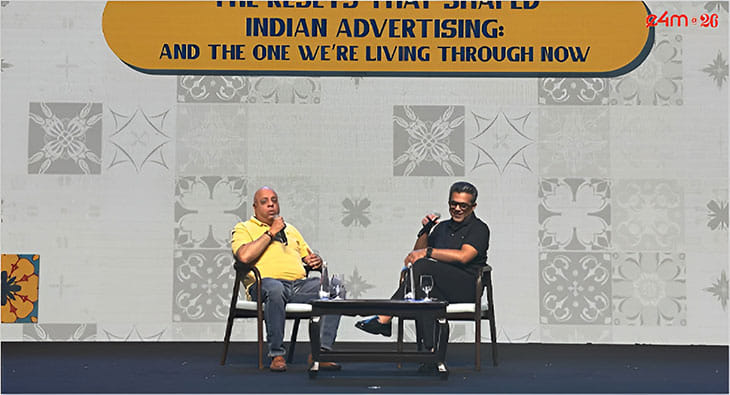

- At Goafest 2026, Dr. Annurag Batra discussed the evolving landscape of Indian advertising, emphasizing the industry's growth potential and the need for agencies to adapt to new roles beyond traditional advertising.
- He highlighted the convergence of technology, advertising, and entertainment, stating that successful agencies will integrate these elements to solve broader business challenges for clients.
- Both Dr. Batra and Dheeraj Sinha acknowledged the transformative impact of AI on workflows, asserting that while AI will enhance efficiency, human creativity and emotional intelligence remain crucial for authentic storytelling.
- The conversation concluded with a focus on the importance of human connection and experiential marketing, suggesting that the advertising industry is not facing decline but rather a phase of reinvention and renewal.
At Goafest 2026, in an interesting role reversal, one of the most influential voices in India’s media and advertising landscape, Dr. Annurag Batra, Chairman & Editor-in-Chief of BW Businessworld Group and e4m, was quizzed by Dheeraj Sinha on the forces transforming Indian advertising and why the industry continues to have every reason to remain optimistic.
The man who has spent decades questioning, analysing and shaping the narratives of India’s media and advertising ecosystem was himself answering the big questions. The conversation only reinforced why Dr Batra continues to be regarded as one of the most influential and respected voices in the business of advertising, marketing and media.
With decades of deep industry experience, Dr Batra spoke with authority on the evolving dynamics of brands, creativity, consumer engagement and the growing impact of technology on storytelling. Widely seen as a mentor, observer and trusted confidant to some of the biggest leaders in advertising and corporate India, he brought a sharp, panoramic perspective to the discussion. His understanding of market shifts, audience behaviour and media transformation reflected the insight of someone who has not only witnessed the industry’s evolution first-hand, but has also played a defining role in shaping many of its conversations over the years.
Sharing interesting insights, Dr Batra said: “Today, the advertising industry is worth nearly ₹1,75,000 crore. It is expected to cross ₹2,00,000 crore next year. Advertising is growing. Brands are spending. Businesses are investing in storytelling. The issue is that the advertising agency of the future may not look like the agency we know today.”
That set the tone for the session. This was not a conversation about survival. It was a conversation about reinvention.
The New Advertising Equation: Silicon Valley, Madison Avenue and Hollywood
One of the strongest themes of the discussion was the convergence reshaping the industry globally.
Dr. Batra described the current moment as the coming together of three worlds that traditionally operated separately: technology, advertising and entertainment.
“For the first time in decades, we are seeing the convergence of Silicon Valley, Madison Avenue and Hollywood,” he said. “The agencies that will succeed are the ones that can bring together technology, storytelling and entertainment for clients.”
Sinha built on that idea by pointing out how agencies are now expected to solve much larger business problems than traditional advertising.
“The client today does not only want campaigns. They want transformation. They want data intelligence. They want consumer understanding in real time. Creativity still matters deeply, but creativity alone is no longer enough.”
Dr. Batra cited the aggressive acquisitions and expansion strategies of global holding companies like Publicis as examples of how agencies are repositioning themselves beyond pure advertising services.
“Publicis understood the shift early. They moved into data, AI and transformation. The narrative around them changed because the business itself changed.”
At the same time, he noted that legacy holding companies now face a structural challenge: differentiation.
“The old holding companies are becoming like cloud kitchens,” Batra remarked. “Different brands at the front, but often the same backend structure. The question now is: how do you truly stand apart?”
While much of the session focused on structural change, one of the most revealing moments came when the conversation turned inward toward the industry's own mindset.
“If senior industry leaders keep publicly saying the industry is collapsing, then naturally that becomes the dominant narrative.” Dr. Batra agreed, and acknowledged that both industry platforms and leadership have amplified fear more than possibility.
“We have not celebrated our positives enough,” he said. “We need totay honest, but we also need perspective.”
AI Is Changing Everything, But Human Creativity Still Wins
AI inevitably dominated large parts of the discussion, but interestingly, neither speaker framed it as an existential threat.
Instead, bot saw it as a force that would radically reshape workflows while simultaneously increasing the value of authentic human thinking.
Dr. Batra shared a striking anecdote about a major client CEO who kept two laptops in his office. One was for day-to-day business operations. The other was exclusively for experimenting with AI tools because his company restricted external LLM access.
“The clients are already learning,” Batra said. “If agencies are not learning at the same speed, that becomes dangerous.”
Sinha agreed that AI will dramatically alter organisational structures.
“Yes, headcounts may reduce in traditional setups,” he admitted. “But entrepreneurship will increase. A creator today can function like an agency. AI reduces operational dependency and increases individual capability.”
Yet both leaders insisted that originality and authenticity would become even more valuable in an AI-heavy world.
“The more AI grows, the more human uniqueness matters,” Dr. Batra said. “AI will become very good at generic output. But authenticity, emotional intelligence and original thinking still belong to humans.”
Sinha echoed the same sentiment in his own way.
“Technology can accelerate execution, but human understanding still creates cultural relevance,” he said.
Performance Marketing Cannot Replace Brand Building
Another key point of alignment between the two was the industry's overdependence on performance marketing.
Dr. Batra warned that while performance advertising delivers immediate metrics, it cannot become the sole engine of brand growth.
“Performance advertising is like a tiger,” he said. “It works as long as you keep feeding it. The moment you stop, the effect drops. Brand building is what creates long-term memory.”
Sinha acknowledged that creativity in some large advertising properties, including the IPL ecosystem, has fluctuated in recent years. But he cautioned against judging the industry in short cycles.
“One good year or one weak year does not define creativity,” he said. “Advertising is not a 12-month business. Great brands are built over years.”
He also criticised the industry’s obsession with annual validation metrics.
“We measure ourselves every 12 months because awards happen every year and business reporting happens every quarter. But real creative impact takes longer.”
The Future Agency Will Be Leaner and More Entrepreneurial
Perhaps the most realistic part of the session was the discussion around operational change.
Dr. Batra drew parallels from journalism, where one individual today often handles reporting, shooting, editing and publishing using AI-powered tools.
“The same shift will happen in agencies,” he said. “The core will remain consumer understanding, strategy and creativity. Everything else will become more centralised and efficient.”
Sinha viewed this not as decline, but redistribution.
“Value creation is shifting from large structures to individual capability,” he said. “Smaller teams, sharper talent and entrepreneurial energy will define the future.”
Dr. Batra also highlighted the explosion of niche creative businesses across India, from meme-led agencies to creator-led studios and independent content companies.
“The entrepreneurial energy in this industry is extraordinary right now,” he said. “That is a very positive sign.”
Why Human Connection Still Matters
Despite all the discussion around automation and AI, one of the most emotional themes of the conversation was the growing importance of human interaction.
Dr. Batra argued that as digital experiences become more automated, people increasingly seek physical, emotional and community-driven experiences.
“The more AI grows, the more valuable human touch becomes,” he said. “That is why hospitality, live experiences and experiential marketing are booming.”
Sinha agreed, pointing to GoaFest itself as proof.
“People still want to gather, collaborate and celebrate ideas together,” he said.
The conversation around experiential marketing extended into culture, politics and consumer behaviour, with both speakers noting how events, communities and live experiences are becoming central to modern brand building.
A Conversation About Reinvention, Not Fear
As the session closed, the discussion returned to a larger philosophical point: industries survive when they adapt without losing their core identity.
For both Sinha and Dr. Batra, advertising’s core identity remains storytelling, cultural relevance and human insight. What is changing are the tools, structures and economics around it.
Dr. Batra summed it up with a deeply Indian metaphor, invoking the idea of “creative destruction” through the symbolism of Shiva.
“Sometimes old business models need to be destroyed for new ones to emerge,” he said. “That is not collapse. That is renewal.”
Sinha ended on a similarly optimistic note.
“Life is about abundance. It is about coexistence and impact,” he said. “And our industry still has the ability to create enormous impact.”
If there was one clear takeaway from the Goafest conversation, it was this: advertising is not entering its final chapter. It is entering a new one.
Read more news about (internet advertising India, internet advertising, advertising India, digital advertising India, media advertising India)
For more updates, be socially connected with us onInstagram, LinkedIn, Twitter, Facebook Youtube & Whatsapp
