The advertising business, as we know it, is dead: Sandeep Goyal on AI & art of reinvention
In a candid conversation with Dr Annurag Batra, Rediffusion's MD looks back on his 40 years in the industry, and what lies ahead
 by
by
Published: Apr 11, 2026 8:18 AM | 9 min read
 Follow Us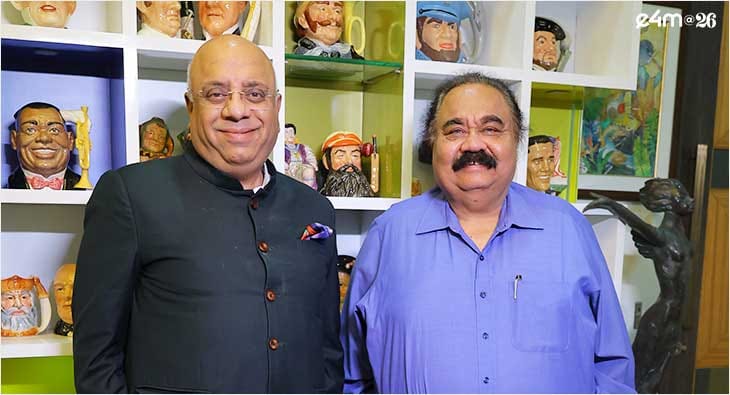

There are very few people in Indian advertising who have been both inside the machine and outside it. Very few have run the biggest agencies, sold them, built technology companies, collected art, written books, and returned to the fray not out of necessity but out of sheer love for the craft.
Dr Sandeep Goyal, Managing Director of Rediffusion Brand Solutions, is one of them. In a wide-ranging conversation with Dr Annurag Batra, Chairman and Editor-in-Chief of BW Businessworld, Goyal pulled no punches on the state of the agency business, the dominance of platforms, the death of the big idea, and what it actually takes to survive and thrive across four decades of industry churn.
The verdict on agencies: Blunt, and not without evidence
The conversation wasted no time getting to the fault lines. The Indian advertising industry is projected to cross ₹1.5 lakh crore in total ad spends by 2025, according to the Pitch Madison Advertising Report. The numbers are going up. The agencies, however, are not growing with them.
"The candid answer is — as it exists today, the advertising business is dead," said Goyal. "The business of advertising, as we understand it — clients spend money on advertising — will possibly migrate to newer platforms. So while the ad agencies might die, the bigger platforms, the Googles, Metas of this world, will survive."
That migration is already well underway. Digital advertising today accounts for roughly 70% of total ad spends in India, up from around 15–20% just five years ago, per GroupM's This Year Next Year estimates. The traditional agency model (built on retainers, commissions, and long-term client relationships) has been structurally displaced. The platforms captured the money, and the agencies were left renegotiating for scraps.
Goyal is particularly clear-eyed about what this means for the creative end of the business. "Revenues for ad agencies are not growing. The creative business, which is largely dependent on retainers, is getting severely hit. More and more clients want to move away from the retainer system." The outcome-based compensation model that WPP recently floated, publicly attributed to consultancy advice to their new CEO, only accelerates the reckoning. "It is going to happen in our lifetime," he said, "and that will only hasten the process for the demise of the agency. Agencies are just not equipped intellectually or philosophically to handle something like this."
The Google search bar and the AI reckoning
If the agency model is structurally challenged, the platforms themselves are not immune to disruption. Goyal's framing of the AI era cuts through the noise that has surrounded most industry commentary on the subject.
"My favourite presentation to clients used to be: which is the most expensive real estate in the world? The right answer was the Google search bar," he said. "Now, the Google search bar may not last the next five years. When nobody's searching, they're all asking, and when they're asking, they're not going to Google. They could go to ChatGPT, Google Gemini, Anthropic, Perplexity — it doesn't really matter. Google has enjoyed a monopoly for 20 years primarily because of its leadership in search. If there is no search, that leadership itself is open to question."
It is a point backed by data. According to a 2024 McKinsey Global Survey on generative AI adoption, AI-powered search and information retrieval is among the fastest-growing enterprise use cases globally. The shift from search to conversational AI querying threatens not just Google's dominance but the entire programmatic ad ecosystem built on top of it. As Goyal put it, "the platforms also cannot take their perpetuity for granted."
The Dentsu years: a masterclass in timing
Before Rediffusion, before entrepreneurship, there were eight years that Goyal describes as the best of his professional life, building what became one of the most formidable agency operations in India under the Dentsu partnership.
The strategic logic was simple but elegant. In 2003, nine of the top twenty companies in the world by market cap were Japanese. Goyal made a calculated bet: ignore the rest, go deep on the Japanese. "I brought a Japanese leader onto every Japanese client we were handling. The Japanese could speak to the Japanese clients at Toyota, Sony, wherever, understand what that client wanted, and then translating it into local communication was that much easier." He captured an estimated 90% share of Japanese business in India during his tenure. Toyota, Honda, Suzuki, Sony, Panasonic, Yamaha; the portfolio read like a directory of the Japanese industry in India.
The risk appetite that came with Dentsu was unlike anything Indian advertising had seen. In 2005–06, Goyal bought the entire cricket World Cup and Champions Trophy airtime on Sony for ₹500 crore. When India exited early, the bet looked catastrophic. Then 2008 arrived, and with it, the IPL. "We bought over 800 seconds on every match of IPL Season One. That was the kind of risk-taking ability that Dentsu had, because they had been running the Olympics, the Asian Games, Formula One, everything."
The exit, when it came, was equally deliberate. "In business, as much as you should know when to get in, you should also know when to get out. Dentsu's ambitions were bigger. They had the money. I didn't. Inevitably, they wanted to buy assets, and I couldn't participate. I was 26%. At a time when they came to me with an offer I couldn't refuse, why not? I'm still young, I can get into so many more lines of business." He sold his stake at a valuation that returned several multiples of his original position, and walked away with the same calm certainty with which he had walked in.
Rediffusion: from rock bottom to reinvention
The acquisition of Rediffusion five years ago was, by Goyal's own admission, driven partly by nostalgia. But nostalgia alone does not turn around an agency that had been battered by Martin Sorrell's exit manoeuvre in 2008, when WPP walked away, taking Airtel, Colgate, Citibank, and Ford with it, and had spent the subsequent decade trying to find its footing.
"When Diwan Nanda asked me to take over, the agency was literally at rock bottom," Goyal said. "What we have been able to do in five years, first and foremost, we've survived. More importantly, every single year of the last five has been profitable."
The turnaround has been anchored in a deliberate pivot away from the traditional agency model. Rediffusion has built what Goyal calls India's finest AI design lab, producing over 400 videos last year alone, of which at least 40 went to television broadcast at full production quality. The agency is also launching Rediffusion Narrative, a content division helmed by Amitabh Nanda, son of founder Diwan Arun Nanda, that moves the agency "from creative to content as a new diversification."
A third vertical, in specialised experience marketing, is in its final stages of definition.
"Technology allows you to do things in content that agencies haven't woken up to," Goyal said. "Deployment of technology and the changing dynamics of communication are reshaping the agency."
The talent crisis, and the monsters agencies made
Across all of this runs a more uncomfortable thread: the deterioration of the talent pipeline into advertising. Goyal traces it directly to the collapse of agency margins. "The average ad agency's earnings are officially 3%. If you add on peripheral services, maybe 5-6%. When you've dropped from 15% to 5-6%, it does not leave you with any scope to recruit from the right kind of places."
The consequence is visible in the industry offices. "All the top ad agencies used to be at Nariman Point. Then Lower Parel. Now further west. The next one is going to be Pune. You can't afford the rents, you can't afford the people, you're only demonetising."
There is also the matter of what Goyal calls breeding, brains, and beauty: his three-part framework for hiring, especially at the senior level. Breeding, he clarifies, has nothing to do with family. "It's cerebral breeding, academic breeding. In the old days, the Arun Nandas, the Balakrishnans, and the Ambi Parameswarans came from the top business schools. When you walked into a client's office, you carried the stature of that badge." Brains follow from that intellectual foundation, and beauty "is how you come across to a client, how you carry yourself. Will the guy from McKinsey or BCG look like this? When you go to a client, and he doesn't respect you, part of it comes from the fact that you don't look the part."
On the client-agency dynamic, Goyal is equally forthright. "We made the monsters out of clients. We allowed clients over the last 20 years to trample the agency. Unnecessary demands and agencies just caved in." The result is a relationship where professional respect has been systematically eroded, and where agencies are now paying the price for having set the wrong precedents. "If you don't leave anything on the table, there'll never be a second transaction."
The idea that media money replaced
One of the sharpest observations in the conversation concerns the displacement of the big idea by media weight. India's IPL ad spends alone crossed ₹5,000 crore in the 2024 season, per industry estimates, with brands paying a premium simply for the guaranteed eyeballs the tournament delivers.
"Today, if you want your brand to be visible, you don't require a great idea. You require ₹200 crore to spend on IPL. If you come up with any crappy advertising, it will become famous," said Goyal. The premium that used to be placed on a transformative creative idea (on the kind of work that built Airtel from scratch, or made Toyota Innova relevant after a failed Japan-originated launch, or gave Maruti its identity for three decades) no longer commands the same market value. "The guy who buys the big idea has no money. All the great ideas are being bought by clients who have enough money just to put it on YouTube."
It is a structural shift that makes the creative renaissance Goyal is building at Rediffusion all the more contrarian, and, in its own way, all the more necessary.
His final word to aspiring entrepreneurs cuts through the noise with characteristic economy: "Whatever you do, have fun." 40 years, multiple industries, two private museums, a profitable turnaround, and a court-filed PIL against surrogate advertising later, it is a line that carries rather more weight than it sounds.
Read more news about Internet Advertising India, Marketing News, PR and Corporate Communication News, Digital Media News, Television Media News
For more updates, be socially connected with us onInstagram, LinkedIn, Twitter, Facebook YouTube & Google News