Media planning is not a media question, it’s a marketing question: Kartik Sharma
In a conversation with Dr. Annurag Batra, Kartik Sharma discusses the Omnicom–IPG merger, platform-first future, and why the media agency's biggest transformation has nothing to do with cost-cutting
 by
by
Published: Apr 8, 2026 7:46 AM | 9 min read
 Follow Us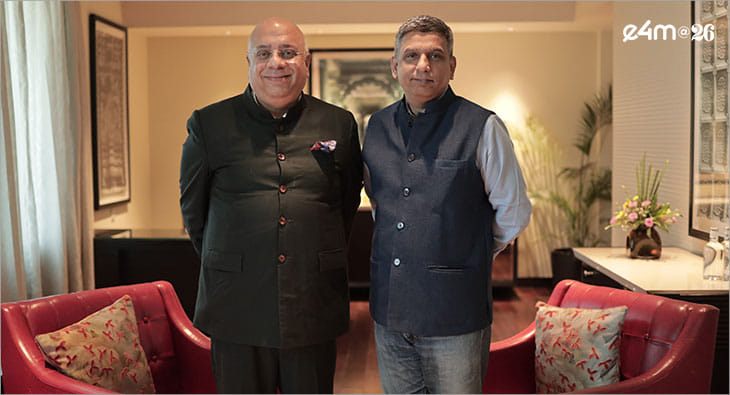

Three decades ago, a media planner was the last person in the room. You got five minutes at the tail end of a client meeting, a handful of TV channels to work with, and just enough time to present a plan before the creative agency reclaimed the floor. Kartik Sharma, CEO of Omnicom Media India, remembers those days well, and the distance between then and now is precisely the lens through which he reads the transformation currently reshaping the media services industry.
That transformation, accelerated sharply over the last 18 months, has converged with a landmark corporate development. In early 2025, the global merger between Omnicom Group and the Interpublic Group (IPG) was completed, creating one of the largest marketing services conglomerates in the world. In India, the merged entity has been rechristened simply as Omnicom Media, a deliberate shedding of the 'Group' suffix that Sharma reads as a statement of intent. "We dropped the word 'Group', and we have now become Omnicom Media again, reflecting the simplicity of what we want to stand for," he says.
Speaking in a wide-ranging conversation with Dr. Annurag Batra, Chairman and Editor-in-Chief of e4m Group & BW Businessworld, Sharma offered a rare inside view of what it means to steer a newly merged media giant through a market that is changing faster than at any previous point in the industry's history.
A board conversation, not a back-room plan
The foundational shift in how Sharma frames the media agency's role is this: media planning has migrated from a tactical function to a boardroom conversation. India's advertising market, which the Pitch Madison Advertising Report and GroupM's This Year Next Year have both pegged at consistent double-digit growth (somewhere between 10% and 12% annually), is no longer driven solely by legacy FMCG advertisers. A new generation of SME and D2C brands has entered the ADEX, with various estimates placing the SME advertising opportunity at ₹40,000 to ₹60,000 crore. "If you take a midpoint like ₹50,000 crore, that's humongous — it's almost 60-70% of what the entire industry itself is," Sharma points out.
As more brands seek public listing and investor scrutiny intensifies, the media budget conversation has grown in complexity. CFOs and boards now want to understand the elasticity of marketing spend, which means the media agency is no longer just advising on reach and frequency but on capital allocation. "Media planning is just not a media planning question alone, but more a marketing question," Sharma says. "You are looking at a much larger window of what you are influencing in the client's business."
The scope has expanded accordingly. Omnicom Media today offers services across planning, buying, data, technology, content, and sports, a full-funnel capability that Sharma argues is no longer optional. Clients no longer want to manage five different agency relationships for what is, from the consumer's perspective, a single brand. "The consumer is seeing one brand, so why can't we offer the same thing?" he asks. "Wherever we have deployed solid integrated teams, you are seeing fantastic results."
The merger 90 days in: More than the sum of its parts
The Omnicom-IPG merger is one of the most significant consolidations in the history of the global advertising industry, and its Indian chapter has moved with notable speed. Omnicom Media now commands close to a 26-27% share of the Indian media agency market, positioning it as a strong number two player. The anxiety that typically dogs large M&As (client churn, cultural friction, talent flight) has, in Sharma's telling, been largely absent.
"The last 90 days have been phenomenal. I met a lot of clients on both sides: the old Omnicom Media Group clients and also some of the IPG clients, and there is a lot of positivity that I'm picking up," he says. "The talent at both companies is amazing. When we were standalone, IPG was a very strong, worthy competitor. Now I'm seeing both companies come together, and it's fascinating."
On the subject of layoffs, which generated considerable media commentary in the months following the merger announcement, Sharma is measured but unequivocal. He acknowledges that some optimization of duplicated roles has occurred, consistent with standard M&A practice, but is emphatic that the merged entity is playing offence, not defence. "This is a growth merger. India is a high-growth market, both at the GDP level and within the ADEX," he says. "None of the client-facing teams have faced any disruptions." He adds that Omnicom's global leadership, including Group Chairman John Wren, has consistently backed India as a top-three market within the APAC portfolio.
Omni: The platform that runs the whole show
At the centre of Omnicom Media's differentiation story is Omni, its proprietary operating platform. Built over 11 to 12 years, Omni is not a recent AI pivot but a long-term infrastructure investment that Forrester has rated best-in-class for integrated offering for three consecutive years. The platform connects briefing, audience creation, media mix modelling, optimization, ideation, and execution: all accessible to both agency teams and client collaborators in a single environment. "Think of Omni like a super app," Sharma says. "You come from a brief to ideation to optimization — you have everything."
The merger has supercharged this further. IPG's proprietary data infrastructure, through Acxiom (widely regarded as the world's largest data and technology company), has now been integrated into the platform. In India specifically, Acxiom holds approximately 520 million unique digital IDs and information on around 915 million individuals, with each identified user carrying 120 to 150 data attributes. The practical implication is a dramatic improvement in targeting accuracy: where lookalike modelling on third-party platforms typically yields match rates of 30-40%, Omnicom Media's deterministic approach via Acxiom delivers match rates of 80-82%. "Imagine what it means to actually pinpoint, for a particular cohort, exactly how many credit cards they hold on average, and have the client confirm it is bang on with their own observation data," Sharma says, recounting a recent demonstration for a financial services client.
Layered on top is Omni Assist, an embedded generative AI engine with multiple plugins that delivers localized consumer insights at a scale and speed that Sharma describes as "absolutely mind-boggling." Omnicom's AI task force was established globally nearly four years ago, making it an early mover on what has only recently become an industry-wide conversation.
Proving the value: From GRPs to business outcomes
The shift from output metrics (GRPs, reach, frequency, impressions) to outcome metrics is perhaps the most consequential evolution in how the media agency's value is measured. The tool at the centre of this shift is what Omnicom calls Agile MMM (Agile Market Mix Modelling), a more dynamic evolution of traditional econometric modelling that enables near-real-time reads on the impact of media investment across business variables.
"If I increase my budget from 100 to 120, what will be my impact on business — on market share, value share, volume share, or leads? We are able to share that with an above 90% degree of accuracy," Sharma says. In fast-moving categories like auto, where Omnicom Media has a strong client portfolio, this translates into forward scenario planning: a client can model multiple budget allocation options before committing, and optimize media mix against a defined business target.
Brand building in the age of performance
The binary framing of brand versus performance advertising has become something of a false dichotomy in Indian marketing circles, driven in large part by the rise of well-funded D2C startups that have leaned heavily on performance channels. Sharma pushes back on the idea that this signals a structural shift away from brand investment, arguing instead that it reflects the constraints of a specific business phase.
"From zero to some place is relatively easy with performance, but zero to infinity is a different ballgame," he says. "The best brands want to create value forever. And that is where you need brand advertising." His argument draws on consumer neuroscience, which consistently demonstrates that purchase decisions are emotional in origin even when they appear rational. Sharma is equally candid about the D2C phenomenon. He sees it as a genuine innovation that’s "phenomenal for consumers, because you are trying new categories and new brands with new propositions," but warns that the influencer-heavy, performance-first playbook will eventually hit a ceiling. The influencer economy in India is currently valued at ₹2,500 to ₹3,500 crore and growing at 20-25% annually, per INCA's India Influencer Marketing Report estimates, but scale beyond a certain threshold demands the brand equity that only sustained above-the-line investment can build.
Culture, trust, and the consultant question
The entry of management consultancies (McKinsey, Accenture, Deloitte) into the marketing services space has been a recurring anxiety for traditional agencies. Sharma is unfazed, framing the relationship as complementary rather than competitive. "Execution is not easy in any business," he says. "The experience and insight of what to do and what not to do — that is not going anywhere."
Where Sharma draws a sharp line is on trust and professional integrity. "Clients come to us with their hard-earned money. We give them advice that is really going to help them," he says. "When you come to Omnicom, their money is almost in a vault; it will only be deployed with thorough, data-backed, professional advice." He draws an analogy to investment banking: the difference between a good bank and a great one comes down not just to technical skill but to the integrity with which it handles a client's capital.
"Culture is not something you write in a pillar statement," he adds. "It is the actions you take, the behaviours you demonstrate. If it's not showing in your behaviour, it's meaningless." His approach to leadership has evolved accordingly: from an early-career instinct to do everything himself, to a coaching model that prioritizes building leaders around him. An early stint at Ogilvy left him with a mantra he has carried ever since: always recruit people who are better than you.
As for what comes next, Sharma is characteristically understated. The ambition to become market leader is stated plainly but without zero-sum framing. "Having two very strong, close competitors is good fun," he says. "Everyone needs to grow, because that's when the industry will grow."
For a man who has watched Indian media evolve from a handful of TV channels and a few print titles to a 200+ day cricket calendar and a ₹50,000 crore SME advertising opportunity, the optimism reads as earned. The industry he helped build is now being rebuilt again, and Sharma seems to be enjoying every moment of it.
Read more news about Internet Advertising India, Marketing News, PR and Corporate Communication News, Digital Media News, Television Media News
For more updates, be socially connected with us onInstagram, LinkedIn, Twitter, Facebook YouTube & Google News
