The Creative Question: Can brands be buzzy and brainy at the same time?
Harikrishnan Pillai, TheSmallBigIdea's CEO & Co-Founder, believes brands must move at the speed of culture without losing their soul, balancing viral moments with long-term value creation
 by
by
Published: Jan 28, 2026 8:26 AM | 8 min read
 Follow Us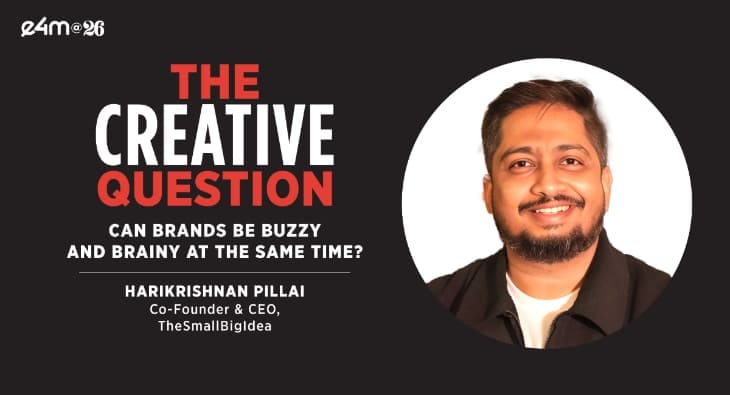

In an industry often focused on quick wins and viral moments, Harikrishnan Pillai, CEO & Co-Founder of TheSmallBigIdea, offers a more grounded perspective on what truly builds brands. His agency, which began in the entertainment sector and now works across BFSI, FMCG and e-commerce, has seen brand building evolve in pace and execution, rather than in its underlying fundamentals.
Entertainment has always operated on momentum, with television delivering weekly verdicts and films judged every Friday. Brands, however, functioned differently. The model was episodic, centred on one large campaign per quarter, with social media used largely for maintenance.
“What's changed is not the fundamentals of brand building, but the cadence,” Pillai explains. “Brands now understand that long-term equity is created through long-term consistent presence. Every touchpoint matters, across platforms, formats, and cultural moments.”
This shift has elevated social media from a support channel to a primary brand-shaping environment. Frequency, relevance and cultural fluency now matter as much as the big idea. When building a brand for a specific community, the question is no longer what is said once every three months, but whether the brand is speaking the community’s language every day. “If they need to cut through the social noise of entertainment, creators and users, they need to think of everyday as the new brand event,” Pillai says.
This constant presence has made brands more creatively bold. Earlier, there was a clear divide between polished television films and simplified social adaptations. Today, those boundaries are increasingly blurred, as brands behave more like entertainment – responsive, culturally aware and confident in tone.
Data as creative fuel, not handcuffs
TheSmallBigIdea’s proprietary tool, ACE, blends data and social insights to inform creative decisions. Pillai is quick to clarify that this does not represent a departure from traditional thinking. “Data is not a new entrant to creativity. Advertising has always been informed by research, first-party data, consumer studies, and cultural insights. Gut and gumption played a role, but ideas were never created in a vacuum.”
What has changed is access and velocity. Information now updates in near real time, making the feedback loop faster and more visible. At its best, data enhances creativity in practical ways. If a particular format or narrative is resonating, it would be imprudent not to lean into it. “Data gives gut some fuel,” Pillai says.
The risk arises when data is viewed in isolation. Optimising purely for reach may deliver scale but dilute impact; reach without reaction is merely noise. The same applies to engagement: a spike in comments is only meaningful if there is clarity on who is engaging and how. The quality of participation matters far more than quantity. As data becomes more granular, it brings brands back to creative fundamentals, sharpening instinct and making it more effective.
The illusion of visibility without viability
In an environment where clients increasingly seek quick results and viral hits, Pillai identifies two distinct types of marketers. One recognises that virality can buy attention, but that attention alone rarely builds anything durable. This group pursues virality with commercial discipline and a clear focus on brand salience. The other treats virality as an outcome in itself, rather than as a tool.
“You often see this when a new CMO comes in,” Pillai observes. “They suddenly spend aggressively on celebrities, big flashy films, high-decibel launches, a lot of influencer campaigns and for a couple of years, everything looks great on the surface. Then the numbers don't move, the sales don't follow, and suddenly that CMO is gone.”
What typically follows is a return to a quieter, more disciplined, fundamentals-driven approach. It may appear less glamorous to the industry, but it is often far more effective. The agency works extensively with celebrities and high-visibility properties, so this is not an argument against celebrity partnerships. Rather, it is about asking the right question: does the money being invested make sense relative to what can realistically be achieved?
The most telling failures occur when brands invest in massive, multi-celebrity campaigns that people remember for the moment, but not for the brand. “At that point, it's not marketing investment, it's just capital burn dressed up as marketing ambition,” Pillai says. His advice is clear: don’t just chase attention—pursue commercial prudence. Visibility without viability is an expensive illusion.
Turning buzz into brand equity
Managing celebrity and influencer ecosystems requires recognising that buzz is a short-term measure of value. On its own, it is fleeting. It only becomes meaningful when embedded within a larger, coherent strategy. Strong brands have traditionally maintained character: while new campaigns might be released every few months, there is always continuity in tone, values and point of view.
“What we should really be seeing is frequent bursts of communication, not frequent changes in identity,” Pillai explains. Brands run into trouble when they start adopting the influencer’s personality. When the brand shifts to match the creator’s style, rather than having the creator operate within the brand’s world, the result feels disjointed and inauthentic.
The solution is simple: think in Venn diagrams. One circle represents what the brand stands for, the other the influencer – their voice and audience. The overlap is the common language, and that is where collaboration should happen. Operating in this overlap ensures the influencer’s audience does not feel sold to, while the brand’s identity remains intact. This is how frequency can be scaled without diluting identity, and how buzz can compound into genuine brand equity.
“The success of a brand campaign is not determined on LinkedIn, but really with social listening, awareness graphs, recall and sales MIS,” Pillai adds.
Moving at the speed of culture
For brands seeking to remain culturally relevant at all times, Pillai proposes a Venn diagram framework. One circle represents the trend, the second what the brand wants to communicate, and the third the brand’s core idea. The work should only exist where all three intersect. If that overlap is absent, the idea should be abandoned or scaled back. Not every trend warrants a major campaign; some are better tested as lightweight social posts.
“The size of the creative response should always match the depth of relevance,” he says. Cultural relevance cannot be ad hoc; it must be embedded in the brand’s operating system. The organisation needs clarity on why it engages with trends, ensuring every action is rooted in the brand’s DNA. Finally, trend-led work should be evaluated like any other brand investment: the resources allocated to creators and cultural moments should compound value over time.
Pillai does not view the tension between virality and consistency as a generational issue. “I don't actually see this as a young-versus-old marketer problem. I see it as a mindset issue, prudent versus delusional,” he states. Flamboyant marketers chase buzz, while prudent marketers pursue understanding. The smartest recognise that it is possible to be both buzzy and brainy.
Building ecosystems that compound
As TheSmallBigIdea expands across India and global markets, Pillai’s vision for a strong, brand-equity-led digital ecosystem is clear. It begins with the quality of the community, not just engaged audiences, but engaged, transacting audiences. People who interact in conversations on social media and choose to transact with the brand. The loop between conversation and commerce is critical.
Every piece of content should expand the brand’s cultural footprint, attracting new audiences. Strong word of mouth and credible reviews become the norm. Over time, the ecosystem should reduce reliance on discounting. “If, two or three years in, consumers still choose you even when you're not offering exaggerated incentives, that's brand equity in action,” Pillai notes.
There is also an internal indicator. In a strong ecosystem, the marketing head is not constantly reacting to competitors or chasing the latest trend. There is confidence in the playbook, a clear point of view, and the discipline to build on it rather than abandon it. “When all of this comes together, you're no longer running campaigns, you're operating an ecosystem that compounds trust, relevance, and business value over time,” Pillai concludes.
In an industry often distracted by the next shiny object, Pillai’s philosophy offers a timely corrective: move at the speed of culture without losing the soul of the brand. The brand must always remain the hero, with the creative device serving as the vehicle. If your special song becomes bigger than the movie, you have not created a hit, you have lost the plot.
Read more news about Internet Advertising India, Marketing News, PR and Corporate Communication News, Digital Media News, Television Media News
For more updates, be socially connected with us onInstagram, LinkedIn, Twitter, Facebook YouTube & Google News