From leading clients to chasing transformation
Guest Column: Shveta Singh, senior marketing and advertising professional, reflects on how the media industry witnessed a slow yet seismic shift over the decades
 by
by
Published: Jan 19, 2026 3:02 PM | 4 min read
 Follow Us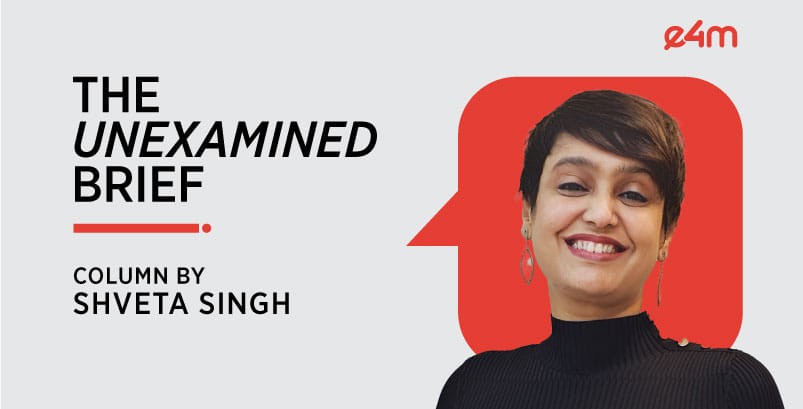

The advertising and media industry, we all know, has undergone a slow yet seismic shift over the decades. If one was to summarise the evolution arc, it has moved gradually from ‘Mad Men’ to ‘Maddening Chaos’.
There was a time when network agencies liked to believe they led clients intellectually, creatively, and strategically. Today, many of them are chasing transformation instead. Network agencies nowadays resemble a bride who arrived late to her own wedding, wearing her grandmother’s dress, altered and patched up to look new. The problem isn’t the dress. It’s the lateness and the panic of trying to look current without significant newness.
So, what interrupted the dream run of the untouchable masters of brand building? Why is the industry now in a constant state of flux?
1. Eyes Wide Shut
We have all witnessed the incredible pace of change in the ecosystem and consumer behaviour thereof. Starting with the advent of digital, followed by social media, walled gardens, data, martech and now AI. The agencies have always been slow in grasping the implications of these changes. By the time they realise, adopt and try to adapt, the ecosystem moves to the next big thing. Call it a structural lag or inertia mixed with comfort, the industry prefers a state of blissful ignorance.
2. Creatively Uncreative
When was the last time agencies authored a genuinely new way of marketing or the logic governing it? The agencies once originated the dominant models of marketing but post the golden age, the industry has only been pushed into adopting ways of marketing defined by others. Whether it is market access systems like programmatic and performance, consumer decision models like The Messy Middle, or attribution frameworks like DDA, all were conceptualised by platforms, consultancies, or technology ecosystems. The industry’s thinking monopoly on brand and marketing has faded.
3. The Unknown Devil
How does one compete with what one does not understand? The competition for an agency is not just other agencies. It’s platforms, consultancies, ecommerce, in-house teams. Each one of these now pulls agencies in incompatible directions. Platforms are driving democratisation and commoditisation of creativity and media, the consultancies stand for premiumisation and high-value strategic advice, ecommerce pushes for thinking like a business owner, and in-house teams for accountability. Agencies, on the other hand, trained to buy media and sell creativity, are now struggling to straddle all these additional roles.
4. Lost in translation
Agencies originated with the DNA of big ideas and impactful campaigns. The clients, however, have moved from saying, "Half the money I spend on advertising is wasted; the trouble is, I don't know which half." to demanding certainty and efficiency. So, the agencies have accepted measurable proxies, vanity and misleading metrics. Metrics didn’t just measure work, they reshaped creativity. Agencies stopped backing ideas they couldn’t fully defend with data. Consequently, creative leadership somewhere is getting lost in safe to do and easy to report ideas.
5. Outsider Inside
Real transformation is only possible when intent is backed by the right talent and skills. We have seen the rise of the specialists in marketing – from martech to ecommerce and from data to performance. This outside talent is under-represented in the agency ecosystem, where it matters. They don’t clearly fit into the traditional agency structures. So even when these specialists are acquired, they often end up staying like outsiders on the fringes, rather than empowered drivers of the new-age business agenda. Isn’t that indicative of why integration keeps failing in most cases?
The erstwhile masters of brand building didn’t lose power because of one single disruption. The issue is multidimensional as we see. The industry was consistently late to adopt, followed a tick-box approach to the new and continues to look at the new with old filters.
The ‘Why’ of agencies has changed. Yet we witness an inability to let go. Why an agency exists and what role it plays in the current environment should not be saddled with the baggage of what worked in the past. The real question agencies should be asking is,
“What should we not be?”
What if it is unrealistic for the industry to try to be and do everything it aspires to? Maybe the answer lies in making hard choices and redefining what an agency stands for. It is time the agencies made some trade-offs. Otherwise, the industry will keep reacting because it refuses to choose and call that reaction transformation.
Disclaimer: The views expressed here are solely those of the author and do not in any way represent the views of exchange4media.com.
Read more news about Marketing News, Advertising News, PR and Corporate Communication News, Digital News, People Movement News
For more updates, be socially connected with us onInstagram, LinkedIn, Twitter, Facebook, YouTube & Google News