If you have a market growth idea, align every other function behind that: Harit Nagpal
The Tata Play MD & CEO spoke to Dr Annurag Batra, Chairman & Editor-in-Chief of e4m Group & BW Businessworld on why CMOs are losing the CEO race, what's killing creative ambition in advertising & more
 by
by
Published: Apr 7, 2026 9:19 AM | 11 min read
 Follow Us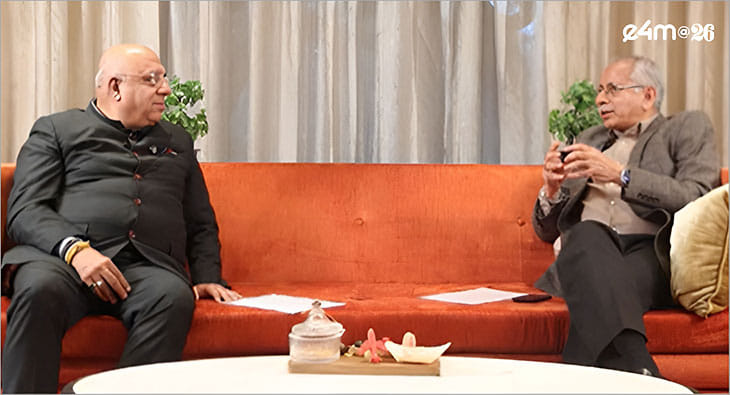

There is a certain irony in the fact that one of India's most enduring media CEOs spent the first decade of his career pointedly avoiding the marketing function. "I said, look, I need to learn how to shoot before I get a license to kill," Harit Nagpal, MD & CEO of Tata Play, told Dr Annurag Batra, Chairman & Editor in Chief of BW Businessworld, in a wide-ranging conversation on leadership, advertising, and the future of media in India. "I saw marketing as a license to kill and sales and operations roles as shooting practice."
It is a metaphor that reveals a particular philosophy, one that has defined Nagpal's 16-year tenure at the helm of what was once Tata Sky and is now Tata Play. That stint, combined with his earlier career across telecom and FMCG, has given him an unusually broad vantage point: part marketer, part operator, part disruptor, and, increasingly, part educator. The conversation with Dr Batra ranged across subjects that are, in many ways, the defining tensions of the Indian advertising and media industry today, and Nagpal did not shy away from any of them.
The CMO-to-CEO problem
The data, as Dr Batra pointed out, is uncomfortable for the marketing community. While less than 5% of CMOs in India are making it to the CEO's chair, over 20% of CFOs do, and that number is trending upward. For a function that ostensibly sits closest to the customer and, therefore, closest to the business, it is a puzzling gap.
Nagpal's diagnosis is blunt: siloisation. "We are celebrating heroes and not celebrating organisational victories," he said. "I am aware of a situation where the marketing guys planned a campaign which led to a huge spurt in demand. But the other functions of the company were not aware of this campaign. The company fell short of making the product available for the demand that came in, and they missed the season. But the marketing guys were celebrating the award they won for the fantastic campaign they put together."
The prescription follows pretty logically. A CMO who wants the corner office cannot afford to operate purely within the marketing function. "Get out of your silo," Nagpal said. "If you have a market growth idea, then align every other function behind that growth. As a colleague, not as a leader. Start with that. If you do that well, there is no reason why the people above you will not see you as a potential CEO."
The single quality that separates a high-performing CMO from a CEO-ready one, in his view, is the shift from a revenue lens to a P&L lens. His own second stint as a CMO was transformative precisely because of this shift. "In my first stint, I was looking at life from a sales and revenue perspective. In the second stint, I was also looking at life from a P&L perspective. And that made all the difference." His advice to the CMO-minus-one watching from the sidelines: collaborate, align, and repeat. "Align every other function: the production guys, the supply chain guys, the IT and technology guys, the CFO. Everybody."
The advertising industry's fragmentation problem
When Dr Batra asked what had changed in advertising that Nagpal finds most concerning, the answer came from the perspective of a long-standing client and it centred on the erosion of agency backbone.
"There is a little more quarterly focus," Nagpal observed. "You are using advertising not to build long-term value, at least that's the client's desire today." This, by itself, is not new. But what has changed, he argued, is that the agencies no longer have the size or the spine to push back. "In the last 20 to 30 years, the agency side has gotten so beautifully fragmented. First, the media and creative sides separated. And then within creative, there are so many small fragments: I am for performance marketing, I am for social marketing, I am for this, I am for that. Each component has become so small that they are unable to challenge the client."
The result is visible on screen. "Most of the creatives I see on television today, or on YouTube or wherever, I can see that this line was written by a CEO, not by a creative person." It is a damning indictment, and one that echoes a broader industry anxiety. According to the Pitch Madison Advertising Report 2024, television advertising revenues in India declined by approximately 5% in 2023, even as digital ad spends grew by over 15%. The pressure on traditional media ad budgets is compressing agency fees, which in turn compresses talent, which in turn compresses creative ambition. It’s a cycle that Nagpal sees playing out in real time.
He invoked Tata Play's own long-standing relationship with its creative agency as a countermodel. "They knew how to be creative, and that's why they were hired. We let them be. The client only gave a brief and did not push back at the agency when it came up with something. We said, we know our business, you know your business. You let us run our business, and we let you run yours." The iconic Vodafone pug campaign, he noted, was an agency creation, not a client brief dressed up as an idea.
On the question of whether consolidation (the bundling of creative, media, performance, and digital under one roof that several holding companies are attempting) offers a way out, Nagpal was cautiously optimistic. "There is a move building up around us towards all of it. I hope that gives the agencies a little bit of spine to push back on clients. Because it has been a while since we saw a Hamara Bajaj-type creative come out."
Television, OTT, and the 40-rupee-to-4-rupee problem
If the advertising industry conversation was animated, the media economics discussion was forensic. Nagpal has been one of the more consistent voices arguing that the television-is-dead narrative is overstated, but he also has the clearest articulation of why television advertising revenues are suffering despite the medium's continued reach.
The core of his argument is a pricing displacement, and it is one the industry has been slow to name plainly. When telecom operators bundle linear TV content into their broadband and mobile plans at bulk rates, a broadcaster who was receiving the equivalent of forty rupees per subscriber from a DTH operator ends up receiving four to six rupees per subscriber from the telecom bundle. "The customer has not stopped watching content," Nagpal said. "But it has actually transported a Rs 40 revenue to the broadcaster kind of a customer to a 4, 5, 6-rupee revenue to the broadcaster kind of a customer. For which the customer is not paying anything additional. He's saved 50 rupees."
The same logic applies to connected TVs, where, he noted, only a small percentage of users are paying subscription fees for what they watch. Most are on YouTube (free, user-generated) or on apps bundled with broadband connections. The eyeballs are there. The revenue is not. "If the reach of television goes down because people have started to watch it for free along with a telephone connection or a broadband connection, then advertising revenue will also suffer."
The solution, in his view, is not regulatory; it is commercial. "The way the owners of content start to understand this equation, they will at least start charging the same price to both sides. Either reduce that for television or increase that for the bundle. Once there is parity across, this is a commercial decision." It is a calibrated ask, and one that the broadcasting industry has been lobbying for through various TRAI consultations without significant movement.
On the broader question of OTT versus television as the site of cultural conversation, Nagpal was characteristically systematic. He used the analogy of personal vehicles and public transport: both co-exist, both serve different needs, both continue to grow. "Just as the proliferation of cars, scooters, and motorcycles has not stopped the train and the bus from growing, television and OTT will co-exist. People will continue to pay less for the bus ticket, and more for the car, and both will have riders."
Aggregation, attention, and the Vinge bet
Tata Play's response to the changing content landscape has been to double down on its identity as an aggregator, not a content producer. This is a deliberate strategic choice in a market where everyone from Reliance to Sony to the telcos is trying to own the content stack. "We are a provision store," Nagpal said, with characteristic directness. "I buy things in bulk and sell them in small packets to my customers; packets made as per their need and requirement."
The aggregation play has evolved. Tata Play Binge, the company's OTT aggregation platform, was built on the insight that the content discovery problem (which app is this on?) is the primary friction point for today's viewer. "We created that about five years ago. First, when television was the technology of the times, we were aggregating TV and making the user interface convenient. Now, we're aggregating apps." The company is also reportedly working on a navigation interface that will allow users to reach their preferred channel in one click and one second from switch-on.
On the question of content quality, Nagpal pushed back on the attention-span narrative that has become something of a received wisdom in media circles. "Customer attention span is not reducing. A person who scrolls through reels does not scroll through one reel; they go on for hours. When he sits down in a dark hall and watches a film for three and a half hours with just a small toilet break, where is his attention span then? If you produce a compelling story, the customer will sit and watch it." He added, with some amusement, that his own intention when sitting down to watch OTT content in the evening is typically two episodes, and he routinely ends up watching four or five.
On leadership, knowledge work, and renting talent
The final arc of the conversation turned to leadership, an area where Nagpal's thinking is shaped as much by practice as by the two books he has written. His view on tenure is counterintuitive for someone who has held the same role for sixteen years: longevity matters less than legacy. In his first twenty-five years across sales, operations, and CMO roles, his average tenure in any single position was 1.7 years.
"It is not the number of years that you spend. What you do in those years is more important. Are you leaving a legacy? Are you leaving a footprint which somebody can take on from where you have left and build on it? Or have you not left a framework?" The question he asks of every role and every leader is whether they have created institutional value or merely individual glory.
On the question of freedom versus accountability in knowledge-era organisations, Nagpal drew a sharp distinction between industrial-age management and what talent actually requires today. "We have moved away from the industrial age to the knowledge era. Knowledge economy does not work in shifts; it needs space. I don't know when the idea will come to me." The framework he uses at Tata Play separates whiteboard time (when the team is physically together, debating and arriving at a common meeting point) from lone working time, which can happen anywhere, at any hour, on any schedule. "Some people are night workers. Some people are day workers. Our working time can be flexible. Our common working time needs to be at our joint availability."
When asked what he looks for when hiring business leaders or CMOs, Nagpal's answer was notable for what it excluded. "I have never looked at skill. I have always looked at curiosity level and ability to handle ambiguity." The third quality: the ability to build, motivate, and mobilise teams. "Skills are easy to achieve. But these are constants. If you have the curiosity to learn more, if you have the ability to handle ambiguity — because ambiguity is not going to reduce, it's only going to increase — then I think you will survive through anything."
For the marketer eyeing the corner office, his parting line was precise and unsparing: "Marketing will become a CEO pathway again when CMOs learn to look at the whole business and not just demand creation."
Outside of Tata Play, Nagpal has quietly begun a parallel life as a teacher, spending his Saturdays at a management institute, teaching strategy and disruption, correcting assignments, and setting papers. "We always keep saying that the institutes are not producing quality graduates as they used to. My question is: what has the industry done to help that?" It is, in miniature, the same logic he applies to everything else: if the system is broken, don't just diagnose it. Build a framework someone else can build on.
Read more news about Marketing News, Advertising News, PR and Corporate Communication News, Digital News, People Movement News
For more updates, be socially connected with us onInstagram, LinkedIn, Twitter, Facebook, YouTube & Google News