Reach is no longer enough. Outcomes are becoming very important: Anil Goel, Nielsen CTO
Anil Goel, Global CTO of Nielsen, talks about how AI is compressing decades of technological change into months and reshaping business fundamentals
 by
by
Published: Jan 17, 2026 8:40 AM | 7 min read
 Follow Us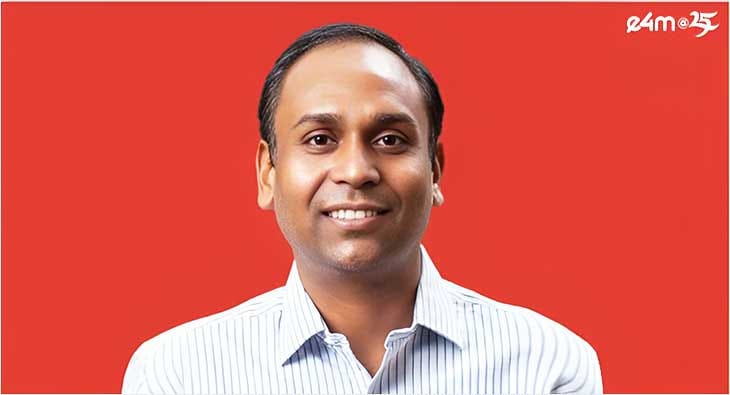

When Anil Goel looks back at nearly three decades in technology, he does not describe progress as a straight line. He describes it as compression. Decades of change are now unfolding in years, sometimes months. Speaking to e4m, the Global CTO of Nielsen frames today’s inflection point with clarity. “We have gone from rule-based automation to capabilities that can potentially leapfrog human abilities,” he says. For businesses, this acceleration is not just technological. It is structural.
Goel’s perspective is shaped by timing. He entered the industry in the mid-1990s when the internet itself was new and digital presence was the goal. Today, computing sits in the pocket, content follows the consumer, and artificial intelligence is rewriting how decisions are made. “AI will continue to drive significant improvements in everything humans need,” he says, pointing not just to software but to robotics and autonomous systems that could fundamentally improve quality of life.
Yet beneath this speed, some fundamentals remain unchanged. Businesses still need customers. Brands still need attention. What has changed is how fractured that attention has become, and how poorly many marketing systems are equipped to deal with it.
The fragmentation marketers still underestimate
From Nielsen’s vantage point, sitting on one of the world’s largest viewing datasets, the single biggest shift between 2024 and now is not a platform or a format. It is fragmentation at scale. Media consumption has moved far beyond the living room. Content now flows across smart TVs, linear broadcast, mobile phones, laptops and an almost infinite universe of apps and websites.
“Ten years ago, most consumption happened on TV,” Goel explains. “Today, you are consuming content everywhere.” With user generated content exploding, audiences are no longer choosing between hundreds of channels but navigating billions of content options. Younger audiences in particular have rewritten the rules. “Gen Z’s attention span is very small,” he says. “Gone are the days of 30 or 60-minute viewing sessions.”
This behavioural reality has created a widening gap between how audiences consume media and how marketers still plan budgets. Traditional brand advertising was built for linear environments. Performance marketing grew up in search and measurable digital channels. Today, those lines are collapsing. A 30-second video can go viral and deliver tens or hundreds of millions of impressions, but it does not sit neatly in either bucket.
“How do you plan brand marketing in such fragmented environments?” Goel asks. The problem is not just inefficiency. It is a misallocation at scale.
Measurement gaps and value leakage
Fragmentation has created opportunity and waste in equal measure. On one hand, brands can now reach micro audiences defined by behaviour rather than blunt demographics. On the other hand, large portions of consumption remain under measured or poorly tagged, leading to value leakage.
Goel believes behavioural targeting is the unlock. Instead of age, gender or geography, advertisers can increasingly define audiences by what they actually do. “You can say I want to target users who play a certain kind of game or watch certain shows because they are more relevant to my brand,” he says.
The business impact of this shift depends on the product. For mass products, the gains are incremental but meaningful. Even FMCG brands today are fragmenting into health focused, protein rich or ingredient specific segments. A chips buyer is no longer just a chips buyer. For niche categories, the upside is exponential.
Goel offers a vivid example. Luxury real estate targeting buyers above a certain price point makes little sense on mass media. Behavioural signals from premium dining, high end content consumption or specific digital habits are far more powerful. “For them, ROI increase could be even 10x or more,” he says, because they are replacing broad waste with precision.
Creators blur the old hierarchies
The rise of the creator economy has further complicated measurement. Goel rejects simplistic narratives that pit creators against traditional publishers. Instead, he describes a spectrum. At one end are creators operating at studio scale, generating millions in revenue with production sophistication rivaling legacy players. At the other are individuals filming on their phones and reaching highly specific communities.
“The lines are blurring,” he says. What matters is not the label but the audience. Why are they watching? Who are they? What makes the content relevant? Nielsen’s role, Goel argues, is to provide insight at both macro and micro levels so advertisers can understand attention across this spectrum rather than guessing its value.
Real time data as a monetisation lever
If fragmentation is the problem, real time measurement is increasingly the solution. Low attention spans mean that post campaign analysis is often too late to inform decisions. “If you know behaviour based on what has already played, you may not predict what comes next,” Goel says. This is why Nielsen is investing heavily in real time capabilities.
The returns are tangible. Goel points to recent large scale sports measurement work in India where monetisation outcomes increased by tens of millions of dollars. He stops short of sharing exact figures but the implication is clear. Optimisation driven by real time audience intelligence can deliver 10 to 20 percent lifts and in some cases multiple fold improvements.
For platforms and advertisers, this reframes measurement from a reporting function to a revenue engine.
Outcomes over impressions
Perhaps the most important shift Goel calls out is philosophical. For decades, reach and frequency defined success. In an AI driven, commerce connected ecosystem, that is no longer enough. “Outcomes are becoming very, very important,” he says. “How many people saw something matters, but what behaviour did it drive.”
Did the exposure lead to a purchase? Did it drive content consumption? Did it change intent? Nielsen is increasingly focused on linking audience exposure to real world actions, moving measurement closer to business impact rather than media metrics.
This shift aligns with the rise of AI agents and automated planning systems. With billions of content choices, human decision making alone cannot keep up. “Most decisions will be made by AI,” Goel says, from programmatic buying to annual budget allocation. Measurement systems must therefore be designed not just for human interpretation but for machine optimisation.
Privacy as competitive advantage
All of this unfolds against a tightening privacy landscape. India’s DPDP framework, alongside GDPR and California regulations, represents a reset for data driven industries. For Nielsen, Goel frames compliance not as disruption but as continuity. “Privacy first is our DNA,” he says.
Operating across more than 50 countries has already forced the company to build security centric systems. Additional compliance requirements will increase investment, particularly around audits and filings, but Goel is clear that the real risk is not financial penalties. “How do you survive if you lose trust from customers?” he asks. In a world where data access is constrained, trust becomes the most valuable currency.
The intelligence layer of modern media
Goel closes with a simple but ambitious vision. Nielsen wants to be the media intelligence authority for the world. Wherever content is consumed, however it is distributed, the company aims to provide insight that helps creators create better content and advertisers reach the right audiences.
In an era defined by fragmentation, automation and accelerating choice, measurement is no longer a back-end function. It is a strategic lever. As Goel puts it, the industry is no longer just counting eyeballs. It is trying to understand meaning, behaviour and outcomes. For marketers navigating 2026 and beyond, that distinction may define who grows and who gets left behind.
Read more news about Marketing News, Advertising News, PR and Corporate Communication News, Digital News, People Movement News
For more updates, be socially connected with us onInstagram, LinkedIn, Twitter, Facebook, YouTube & Google News