Most brands understand India's new consumers, but few are building for them: Gunjan Khetan
At Pitch CMO Summit 2026, Perfetti Van Melle India’s Gunjan Khetan discusses how the growing influence of artificial intelligence is reshaping the way consumers engage with brands
 by
by
Published: Jun 8, 2026 1:59 PM | 4 min read
 Follow Us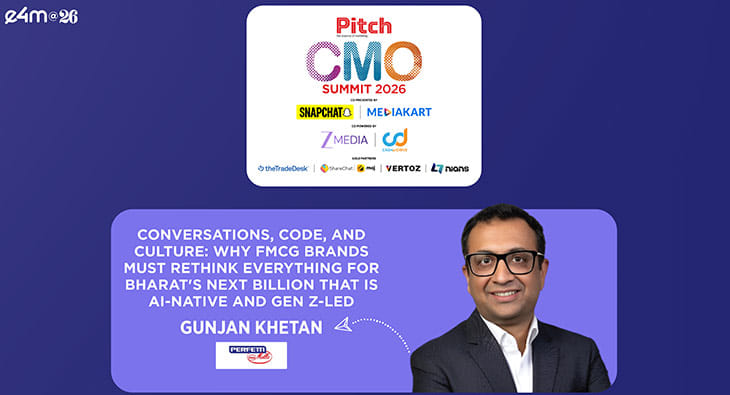

- Gunjan Khetan, Director of Marketing at Perfetti Van Melle India, emphasizes the need for brands to adapt their marketing strategies to engage consumers in Tier 2, Tier 3, and rural India, as well as digital-first communities and younger generations.
- He highlights that traditional campaign planning is misaligned with modern consumer behavior, where discovery and validation of products increasingly occur through social media and AI-driven platforms.
- Khetan introduces the "Three Cs" framework—Conversation, Code, and Culture—to guide brands in understanding and connecting with consumers in a more meaningful way, advocating for hyper-personalized interactions.
- He cites Perfetti Van Melle's successful Center Fresh campaign as an example of leveraging consumer insights to create culturally relevant marketing, stressing that growth lies in creating culture rather than merely participating in it.
As brands chase growth in India's urban centres, the next wave of consumption is already taking shape elsewhere, according to Gunjan Khetan, Director - Marketing, Perfetti Van Melle India, who believes marketers must rethink how they engage consumers across small towns, digital-first communities and younger generations.
Speaking at the Pitch CMO Summit 2026, Khetan argued that traditional campaign planning models are increasingly out of sync with the way consumers discover, validate and purchase products today.
"The next billion opportunity is sitting in Tier 2, Tier 3 and rural India," Khetan said. "These are people who are living and breathing your brand without you even knowing about it."
According to Khetan, India's consumption story is no longer defined solely by metropolitan markets. The rapid spread of smartphones, affordable data and rising aspirations has created a new class of consumers who are digitally connected and actively shaping brand conversations.
Alongside consumers in smaller towns, Khetan identified first-generation internet users and Gen Z and Gen Alpha audiences as the three groups marketers need to understand most deeply.
"These consumers are discovering, engaging and purchasing products differently. They trust their feeds, their communities and even their algorithms more than they trust our advertising," he said.
The shift is creating a more fragmented customer journey, where consumers discover products on social feeds and AI-powered platforms, validate choices through creators and communities, and then decide whether to buy online or offline based on convenience and value.
"They are not bound by channels. They are bound by experiences," Khetan noted. "If your brand is not present at the right moment, in the right form, for the right customer, on the right platform, then you are probably present in only half the conversation."
The growing influence of artificial intelligence is also reshaping how consumers encounter brands. Referring to recent developments in AI-driven content consumption, Khetan said marketers must recognise that discovery is increasingly happening through algorithmic recommendations and AI-powered experiences.
Consumers, he argued, now expect hyper-personalised interactions throughout their journey because technology has conditioned them to expect products, services and content tailored to their specific needs.
Yet despite widespread awareness of these changes, Khetan believes many organisations remain slow to adapt.
"While many brands understand these consumers, only a very small percentage are actually planning for them and designing for them. That gap is either a massive opportunity or a significant threat," he said.
To bridge that gap, Khetan proposed what he called the "Three Cs" framework: Conversation, Code and Culture.
He described conversation as understanding how consumers communicate across languages, dialects, contexts and communities rather than relying on messaging crafted solely within agency boardrooms.
"It is important for brands to engage consumers in the language they understand, not in a language that was crafted in a boardroom in a remote corner of Mumbai or Delhi," he said.
The second pillar, code, focuses on using technology as a creative and distribution tool rather than treating AI, data and machine learning as functions reserved for technology teams.
"AI, data and machine learning are no longer just the realm of the IT team. These are now tools in the hands of brand managers," Khetan said.
The final pillar, culture, centres on helping brands move beyond reacting to trends and instead actively shaping them.
"It is important for brands to move from a culture-fit perspective to a culture-first perspective, creating moments of culture rather than trying to fit into moments of culture," he said.
Khetan pointed to Perfetti Van Melle's Center Fresh campaign, the India Overthinking Report, as an example of the framework in action. The initiative tapped into a behavioural insight around overthinking among younger consumers while connecting it to the brand's freshness proposition.
Because the campaign was rooted in a strong consumer insight, Khetan said it generated significant earned media, user-generated content and brand participation beyond paid advertising.
For marketers navigating an increasingly complex media landscape, Khetan's message was clear: growth will come from understanding how India's emerging consumers communicate, discover and engage rather than relying on traditional channel-based marketing approaches.
"The opportunity is not just to participate in culture," he said. "The opportunity is to create culture."
Read more news about Marketing News, Advertising News, PR and Corporate Communication News, Digital News, People Movement News
For more updates, be socially connected with us onInstagram, LinkedIn, Twitter, Facebook, YouTube & Google News