A New Blueprint for Marketing Leadership: Owning the Brand, Voice and Customer Experience
Sumeet Chunkhare, SOBHA Ltd., explores whether today's leaders are ready to own more than marketing and why the future belongs to leaders shaping brand, voice and customer experience
 by
by
Published: Jul 23, 2026 3:15 PM | 6 min read
 Follow Us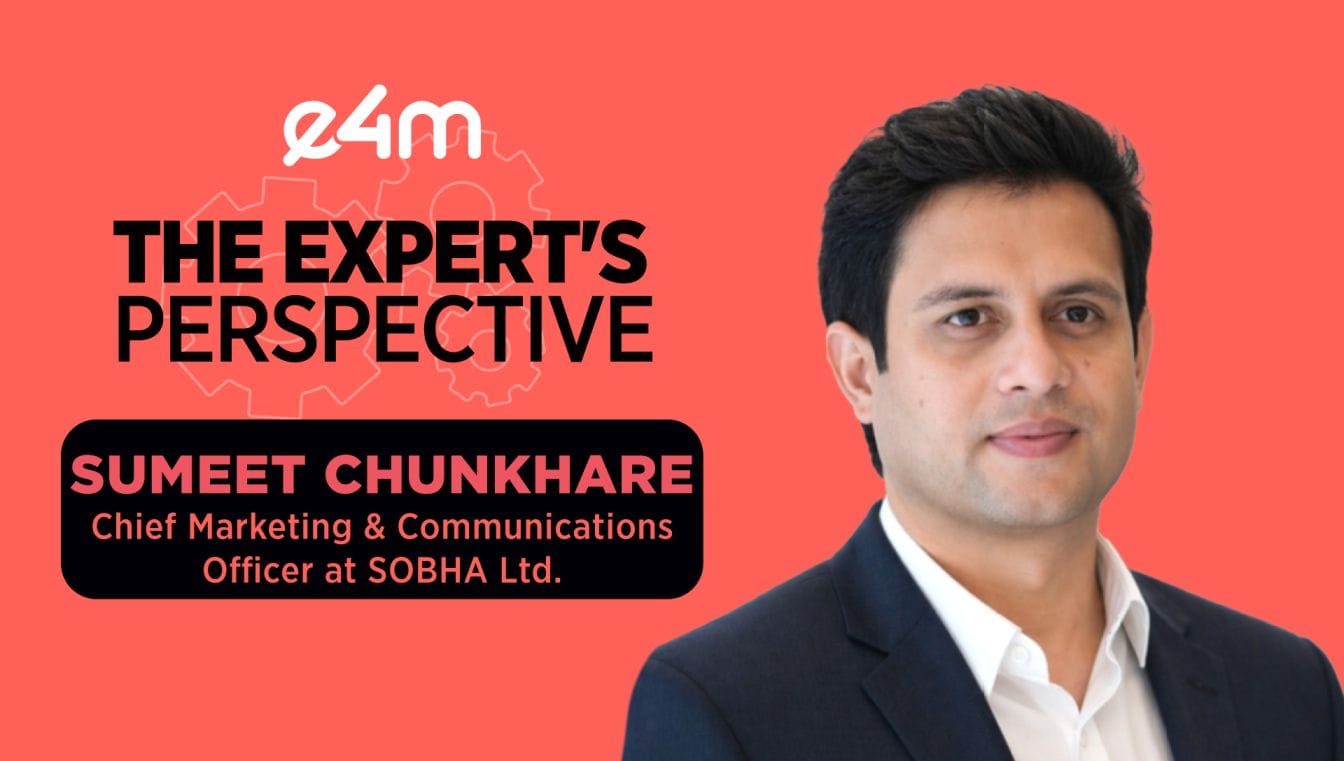

- The role of marketing communications leadership, particularly for CMOs, has evolved to encompass the integration of marketing, corporate communications, and customer experience into a unified brand strategy, especially in the post-pandemic landscape.
- This shift is driven by the need for consistency across multiple customer touchpoints, particularly in sectors like real estate and luxury, where brand perception is influenced by various interactions rather than single advertisements.
- Future leaders in this space will be evaluated on their ability to connect different functions, act quickly with sound judgment, communicate authentically, and take broader accountability for outcomes traditionally managed by separate departments.
- Artificial intelligence is emerging as a key tool for enabling integrated leadership, enhancing decision-making, ensuring messaging consistency, and facilitating personalized customer interactions while maintaining the human touch essential for high-value purchases.
Marketing communications leadership has evolved into one of the most strategic functions within an organisation. For a long time, the role of the CMO and communications leader was largely centred on managing campaigns, shaping brand positioning and driving communications strategy. While these priorities remain, the post-pandemic business landscape has significantly expanded the mandate. Today's marketing leaders are expected to integrate marketing, corporate communications and customer experience into a unified brand strategy. The next generation of leaders in this space will be judged less on how well they managed individual functions and more on how effectively they connected functions that once operated in silos to build a unified brand, voice and community. This evolution is also being accelerated by artificial intelligence, which is emerging as a powerful enabler of integrated communications, data-driven decision-making and consistent brand experiences across every customer touchpoint.
That shift is already visible in how the CMO role itself is being redefined. Increasingly, the mandate is not just marketing, but aligning marketing, corporate communications and customer experience into a single, coherent effort. In a market that is evolving as quickly as this one, with customers forming perceptions across a brand's advertising, its media positioning, its social media presence and its actual service delivery, a CMO managing only one of these levers is managing a fraction of the brand.
Why Real Estate and Luxury Brands Feel This First
This convergence is particularly visible in real estate and luxury sectors, where purchase decisions are shaped by multiple touchpoints rather than a single advertisement. A prospective homebuyer may read analyst commentary, explore media coverage, review customer experiences and interact with sales teams before making a decision. If a brand's messaging promises exclusivity and craftsmanship, but the actual experience suggests otherwise, the inconsistency is immediately apparent.
Luxury brands, whether in real estate, hospitality or premium consumer goods, rely on consistency across every interaction. A strong advertising campaign can quickly lose impact if the customer experience or public narrative falls short.
The next generation of leaders understands that luxury is not built through a single channel but through a consistent experience across all channels. This is why marketing, communications and customer experience can no longer operate in isolation.
One Narrative, Every Touchpoint
This is where unified messaging becomes the discipline that holds everything together. A customer today moves fluidly between a brand's website, its social media presence, a news article, a sales conversation and a service call, often within the same week. If each of these tells a slightly different version of the brand story, the customer notices the gap even if they cannot articulate it. Unified messaging means ensuring that every audience, regardless of which touchpoint they encounter first, receives the same cohesive narrative about who the brand is and what it stands for.
This is harder than it sounds. Websites go stale, social calendars run ahead of corporate announcements, and regional teams sometimes localise language in ways that drift from the parent narrative. Getting this right requires treating consistency as an ongoing discipline rather than a one-time exercise, with company websites, social platforms and every other communication channel reviewed and updated regularly so that no touchpoint is telling yesterday's story to today's customer.
What the next generation will be measured on
A few capabilities are likely to define the next wave of leadership.
The first is fluency across disciplines rather than deep expertise in a single function. Future leaders do not need to manage every aspect of communications, marketing or customer experience themselves, but they do need enough understanding to connect these functions and ask the right questions when priorities diverge.
The second is speed paired with judgment. In an environment where narratives can shift within hours, waiting for lengthy approval processes is no longer practical. Successful leaders will be those trusted to act quickly while exercising sound judgment.
The third is authenticity over polish. Today's audiences are quick to recognise when a brand's messaging does not align with its actions. Leadership will increasingly favour those who communicate with honesty and transparency, even when the message is imperfect, over those pursuing a flawless but less credible narrative.
Finally, leaders must be comfortable with broader accountability. Reputation, customer retention and service quality increasingly intersect, regardless of organisational structures. While some companies are redefining roles as Chief Experience Officer or Chief Brand Officer, titles matter less than a willingness to own outcomes that were once considered the responsibility of separate departments.
AI as the Enabler of Integrated Leadership
Artificial intelligence is becoming the connective layer that enables integrated leadership at scale. Used well, it does not replace judgment—it strengthens it. Predictive analytics can identify shifts in customer sentiment before they become reputation challenges, while real-time monitoring tools help leaders act on insights far more quickly than before.
AI also helps ensure messaging consistency by flagging gaps between website content, social media communication and sales conversations, making it easier to keep every channel aligned. On the customer engagement front, AI can support more personalised interactions through relevant content and faster responses, while preserving the human touch required for high-consideration purchases like a home.
While AI cannot replace the instincts needed for a crisis or customer conversation, it reduces the effort involved in piecing together fragmented information, allowing leaders to focus on strategy, decision-making and delivering a consistent brand experience across every touchpoint.
Building for a market that is changing rapidly
Customers no longer experience a company through a single department. They experience it as one continuous impression, built from an advertisement seen last week, a news article read yesterday, a social media post viewed this morning and every interaction in between. Leaders who continue to manage these as separate workstreams, reporting into separate teams with separate goals, will find themselves constantly navigating inconsistencies rather than building trust.
The next generation of marketing communications leadership will not be defined by louder campaigns or cleverer taglines. It will be defined by the discipline of alignment and the intelligent use of technology in service of that alignment, ensuring that what a brand says, what is said about it, and what a customer experiences are always the same story, told well and told consistently. In categories like real estate and luxury, where trust is the product being sold as much as the offering itself, this alignment is not a differentiator anymore. It is the baseline expectation, and the leaders who understand that first will be the ones setting the pace for everyone else.
Read more news about PR and Corporate Communication News, Internet Advertising, Marketing News, Digital Media News, People Movement News
For more updates, be socially connected with us onInstagram, LinkedIn, Twitter, Facebook YouTube & Google News