Restructuring the Media Ecosystem: The CDC Framework
L.V. Krishnan, CEO, TAM Media Research, in conversation with Shripad Kulkarni on the ecosystem architecture needed to manage the funnel that collapsed into one device—and the 650,000+ brand explosion
 by
by
Published: May 7, 2026 8:42 AM | 7 min read
 Follow Us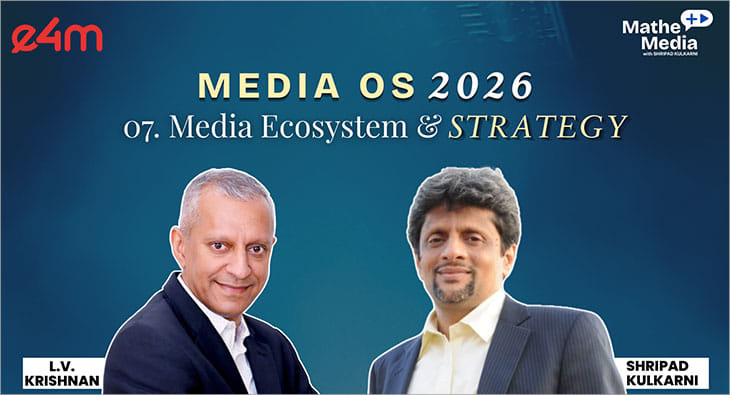

- India now has approximately 650,000 active brands in advertising, a significant increase from around 200,000 a decade ago, primarily driven by digital-first brands entering the market.
- The majority of new advertisers (90%) are utilizing digital platforms, benefiting from reduced costs and the ability to target consumers more precisely.
- The consumer journey has been transformed by smartphones, which integrate social media, payment, and commerce, leading to shorter campaign durations and a need for brands to adapt quickly to changing consumer behaviors.
- L.V. Krishnan advocates for a CDC (Content, Communication, Data) structure in advertising organizations to effectively respond to the fast-paced market and consumer needs, emphasizing the importance of real-time data and integrated strategies.
India now has approximately 650,000 active brands advertising across media. A decade ago, that number was around 200,000. The advertiser universe has tripled. But the number alone does not tell you what changed.
L.V. Krishnan, CEO of TAM Media Research, reads this data every week — 25 years of continuous measurement across every platform in India. What LV, as we in the industry fondly call him, is reading right now should prompt a structural rethink at every brand, every agency, and every media company. Not someday. This year.
The Long Tail Has Arrived
The tripling of the advertiser universe was not driven by large incumbents multiplying. It was driven by a long tail of nimble, digital-first, low-overhead brands flooding in through a door that was previously too expensive to open.
“If you look at just the number of brands — around close to 650,000. Which was at one time probably in the range of around 200,000. So it’s a three-time explosion. The first-time advertisers have moved from around one or two percent to something like around close to 12 to 15 percent. And 90% of them are on the digital platform.”
- L.V. Krishnan
Ninety percent on digital. That is not a coincidence. It is because the cost floor dropped.
“The cost per person personalisation is actually getting reduced. So earlier, you had a certain budget in mind that the advertiser needed to come to get onto any particular platform. Today, it can start from bottom.”
These new entrants move fast. They target precisely. They spend small and appear right next to an established brand at the exact moment of purchase. The planning model built for a manageable universe of national brands with predictable budgets and established platform relationships is gone. The top 20% of advertisers still account for roughly 50% of total ad spend — and those accounts get personalised counsel and bespoke strategy. The remaining 80% will increasingly be served by AI agents managing their budgets with minimal human intervention. That is already the direction the industry is moving.
One Device. Three Funnels. One Consumer.
What the new entrant is exploiting is something L.V.’s data makes precise. The smartphone has collapsed the consumer journey.
Among 15–30 year olds, smartphone penetration in India sits at 95%. That segment — the one setting consumption trends — has, on one device, access to social media for influence, a mobile wallet for payment, and a commerce site for purchase. Three sections of the traditional marketing funnel, collapsed into a single connected device.
“When I have all three funnels getting filled up by one single device, the galvanising of content by content makers, as well as communication from advertisers, are all getting piped into that particular platform.”
The result is a consumer who is not moving through stages. She is moving through moments. Campaign bursts that used to run for eight weeks are now compressing to four or five. The pace of consumer change is outrunning the planning cycles most brands are still operating on. The brand building its next-quarter plan on last year’s consumer understanding is not just behind — it is planning for a person who no longer exists.
The challenge is no longer access. It is architecture.
The Answer: CDC
“I see this entire media getting moved into a CDC structure. Content, communication and data — all integrated, all connected.”
This is not a planning tool. It is an organisational blueprint. Three elements. Each with one job.
Content earns attention regardless of platform. Audiences gravitate toward good content the way shoppers find the best store in a crowded mall — without being directed there. The ball is in the court of the content creator, not the platform.
“As long as you’ve got the content right, the mall will be filled with people going towards that particular store. They’ll find it some way or the other.”
Communication must be simple, direct, and solution-providing. The consumer is moving fast. She has no time to decipher what a brand is trying to say.
“People don’t have time to think through what you’re trying to say. So, they need direct communication. Do this, you’ll get this.”
Data is the connective tissue that makes the other two work. The consumer is spending over six hours a day on a mobile device. The brand that reads those signals in real time — and shows up at the closest moment to the purchase decision — wins.
“Today, with the intrusion of digital and the device being mobile — where over six hours of time is being spent on a single day by an average consumer — presence of brand at the closest moment when the purchase decision is being created is what matters. I can’t do long-term communication because he doesn’t have the time. The quickness with which I can take this very emotional connect with my brand is the key.”
But CDC is not three separate disciplines. It is one integrated function. The three cannot sit in separate departments handing briefs to each other.
“The structure that one has to put in place — whether it’s a media company, an agency, a broadcaster — those three fragments of the organisation should be the content, communication and data set-up side.”
The strategy is straightforward. The restructuring is not.
What CDC Looks Like in Practice
LV is not only a theorist of this framework. He has practised it. A brand came to TAM being outspent on share of voice, asking what to change before a campaign re-burst. LV’s team applied neuroscience to the creative — tracking attention and emotional response as consumers watched the ad.
“We used neuroscience in this entire exercise. Three things came out. One: the communication had a star but the star was coming in probably in the fifth or sixth minute — bring that lady up front so that the attention goes from the very first second. Two: you need to verbalise that communication, rather than just doing it in the video. Three: the branding need not always come at the end — when your key proposition is being made, bring the branding straight away upfront. So we could collapse that entire communication from 30 seconds to almost around 10 to 12 seconds.”
The result: The attribution was direct and measurable. Within the same budget, the brand achieved much better message registration with double the share of voice of its competition. This is what CDC looks like in practice — not as a framework on a slide, but as a working methodology that produces outcomes.
Plan for the Person Who Will Exist
The numbers are already telling this story. The advertiser universe has tripled. The funnel has collapsed into a single device. Campaign windows are shrinking. The long tail is moving faster than the incumbent can plan.
The brands that respond are the ones that separate two questions most plans still conflate.
“It’s very important to segregate the planning as well as for attribution, what you want to do for the future from what you want to do for the present. How has the consumer moved in the last one and a half years — and therefore how is it expected to move in the next one and a half years? Develop plans and a measurement suitable to him based on this focus.”
Present planning and future planning are two different exercises. The brand that conflates them will keep optimising for a consumer who no longer exists. The one that separates them — and builds the CDC architecture around where the consumer is going — is the one that compounds.
LV is simply the first to read them.
L.V. Krishnan is a contributor to the Media OS 2026 Report, examining how Indian advertising is being rebuilt from the ground up. This piece has been curated by Shripad Kulkarni based on the conversation for the MatheMedia Podcast Series.
Read more news about Marketing News, Advertising News, PR and Corporate Communication News, Digital News, People Movement News
For more updates, be socially connected with us onInstagram, LinkedIn, Twitter, Facebook, YouTube & Google News
