The new rules of customer centricity: Trust, convenience and personalization
At the Pitch CMO Summit 2026, Milind Shah, Varun Sethuraman and Vivek Malhotra debated how empathy, data, and bold ideas are rewriting the rules of customer centricity
 by
by
Published: Jun 5, 2026 7:35 PM | 6 min read
 Follow Us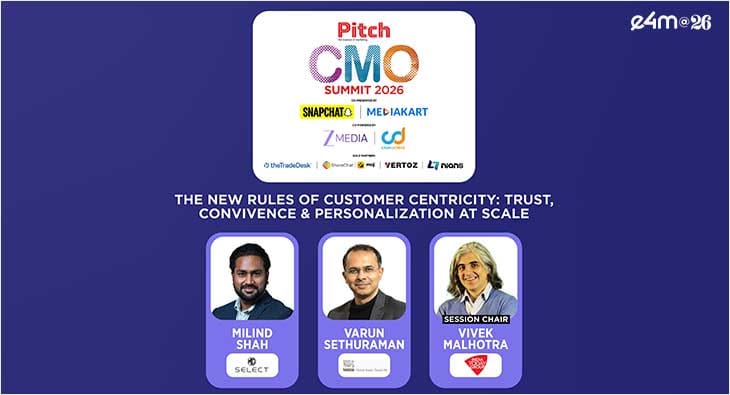

- The final Fireside Chat at the Pitch CMO Summit 2026 featured Milind Shah from MG Motor India and Varun Sethuraman from Nestle India, discussing customer centricity, trust, and personalization in marketing.
- Shah emphasized the shift in consumer behavior, highlighting the need for brands to engage in meaningful conversations rather than mere transactions, and to focus on technology and innovation in the automotive sector.
- Sethuraman contrasted this by stressing the importance of long-term consumer relationships and the need to refresh brand narratives for newer audiences, particularly Gen Z, through relevant campaigns.
- Both speakers underscored the significance of understanding consumer insights and measuring brand equity, with Shah advocating for practical innovation in marketing strategies.
Few conversations at the Pitch CMO Summit 2026 were as wide-ranging or as candid as the final Fireside Chat that brought together Milind Shah, Head of MG Select at JSW MG Motor India, and Varun Sethuraman, Head of Marketing Communications at Nestle India. Moderated by Vivek Malhotra, Group CMO and COO Strategy at the India Today Group, the session, themed ‘The New Rules of Customer Centricity: Trust, Convenience and Personalization at Scale’, covered everything from showroom philosophy to Gen Z passion points, and from snack-time nostalgia to the art of practical innovation.
Malhotra set the tone early by framing both speakers as representatives of two very different but equally instructive worlds: one bringing technology and personalisation to a legacy sector like automobiles, the other building enduring emotional equity around some of India's most iconic FMCG brands. The opening remarks cut straight to the point. "All of us are dead without consumers," said Sethuraman. "And so is the cash register." Shah was equally direct: "The only way to be distinct is to focus on how we really have a conversation with the customer. Once we have cracked doing not a sales but a conversation with the customer, that's where you as a brand have a unique point to win your competition."
The conversation quickly moved to how the nature of the consumer relationship has shifted. Shah, drawing on his expertise in the automobile segment, observed that the luxury car buyer of a decade ago was motivated almost entirely by badge value. "People used to buy a BMW, a Mercedes, an Audi — irrespective of whatever the product was," he said. "Many of them didn't even know the product name." That era, he argued, is decisively over. Today's buyer walks into the showroom already informed, sometimes, he noted wryly, more so than the consultant on the floor.
MG Select's response has been to reimagine the retail environment entirely, modelling it on an art gallery: minimalist, uncluttered, and designed to feel like a home. "We have taken the concept from our history — Atithi Devo Bhava," Shah said. "How do you treat the person who walks in as a guest and not a customer?" The goal, he explained, is to move from a transactional interaction to a genuine conversation: "When a customer comes in, he just wants to have a conversation with someone and wants a tick box that the decision he has made is correct."
On the technology front, Shah was unapologetic about MG's edge. "The consumer is not looking only for a car with an engine. What they want is new-age technology," he said, pointing to the brand's early moves to bring internet connectivity and autonomous electric vehicles to the Indian market. "The engine and the space inside the car are given. What is that unique thing I will get? What is that other driving right I will have among my peers?" The answer, he suggested, lies in staying ahead on technology and consistently combating what he called brand fatigue among consumers of traditional luxury labels.
Sethuraman offered a counterpoint rooted in longevity rather than novelty. At Nestle, the relationship with the consumer is measured not in product cycles but in decades. "It's like a relationship over a long period of time," he said. "Even the existing ones, like Maggi — I'm sure across the room, you had a Maggi a decade back, you will have a Maggi now, you'll possibly have a Maggi a decade later." The challenge, he explained, is not to reinvent the relationship but to keep narrating it freshly. "Some stories are evergreen. You keep repeating them to a new set of audience, with the messaging being the same, the platform and the medium differing." For newer consumer cohorts, however, the approach changes: "For a Gen Z, that could be entertainment with a passion point."
That insight directly informed some of Nestle's most talked-about recent campaigns. The KitKat-Spotify collaboration (built around the brand's core proposition of a ‘break’) invited consumers to break the loop in their listening habits. "It's a simple idea," Sethuraman said. "You listen to a lot of music. KitKat is here, and the whole proposition of KitKat is about a break. So why don't you take a break from what you usually listen to?" Similarly, a Maggi and Uniqlo merchandise tie-up and a KitKat association with anime franchise One Piece reflected the same logic: identify a genuine consumer passion point, find where the brand has a relevant point of view, and marry the two.
On the question of measurement, Sethuraman was systematic. Nestle tracks brand equity scores consistently, monitors imagery statements (whether consumers perceive a brand as fun, cool, or innovative) and runs pre- and post-campaign brand lift studies with partners. "When consumers do think about a brand, what do they think of? Or if they have a certain need out of a category, is our brand sitting at the top of that?" he said. "We keep measuring that movement over time."
Shah, meanwhile, described MG Select's campaign Select Art as proof that community-building can be as powerful as any media spend. The initiative invited artists to submit work for a year-long display inside MG Select showrooms, creating content both on-ground and digitally. "It's not about showcasing the car," he said. "It's more about talking about why they are creating art, what the stories of their life are, and how they are projecting art in our place." The ambition is to grow it into the country's largest art community.
As the session drew to a close, Malhotra asked Shah for a final word of advice to marketers entering the field. His answer was a critique of how the industry currently thinks. "Most marketers in today's time are talking medium — let's do television, let's do print. That is advertising. That is all the ideas about money spending," he said. "Think about an idea. Think about a campaign idea. How can you talk to your consumer in the language that the consumer wants? You will find out multiple ways — TV, print, that is the medium." His broader counsel was to stay curious and to pursue what he called practical innovation: "What is that smart move I can do which is practically possible to implement? It's not just about thinking about an idea which is 10,000 feet above. It has to have arms and legs to execute."
Read more news about Marketing News, Advertising News, PR and Corporate Communication News, Digital News, People Movement News
For more updates, be socially connected with us onInstagram, LinkedIn, Twitter, Facebook, YouTube & Google News