The next CMO must think like a CEO: Haier India’s N S Satish
N S Satish, President, Haier Appliances India, took stage at e4m Pitch CMO Summit to decode modern CMO’s role and how marketing today is at the intersection of consumer insight & product innovation
 by
by
Published: Jun 5, 2026 1:29 PM | 3 min read
 Follow Us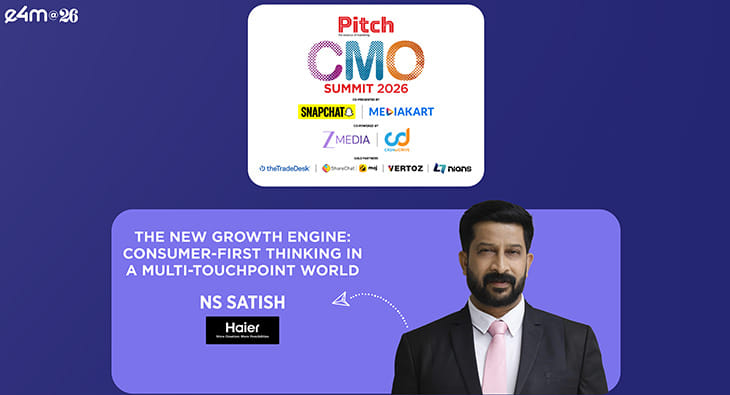

- N S Satish, President of Haier Appliances India, emphasized at the e4m Pitch CMO Summit that future CMOs must evolve beyond traditional brand custodianship to understand various aspects of business, including customer insights, product innovation, and financial management.
- He highlighted the shift in brand perception, urging marketers to view themselves as problem solvers rather than mere product sellers, exemplifying this with the need to provide solutions like cooling or comfort rather than just selling appliances.
- Satish pointed out the non-linear consumer journey today, where customers are informed through multiple channels, and stressed the importance of addressing negative feedback for innovation and enhancing after-sales service to build brand loyalty.
- He warned that organizational agility is crucial in a rapidly changing market, stating that legacy leaders must adapt by being open to learning and unlearning, as past successes can hinder future growth.
At the e4m Pitch CMO Summit, N S Satish, President, Haier Appliances India, delivered a keynote that was less about marketing campaigns and more about the making of a future business leader.
His message to CMOs was clear: the marketing leader of tomorrow cannot remain only a brand custodian. To move towards the CEO’s chair, the CMO must understand the customer, the P&L, the product, the service promise, the channel, and the speed at which consumer behaviour is changing.
Satish’s address was personal, raw and deeply grounded in the realities of running a consumer business. He moved from stories of customer complaints to quick commerce, from D2C disruption to product design, from his own career in rural markets to conversations with younger consumers and interns.
At the heart of his keynote was a powerful shift in thinking. Brands, he suggested, must stop seeing themselves as sellers of products and start seeing themselves as solvers of consumer problems.
“You can’t think you are selling a refrigerator. You have to think you are providing a cooling solution or keeping the food fresh,” he said. “You are not selling an air conditioner. You are in the business of keeping the customer comfortable at his house.”
For Satish, this is where the modern CMO’s role becomes larger than communication. Marketing today sits at the intersection of consumer insight, product innovation, service delivery, digital commerce and business growth. The CMO who understands only campaigns will remain limited. The CMO who understands the business can become a CEO.
He pointed out that the consumer journey is no longer linear. Earlier, a customer would walk into a dealer store and depend heavily on the salesperson. Today, the consumer arrives with information from YouTube, social media, e-commerce reviews, family WhatsApp groups and peer recommendations.
“The customer today goes everywhere. You cannot anticipate where he will go and what he will do. You have to ensure every checkpoint is ticked,” Satish said.
He also spoke about how Haier studies negative reviews, both of its own products and competitors, to understand what customers are really struggling with. Those complaints, he suggested, often become the starting point for innovation.
One example was the washer-dryer category, where consumers dislike long four-hour cycles. Haier, he said, is working on reducing drying time significantly because the real problem is not the machine, but the consumer’s need for convenience.
Satish also underlined the importance of after-sales service in brand building. In categories such as kitchen appliances, downtime can immediately disrupt a household. That is why, he said, Haier does not sell hobs in every city. The company first ensures it has the service capability to support the product.
The larger lesson was about agility. Satish warned that as companies become bigger, processes and policies can make them slower. In a market shaped by D2C brands, quick commerce and digital-first discovery, that can be dangerous.
“If you don’t have agility in your organization, you are dead,” he said.
Perhaps the most striking line of the keynote was also the most uncomfortable for legacy leaders: “Experience is a deterrent.”
But Satish did not use it cynically. He used it as a reminder that past success can become a blind spot. The next generation of marketing leaders, he argued, must be willing to learn, unlearn and listen more closely.
His keynote ultimately reframed the CMO’s role. The future CMO is not just the person who builds the brand. The future CMO understands the customer deeply enough to influence product, service, commerce, growth and P&L.
That is the CMO who can become CEO.
Read more news about Marketing News, Advertising News, PR and Corporate Communication News, Digital News, People Movement News
For more updates, be socially connected with us onInstagram, LinkedIn, Twitter, Facebook, YouTube & Google News