India won't be shaped by one big trend: PepsiCo's Saakshi Verma Menon on snacking paradox
At the Pitch CMO Summit 2026, PepsiCo India Foods CMO Saakshi Verma Menon unpacked why India's snacking market rewards only those who think local first
 by
by
Published: Jun 5, 2026 6:29 PM | 4 min read
 Follow Us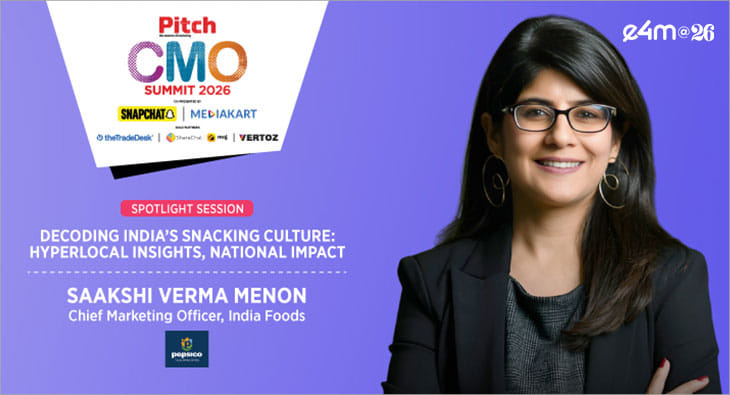

- Saakshi Verma Menon, CMO of India Foods at PepsiCo, addressed the Pitch CMO Summit 2026 on the complexities of India's diverse snacking culture, emphasizing the need for localized strategies in a fragmented market with over 3,000 snack brands.
- She outlined a dynamic equation for snacking choices in India, which includes cultural influences, contextual factors, and consumer needs, highlighting the importance of understanding these nuances for effective marketing.
- Menon identified five macro trends reshaping Indian snacking: experiential fun, the significance of crunch as a sensory indicator, flavor stimulation influenced by regional chili varieties, the reinvention of traditional snacks, and a shift towards mindful indulgence with cleaner ingredients.
- She concluded that India's snacking landscape will not be defined by a single trend but will evolve through a multitude of localized insights reflecting the country's rich culinary diversity.
At the Pitch CMO Summit 2026, Saakshi Verma Menon, Chief Marketing Officer, India Foods, PepsiCo, took the stage for a Spotlight Session that was equal parts data-driven and deeply intuitive. Her topic, "Decoding India's Snacking Culture: Hyperlocal Insights, National Impact," drew from PepsiCo's on-ground experience navigating a market that, as she put it, "just refuses to homogenize."
Menon opened by framing the central paradox that food marketers in India grapple with every day. "In a country where you have thousands of snacking cultures, 31 cuisines, 1,000-plus regional dishes, and 3,000 branded snacks players, it's really critical to know how brands win," she said. "There is no one food truth, there is no one food insight, and therefore the biggest challenge continues to remain: how do I build locally and scale nationally?"
Her answer to that challenge rested on two pillars: understanding consumer behaviour and building the right portfolio. First, she introduced what she called the dynamic equation at the heart of every snacking choice in India: culture, context, and need. "Every snacking choice is a negotiation," Menon explained. "In the North and West, there is a strong Mughal, Rajputana, and Marwari cultural influence. In the South, it is very local, very regional — the Pandyas, the traditions. It becomes so culturally different that your food habits, the taste, the palate, the spices — all of that changes."
Overlay on that the context of when, where, and with whom someone is eating, and then the underlying need (fuel, mood shift, social connection), and the equation becomes, in her words, "very complex." "If you don't understand this equation that deeply and in that nuanced manner, you will struggle," she said. "There is no one-size-fits-all solution when it comes to snacking."
Moving to portfolio strategy, Menon walked the audience through five macro trends reshaping Indian snacking. The first was experiential fun: consumers are no longer satisfied with a static eating experience. "Format is like a new flavor," she said. "Consumers have moved from dry to wet, from static to interactive." Flavor, too, has expanded from simple linear descriptors to what she called adventures, "spicy, sweet, global mashups." Texture, she argued, has become theater. "The crunch, the cream — it was not this nuanced in snacking decades ago."
The second trend she highlighted was the sound of crunch, which she treated as a distinct sensory language. "India snacks literally with all its senses," she said. "Crunch means satisfaction. It's a signal that what I'm having is fresh, good quality, good ingredients." Drawing on her own household as an example (she is from the north, her husband from Kerala), she noted that definitions of crunch vary sharply by region, and that PepsiCo has deliberately designed for this, with Lay's offering a sharp, clean crunch, Kurkure a hard, intense one, and Kurkure Puff Corn an airy variant.
Flavor stimulation was the third trend, anchored in a striking fact she shared: India has 400 distinct chili varieties. "As a marketer, I should know that when you say you want something with chili in it, you could all be meaning very different things," she said. "Taste is a cultural code. Every time you taste something, it triggers memory, belonging, nostalgia."
The fourth trend, reclaiming tradition, captured a broader cultural shift. "Tradition isn't fading. It's being reinvented," she said. "There is a lot of pride in being regional." PepsiCo has responded with products like ‘Lay's Mini Stix’, a contemporary take on the aloo lachha, and a new ‘Kurkure Solid Masti’ offering inspired by traditional gathiya, launched in recent months.
The fifth and final trend was mindful indulgence. "Indulgence is now intentional. Guilt has moved to permission," she said, adding that consumers are seeking cleaner ingredients, greater transparency, and both global and locally rooted notions of better-for-you snacking.
Menon closed by returning to her central argument. "India won't be shaped by one big trend," she said. "It will continue to scale through millions of small truths, because the consumer in the snacking category is so influenced by the food palette of this country, which honestly is as diverse as it can get."
Read more news about Marketing News, Advertising News, PR and Corporate Communication News, Digital News, People Movement News
For more updates, be socially connected with us onInstagram, LinkedIn, Twitter, Facebook, YouTube & Google News