From corporate voice to corporate compass: The rise of communications leaders
Sujit Patil, CCO, Godrej Industries Group, talks on communications' journey from the sidelines to the strategy table and the future of communications leadership
 by
by
Published: Jun 29, 2026 11:00 AM | 11 min read
 Follow Us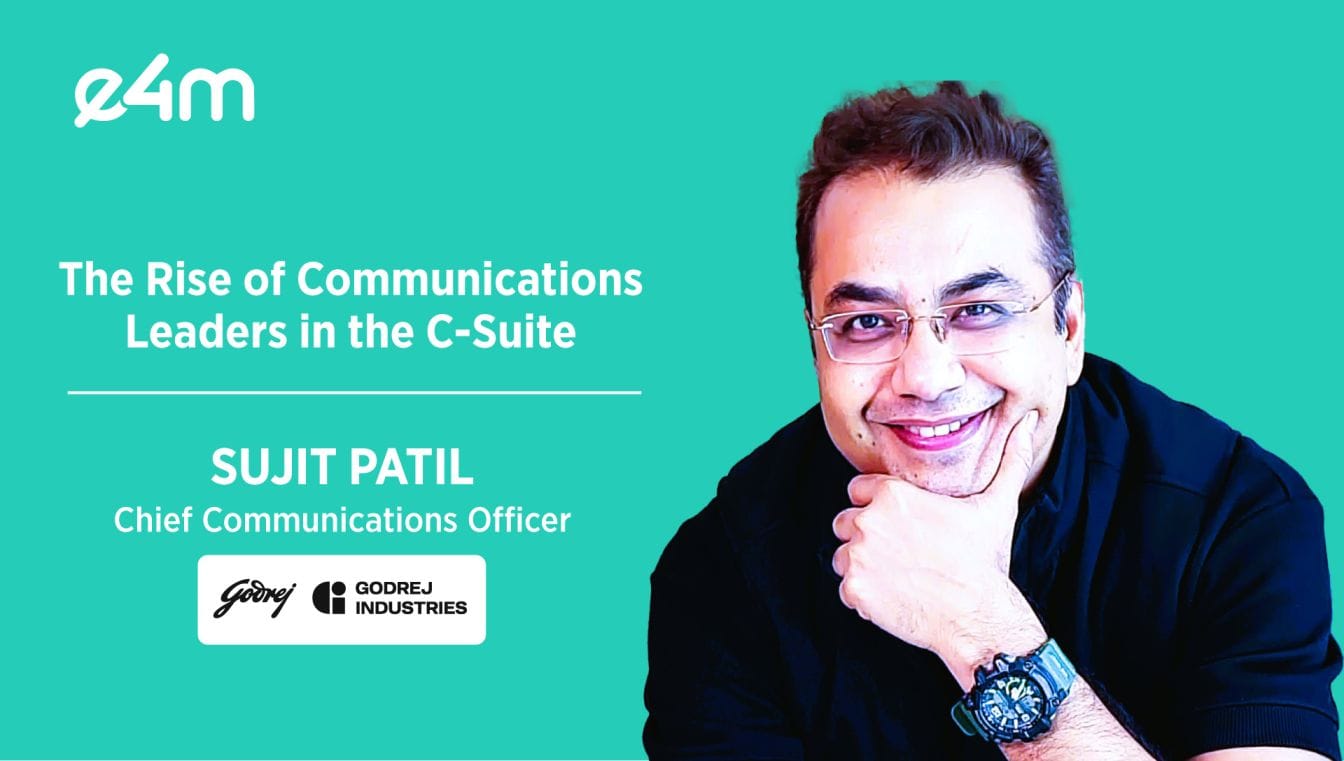

- Communications has evolved from a supportive role to a strategic function within organizations, with Chief Communications Officers (CCOs) increasingly reporting directly to CEOs and influencing corporate decisions amid challenges like AI, geopolitical uncertainty, and stakeholder activism.
- A Wall Street Journal report highlights the rise of CCO roles, with nearly half now directly reporting to the CEO, reflecting the growing importance of communications in shaping corporate reputation and navigating crises.
- The future of communications will focus on strategic contributions, requiring leaders to possess business fluency, stakeholder intelligence, ethical judgment, data-backed intuition, and courage to effectively manage reputation and trust.
- Internal communications are critical for employee engagement and organizational transformation, with risks such as trust erosion and execution failure arising from neglecting this aspect; investments should prioritize intelligence-led communications infrastructure while cutting low-impact visibility activities.
For years, communications was seen as the function that gave brands a voice. Today, it's the function that gives businesses direction, helping CEOs navigate an era defined by AI, geopolitical uncertainty, stakeholder activism and an unforgiving 24/7 news cycle. From steering organisations through crises and shaping corporate reputation to influencing boardroom decisions and driving transformation, communications leaders have steadily expanded their remit and earned their place at the highest table. Hence, communications is finally having its boardroom moment.
The shift is no longer anecdotal. A recent Wall Street Journal report observed that communications executives have “stormed the C-suite,” with companies across industries creating first-ever Chief Communications Officer roles and expanding their mandates to encompass corporate affairs, policy, AI governance and executive strategy. Nearly half of Chief Communications Officers now report directly to the CEO up from 37% in 2015 underscoring the function's growing proximity to power.
Research from Gartner echoes the trend. In one of its landmark surveys, 83% of CCOs said their influence within the C-suite has grown, while 75% believe they wield greater influence than many of their executive peers. Today, the question is no longer whether communications deserves a seat in the C-suite but how much influence it will have in shaping the future of business.
To unpack this transformation, we spoke with Sujit Patil, Chief Communications Officer, Godrej Industries Group, about what propelled communications from the sidelines to the strategy table, how should CCOs balance reputation with business outcomes, embrace AI without losing the human touch, and bring employees along through unprecedented change, and so much more.
Excerpts:
What drove communications’ shift from being an execution partner to owning boardroom conversations, and how sustainable is that shift?
The shift is happening due to the changing nature of enterprise risk. Boards and CEOs are realizing that trust, perception, culture, legitimacy, and stakeholder confidence are now material business variables. For a long time, communications was seen as the function that explained decisions after they were made. The business decided, and communications translated it through media, advertising, messaging etc.
Today, reputation is real-time, multi-stakeholder and deeply interconnected with business continuity. A product issue can become a trust issue. A policy decision can become an employee morale issue. A leadership statement can move from an internal townhall to social media within minutes. A supply chain choice can become an ESG question. Silence can be interpreted as a position.
The second driver is stakeholder capitalism. Businesses are no longer judged only by shareholders or customers. They are judged simultaneously by employees, regulators, communities, investors, activists, media, partners and increasingly by digitally networked citizens. Communications is the only function that naturally sees across all these constituencies. That panoramic stakeholder view has become strategically valuable.
The third driver is uncertainty. In a polarized, AI-disrupted, climate-conscious, and socially sensitive world, leadership teams need more than message crafting. They need Trust Crafting. They need a sense of timing, tone, consequence, empathy, and credibility. Communications has become the enterprise function that helps leaders understand not just what to say, but what a decision will mean in the court of public trust.
Is the shift sustainable? Yes, but only if Communications continues to evolve.
It will be retained only if communicators bring business acumen, data, counsel, and courage to the table. The function must move from output metrics to enterprise impact; from press coverage to trust architecture; from campaigns to business outcomes; from reactive issue handling to early-warning intelligence.
What role should communicators play in shaping business strategy itself? What will define the communications leader of the next decade?
Communicators should play the role of strategic sense-makers.
Business strategy cannot be built only from financial models, market sizing, operational capability, and competitive intelligence. Those are essential, but incomplete. Strategy also needs social permission, employee belief, cultural relevance, regulatory confidence, and reputational resilience. That is where communications become central. A strong communications leader must bring the outside world into the boardroom and take the inside truth of the organization to the world. Both directions matter.
In shaping strategy, communicators should help leadership teams understand stakeholder expectations before decisions are locked. They should pressure-test the reputational consequences of major choices: acquisitions, restructuring, AI deployment, sustainability commitments, pricing decisions, leadership transitions, brand architecture, new market entry, crisis response, and public positions on sensitive issues.
The best communicators do not merely ask, “How will this be announced?” They ask, “Will this be believed?” “Who will feel excluded?” “What is the gap between our intent and stakeholder interpretation?” “What proof do we have?” “What behavior must accompany this message?” “What will employees say about this when leadership is not in the room?”
That is a strategic contribution.
For me, the communications leader of the next decade will be defined by five capabilities.
First, business fluency. Communications leaders must understand P&L, capital allocation, operating models, category dynamics, investor expectations and risk. Without business fluency, counsel becomes cosmetic.
Second, stakeholder intelligence. The next-generation CCO will operate like a radar system, reading weak signals across employees, media, policy, culture, digital communities, and markets.
Third, ethical judgment. In an AI-amplified world, reputation will depend heavily on whether organizations act with transparency, fairness and responsibility. Communicators will need to help companies choose credibility over convenience.
Fourth, data-backed intuition. The future will not belong to leaders who rely only on instinct or only on dashboards. It will belong to those who can combine analytics with human reading of context.
Fifth, courage. The real test of a communications leader is not writing the CEO’s note. It is telling the CEO when the organization is not ready to say what it wants to say.
The next decade will belong to communicators who can operate as reputation economists, culture shapers, stakeholder strategists and conscience keepers.
Which aspects of communications will remain uniquely human, and where are the greatest opportunities for AI-human collaboration?
For me, the uniquely human aspects of communications are judgment, empathy, trust-building, moral reasoning, and the ability to understand emotional context.
AI can generate language, summarize sentiment, identify patterns and accelerate production. But communications is not merely the creation of content. It is the interpretation of meaning. It requires understanding what is unsaid, why people are anxious, when silence is respectful, when transparency is overdue, when a technically correct message is emotionally tone-deaf, and when a leader’s words need more humility than polish. Empathy will remain human. So will the ability to read a room, sense fear in an organization, understand the difference between compliance and conviction, and build trust through relationships over time.
Crisis counsel will also remain deeply human. During a crisis, the most important question is rarely, “What is the perfect statement?” It is, “What is the responsible thing to do now?” That requires ethics, accountability and lived judgment.
The greatest opportunity for AI-human collaboration lies in augmentation, not substitution.
AI can help communications teams listen at scale. It can analyze large volumes of media, social conversation, employee feedback, investor commentary, policy developments, and consumer sentiment. It can identify emerging risks earlier than manual systems. It can personalize communication for different audiences. It can help draft, translate, repurpose, simulate stakeholder reactions, and improve speed. But humans must remain accountable for interpretation, intent, nuance, and final judgment.
The most effective model will be “AI for intelligence and efficiency, humans for meaning and trust.”
Is internal communications still underappreciated as a strategic function, and what risks do organizations face when employees are not brought along on the transformation journey?
I do tend to agree that internal communications remain underappreciated in many organizations, especially when compared with external reputation management. If so, it is a strategic mistake.
Employees are no longer just an internal audience. They are the most credible carriers of corporate reputation. They influence customers, communities, families, professional networks, and digital conversations.
When organizations overinvest in external reputation while underinvesting in internal clarity, they create a credibility gap. The world hears a confident transformation story, while employees experience uncertainty, ambiguity, and fatigue. That gap eventually becomes visible.
Internal communications must therefore move beyond announcements. It must become a transformation capability. Its role is to create understanding, not just awareness. It must explain the “why,” clarify the “what,” humanize the “how,” and create feedback loops around the “what next.” It must equip managers, because in moments of change, employees do not experience the organization through corporate campaigns; they experience it through their immediate leaders.
The risks of not bringing employees along are significant.
First, trust erosion. When people do not understand the direction of change, they fill the silence with speculation.
Second, execution failure. Transformation is not implemented by strategy decks; it is implemented by people. If employees do not believe in the change, adoption suffers.
Third, culture fragmentation. Different parts of the organization create their own versions of the truth.
Fourth, talent loss. High-performing employees leave environments where they feel uncertain, unheard, or undervalued.
Fifth, reputational leakage. Internal discontent rarely stays internal.
The organizations that will lead effectively through transformation and change will be those that communicate with transparency, reskill with sincerity, listen with humility, and make employees co-authors of the change.
With limited budgets and expanding expectations, what is one communications investment leaders should aggressively increase and one they should confidently cut?
The investment I would aggressively increase is intelligence-led communications infrastructure.
By that I mean the capability to listen, analyze, predict, measure, and respond across stakeholders in an integrated way. Communications teams need sharper systems for stakeholder intelligence: employee listening, media analytics, digital risk sensing, policy scanning, influencer mapping, investor perception, brand trust measurement, and issue forecasting.
This is not about buying more dashboards. It is about building a decision engine.
The future communications function must be able to tell the business: “Here is what is changing, here is why it matters, here is the stakeholder risk, here is the reputational opportunity, and here is the recommended action.” That requires investment in data, tools, talent, and operating rhythm. It also requires people who can interpret data intelligently. Measurement must move from vanity metrics to decision metrics.
The investment I would confidently cut is low-impact visibility activity.
Every communications function has legacy spends that continue because they are familiar: events without strategic purpose, awards that do not build meaningful credibility, media activity that chases volume over influence, content that is produced because calendars need filling, sponsorships that do not reach the right stakeholders, and campaigns that create noise but not trust. The question should not be, “Did this get visibility?” The question should be, “Did this move belief, behavior, reputation, advocacy, preference, resilience or business confidence?” I would cut anything that cannot answer that question.
In a constrained environment, communications leaders must be ruthless about relevance. Fewer, sharper, more strategic interventions will outperform scattered activity. The discipline is simple: increase investments that improve judgment, trust and business impact; cut investments that merely create the appearance of busyness.
If today’s communications leaders have earned a seat in the C-suite, what is the next evolution of the function? How will the role change over the next five years?
I think having a seat should not be the only ambition. The ambition should be to shape the quality of decisions made at that table. Over the next five years, communications should become more integrated with business strategy, risk, culture, technology, and transformation. The function will sit at the intersection of reputation, employee belief, stakeholder capitalism, AI governance, sustainability, policy, and leadership credibility.
I see six shifts.
First, from messaging to meaning. Communications will focus less on what companies say and more on how stakeholders interpret what companies do.
Second, from campaigns to systems. Reputation will be managed through consistent behavior, proof points, leadership actions, employee experience and stakeholder engagement, not episodic communication bursts. This is what I call Trust Crafting.
Third, from media relations to stakeholder architecture. Media will remain important, but communications will manage a wider ecosystem of influence: employees, creators, communities, regulators, investors, partners, analysts, and digital networks.
Fourth, from crisis response to resilience design. The best communications teams will not only respond to crises; they will help businesses anticipate and prevent them.
Fifth, from content production to intelligence and counsel. AI will automate a meaningful share of production. That will push communicators up the value chain toward insight, advisory, ethics, narrative strategy, and leadership counsel.
Sixth, from corporate voice to corporate character. In a low-trust world, stakeholders will judge companies by consistency between promise and practice. Communications will increasingly be responsible for ensuring that the organization’s voice reflects its actual character.
The CCO of the future will be part strategist, part sociologist, part economist, part technologist and part conscience keeper.
Read more news about PR and Corporate Communication News, Internet Advertising, Marketing News, Digital Media News, People Movement News
For more updates, be socially connected with us onInstagram, LinkedIn, Twitter, Facebook YouTube & Google News