AI, attention spans and the myth of the dying TVC
Noting the expansion of media ecosystems and the shrinking of attention spans, brand leaders at the PMAR 2026 launch, argued that the conversation must shift from format battles to business objectives
 by
by
Published: Feb 25, 2026 1:58 PM | 13 min read
 Follow Us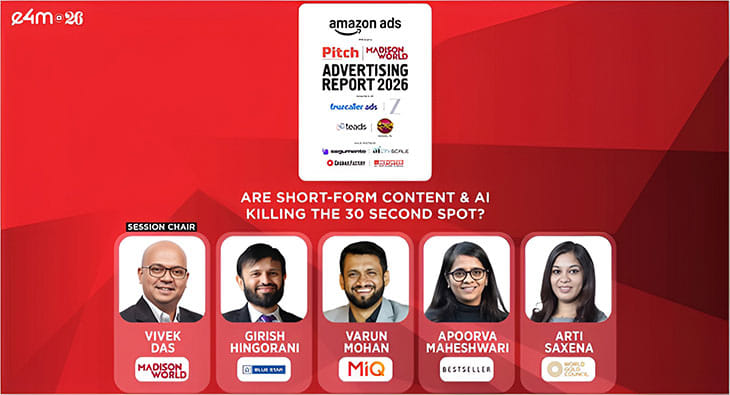

Every few years, the advertising industry declares something dead. First print. Then TV. Now the 30-second commercial.
With AI-generated content and six-second edits multiplying across platforms, the mainstream narrative suggests long-form brand storytelling is obsolete. But marketers at the launch of the Pitch Madison Advertising Report 2026, said the real question isn’t about format but about objectives, persuasion and performance.
A panel discussion titled ‘Are Short-form content & AI killing the 30 second spot?’, at the event, brought together Girish Hingorani, Vice President – Marketing (Consumer Products) & Corporate Communications, Blue Star; Varun Mohan, Chief Commercial Officer – India, MiQ; Apoorva Maheshwari, Head of Marketing – India, Bestseller; and Arti Saxena, Head of Marketing – India, World Gold Council. The session was chaired by Vivek Das, Chief Digital Officer, Madison World.
Setting the context, Das noted that the conversation would focus on “busting a lot of stereotypes and myths that surround this entire topic of AI and short form.” Referring to the report unveiled earlier in the day, he pointed to the “massive shift underway in terms of the entire media mix,” while adding that the big picture often masks what is happening within categories.
Different categories are operating with unique media mixes depending on whether they are highly established, cluttered, slow-moving or high-involvement. Framing advertising through Madison’s lens, he added that its role is fundamentally threefold, i.e. “attention, memory and response.” Advertising, he explained, can “generate attention or capture attention, build or refresh memory structures, or drive responses,” and the panel would examine creativity, human or AI-driven, from that standpoint.
Opening from a category perspective, Saxena underscored the centrality of communication for the World Gold Council. “Communication for us is very important,” she said, explaining that the Council focuses on gold both as jewellery and as an investment.
When it comes to jewellery, she noted that relevance is driven through emotional storytelling, adding that the objective is to “tell a beautiful, emotionally evocative story to drive relevance.”
However, communication takes on a different role in the investment context. “When it’s about investment, it’s driven more by awareness and simplification,” Saxena said. In that space, the emphasis is on making it clear how easy it is to invest. Beyond positioning gold as a strategic asset class, the Council also focuses on driving awareness for gold ETFs. Communication, therefore, becomes pointed and functional, centred on the “reason to believe” and what the proposition stands for.
Representing Bestseller, Maheshwari brought in the fashion lens. “Because it’s fashion and it’s trend-first fashion, it becomes extremely important that we deliver these trends visually to our consumers,” she said. The role of communication, she added, is to ensure constant inspiration, showcasing trends that are current and those that help consumers “look and feel good.”
From a markedly different category, Hingorani described air conditioners as “highly commoditised” and yet low involvement, driven more by functional than aspirational needs. “The reason you buy an air conditioner is just for cooling,” he said, highlighting the intense competition within a market that currently has only around 35 million AC-owning households, despite an opportunity of nearly 150 million households given India’s tropical climate.
Growth is increasingly coming from Tier 3, 4 and 5 markets, where first-time buyers are seeking better living conditions. “These purchases are often driven by social triggers, like the desire to create a better environment for children to study or sleep in rising heat conditions.”
In such a commoditised category, Hingorani argued that communication becomes indispensable. “Unless you create a strong brand, unless I have a very compelling reason that I give you of why buy me, it will then just be a price sport,” he said. Without differentiation, he added, the category risks becoming indistinguishable.
Shifting the conversation to platforms and technology, Das turned to Mohan to explore whether a tech-first, data-first ecosystem is equipped to support emotion-led, memory-building communication or whether it is primarily geared towards scale.
Drawing on two decades in digital, Mohan reflected on recurring predictions of media extinction. “Throughout the journey, I’ve been hearing that print is going to die, radio is going to die, outdoor is going to die, TV is going to die, but nothing has died yet,” he said. Instead, he argued, everything has transformed.
“The whole ecosystem has evolved or transformed in a way, but nothing has replaced anything,” he said, maintaining that platforms coexist rather than substitute each other.
He pointed to the dramatic growth in digital scale, from approximately 250 million internet users in 2016 to nearly a billion today. With India now among the cheapest markets for data, consumption patterns have intensified. “The average Indian consumer consumes approximately four hours of video content on a daily basis, mostly on a doom scroll,” Mohan noted.
In such an environment, AI becomes indispensable for decoding behaviour. It plays a “significant role in understanding user behaviour, content consumption and context,” he said, helping create audience cohorts for better targeting and engagement.
Building on the earlier argument, Das returned to what he described as a “business-first lens” rather than a media-first one. The debate around AI and short-form content replacing the 30-second or 60-second spot often begins from a platform perspective rather than a brand objective.
“When you’re looking at communication, how do you decide whether you need a 60-seconder or a 30-seconder?” he asked.
Responding from the gold category, Saxena emphasised that the starting point is never media. “As a marketer, we do not look at a media-first approach. It’s very important to have the right contextual understanding of what you’re trying to do,” she said.
She cited the example of gold jewellery, where the brand identified a clear emotional disconnect among millennials and Gen Z. “It was very important that we tell stories which are relevant and emotionally captivating,” she said. For that reason, the brand has historically leaned on 30-second formats, and even 45-second films in the past, though edits have become sharper over time.
At the same time, Saxena acknowledged shrinking attention spans. As a result, 30-second narratives are designed alongside 15- and 10-second edits, ensuring the story remains complete across formats. “It is by design that we look at all separately and ensure that the story is complete,” she said.
For Saxena, format follows resonance. If the content is compelling, length becomes secondary. She pointed to long-format global brand films that have gone viral as evidence that strong storytelling can sustain attention. “If you have the right content and it resonates with your audience, it has the potential to be seen in a longer format,” she said.
Maheshwari echoed the sentiment that there is no universal template. “There isn’t a one-size-fits-all master of 60, or 90, or 45, or 30, or 10, or five,” she said. Format depends on the category, the life stage of the brand, and the specific problem being solved.
Within Bestseller itself, four brands cater to four distinct consumer segments, each with different channel mixes, distribution strategies, product propositions and price points. Communication strategies therefore vary accordingly.
During seasonal launches, autumn/winter and spring/summer, the task is often to simplify choice across 800 to 1,000 new options. “We don’t need long-format storytelling there,” she said, explaining that consumers simply need to see the fit across body types and understand how to style it.
“The consumer is not looking at the seconds of the campaign,” Maheshwari added. “Instead, the questions they ask are ‘do I understand this, do I register it, do I like it, do I want to buy it?’”
Hingorani took the discussion further, drawing a distinction between media deployment and storytelling. “Seconds are in our mind. It’s media deployment. The consumer is looking at content,” he said.
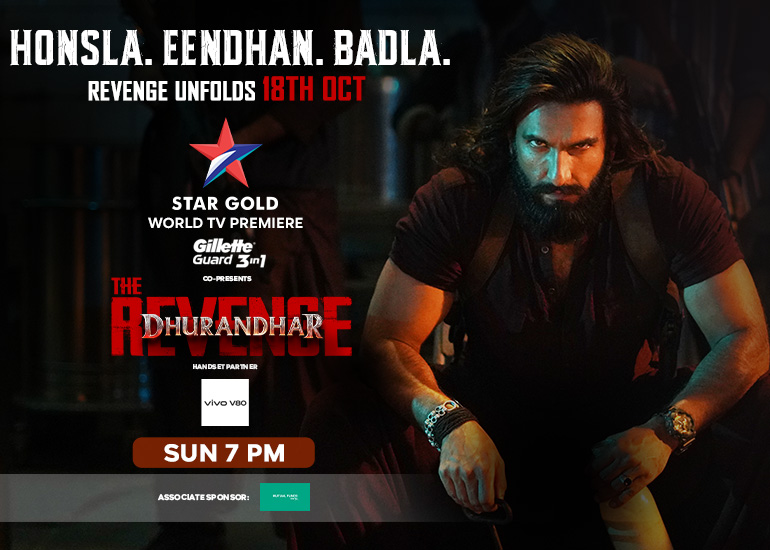
Giving the example of Dhurandhar, he pointed to the success of long-format cinema as proof that attention span alone does not determine engagement. “It’s all about the content and how engaging the content is. The time is immaterial,” he said. Content can engage for 60 seconds or 10 seconds; the determining factor is the story being told.
“As marketers, we are storytellers. Often we confuse media deployment with storytelling. The two should not be interchanged,” Hingorani said. For Blue Star, the first creative brief to agencies is to create something which is entertaining.”
He illustrated the point with performance metrics. A Blue Star campaign featuring Virat Kohli recorded a 15% view-through rate on a 15-second ad with five million impressions three years ago. Last year, a 30-second commercial delivered across 27 million impressions achieved a view-through rate of 55%. “It’s how well you tell your story that matters,” he said.
Maheshwari added that in today’s omnipresent media environment, the challenge has shifted. “It is so easy for brands to be omnipresent,” she said, contrasting it with the earlier days of her career when building awareness and persuasion required far greater effort.
With ubiquity now accessible, the burden has shifted back to persuasion. “The impetus is back on the marketers, the agency partners, the storytellers,” she said. Whether through a static asset or a full-scale film production, the act of persuasion has returned to the centre of communication.
Das, however, flagged what he described as a contradiction. Platforms often sell AI-enabled content creation through a transactional lens, enabling discovery to purchase journeys that prioritise efficiency over storytelling. In parallel, he noted, AI tools are now capable of generating entire films, underscoring the spectrum of possibilities.
Addressing this tension, Mohan framed the issue around two determinants - the life stage of the brand and the campaign’s objective KPI. “That defines what ad format will work,” he said.
On platforms selling transactional outcomes, Mohan argued that they respond to marketer demand. “Platforms are selling what the marketers are asking for,” he said, suggesting that the industry has fallen into a loop of chasing reach and frequency at the lowest cost. Budget constraints often push brands towards six- or 10-second formats because 30-second spots are more expensive. Yet, he questioned whether such optimisation truly meets the campaign objective.
He also rejected the nostalgia-driven argument that advertising has lost memorability. Consumers today face far more channels, platforms, brands and content than they did 25 years ago. With hundreds of linear channels, dozens of OTT platforms, music apps and social feeds, clutter has multiplied, as has competition for share of voice.
In such an environment, format must follow objective. “What is the brand objective? Are you building a story connected to emotion, or are you driving performance? Which funnel are you focusing on?” Mohan said. Creative should be built around the objective first, and media selected thereafter.
As the discussion moved towards a close, Das broadened the lens beyond format wars.
Introducing the final question, he added two practical filters: speed and economics. In scenarios such as brand building, seasonal launches, e-commerce pushes or sales promotions, marketers now need hundreds or even thousands of assets. “How do you choose between human creativity and AI creativity?” he asked.
Saxena returned to the gold investment example to illustrate how agility influences that choice. While much of the Council’s work is rooted in emotional, long-form storytelling, she explained that the investment narrative operates differently.
Gold is inversely correlated with the stock market. During periods of volatility, the team wanted messaging to respond in real time to market movements. “We deployed DCO (Dynamic Creative Optimisation),” she said, explaining that when markets moved up, one message was triggered while when markets fell, communication pivoted to highlight gold as a hedge against inflation and a diversifier.
“This was a very agile approach and we performed very well,” she said, adding that multiple creatives can be developed and served as per need when the objective is clearly defined.
Maheshwari offered a contrarian view, presenting both sides of the coin. In an omnichannel retail environment, there are instances where human creativity is either not required or becomes a bottleneck that slows speed to market.
Certain use cases, such as post captions, A/B testing for ads, repetitive social media outputs, do not necessarily require deep creative intervention. “AI really helps there,” she said, particularly when multiple audience sets and campaigns are running simultaneously and require automated content at scale.
However, she added a note of caution. “I am yet to see in India any fully AI-generated campaign which has had sizable media spend behind it,” she said. Across categories, she observed that major, effective brand campaigns continue to rely on human-led creative thinking.
Hingorani reinforced that distinction between tool and originator. While acknowledging that more TV commercials are now being generated with AI assistance, he argued that emotional resonance remains inherently human. “As long as we are human beings and we react to emotions, human creativity will play a role,” he said.
AI, in his view, is powerful when deployed for precision and scale. “Speed of execution, microsurgical strikes, relevance and conversions can be done brilliantly by AI,” he said. But foundational brand building and storytelling still depend on emotional intelligence.
Mohan described himself as “a strong believer of coexisting.” Platforms, formats, AI and human innovation, he said, are “bound to coexist” rather than replace one another.
Master concepts and emotional narratives still require human intervention, he suggested, while customisation and deployment can be automated. “AI can reduce turnaround times, manage scale and streamline trading, planning and measurement functions as activations and user bases expand.”
Yet even AI requires human direction. “Without giving the right prompt, you don’t get the right results,” Mohan said, underscoring that human judgement remains central to guiding technological tools.
Concluding the session, Das reflected on the tendency of headlines to frame debates in black and white terms. In reality marketing has become increasingly complex. The challenge for agencies is not to champion one format over another, but to understand the consumer, the category and the competitive landscape in their full complexity.
“It’s the era of complexity, and how we can solve and orchestrate that complexity for our brands,” he concluded.
Read more news about Internet Advertising India, Marketing News, PR and Corporate Communication News, Digital Media News, Television Media News
For more updates, be socially connected with us onInstagram, LinkedIn, Twitter, Facebook YouTube & Google News