The death of absolute reach? Rethinking metrics in a fragmented market
As CMOs navigate investor pressure, platform proliferation and premium ambitions, panellists at the PMAR 2026 launch explored whether brand building still holds ground against short-term sales metrics
 by
by
Published: Feb 25, 2026 1:49 PM | 8 min read
 Follow Us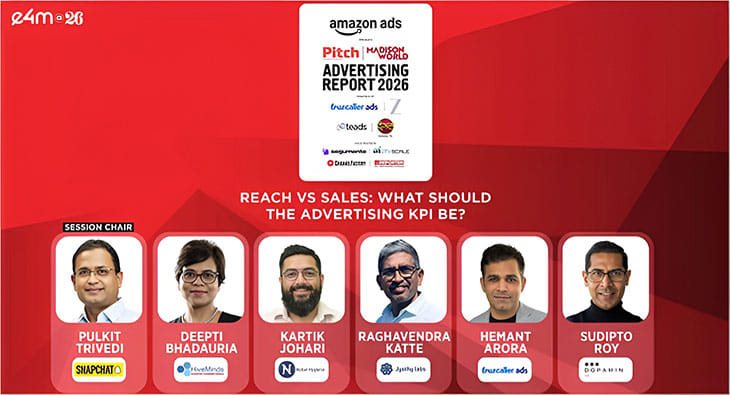

At the launch of the Pitch Madison Advertising Report 2026, industry leaders came together to debate the age-old question confronting boardrooms: should advertising be measured by reach or by sales?
The session, “Reach vs Sales: What Should the Advertising KPI Be?”, was chaired by Pulkit Trivedi, Managing Director, Snapchat. The panel featured Kartik Johari, Chief Marketing and Growth Officer, Nobel Hygiene; Raghavendra Katte, Assistant Vice President – Media, Jyothy Labs; Hemant Arora, VP – Global Ad Business, Truecaller Ads; Sudipto Roy, Co-founder, emergentlab.ai, Dopamin UK; and Deepti Bhadauria, Partner and CEO, HiveMinds.
Opening the discussion, Trivedi asked the panellists what does brand building mean in 2026?
Katte, representing the FMCG perspective, brought the conversation straight to revenue. “I represent an FMCG business and our issue is simple. It’s how do I get the business moving? For us, brand building is about getting revenue into the system. Yesterday it was reach and today could be something else. Ultimately, brands are what get products to move.”
At its core, however, he stressed that the fundamentals remain unchanged. “A brand is supposed to respond to or give me a stimulus for my emotions so that I can have an emotional transaction with you, which builds loyalty. On the other side, a brand is supposed to perform on sales,” he said, adding that while media narratives may evolve, “at the basic level, the principles of brands are exactly the same.”
Roy introduced a counterpoint, referencing contemporary thought leadership. “If you listen to Scott Galloway, he says brands as an instrument are dead,” he noted. Yet his own analysis of 20 brand owners and over 50 variants suggested otherwise. “Anybody who has not invested in building the brand has declined. That pattern is very clear. If you do not invest in brand building for three or four years, you will see the problem.”
What has changed, according to Roy, is the mechanism. For decades, brand growth was driven by reach, frequency, and shelf dominance. That model, he argued, depended on limited competition and linear retail structures. “When everything moves to an online marketplace, and you collapse the distance between discovery and fulfillment, the game changes,” he said. The need to build a brand does not disappear, but “how much of that is required to build sales in the early stage of brand development has changed.”
Johari framed the issue through multiple lenses. “The academic in me says a brand exists to reduce choice overload. The marketer in me says it is there for emotional messaging and consumer stickiness. The business owner in me says the brand should command a premium and keep selling,” he said. There is no simple answer, he acknowledged, but marketers are expected to condense these objectives into one coherent direction.
Bhadauria drew an analogy to schooling. “How happy we are today has no bearing on how we scored in 10th standard,” she said. “But if you have a child in 10th standard, that is the only KPI you are focused on.” Similarly, she argued, sales growth is the mission. “You build a brand so that it sells and gives you profit. Reach, CTR, CPM are KPIs. You optimize for a point in the journey but the goal remains profit. Without growth, there is no business.”
As the conversation moved into today’s volatile macro environment, Trivedi highlighted the mounting pressures on CMOs, fragmented journeys, dozens of platforms competing for budgets, and CFOs demanding ROI. When does balancing reach and sales risk eroding a brand’s ability to charge a premium?
Arora responded by reframing the dichotomy. “Eventually everything is sales. Whether it is short term or long term is the only difference,” he said. The tension lies between transactional outcomes and the memories left in consumers’ minds. Premium erosion, he suggested, is less about sales focus and more about dilution of purpose. “The day I short-change our purpose, i.e. creating a safe, efficient communication environment, my consumer will go away,” he said, stressing that revenue must not cloud brand intent.
Building on this through behavioural science, Roy argued that human decision-making operates on mental shortcuts. “A brand is a vehicle that transports reliability and quality consistently. It is a mental shortcut,” he said. Equally important, a brand connects consumers to identity. “If you short-change either reliability or how the brand makes you feel, your ability to command a premium goes down.” In that scenario, functional parity invites commoditisation.
From the FMCG lens, Katte reinforced the balance between urgent and important priorities. Citing the example of toilet soaps, once predicted to disappear, he noted that categories survive when long-term brand work is not sacrificed for immediate gains. “If urgent work replaces important work, sales will take over and it will hurt,” he cautioned. Premiumisation depends on sustaining foundational brand effort.
The discussion then turned to reach itself and what does it mean in today’s fragmented landscape.
Unequivocally, Bhadauria said, “Reach is no longer a unified metric.” For always-on digital brands, the focus is on incremental reach layered over ongoing efforts. Given multi-screen consumption, she emphasised multimedia strategies. “Reach cannot be built on one medium. It has to be built across at least three screens,” she said. She also highlighted that, particularly in FMCG, ecosystem confidence, from stockists to retailers, is influenced by media presence, including regional print and TV.
Instead of chasing quantified metrics, Katte advocated connecting media measurement directly to business outcomes. He urged the industry to reframe fragmentation as opportunity. “We do not see reach as a number. We see it as the audience we want to do business with.”
Johari was blunt in his critique of conventional metrics. “I hate the phrase ‘absolute reach’. What does that mean? There is no metric for purity of reach,” he said. In categories such as adult diapers, where stigma runs deep, frequency alone cannot drive change. “You think a reach of 12-plus frequency is going to solve that? Absolutely not. There has to be something deeper.”
Roy added that collective attention, such as major sporting events, still holds value. Context matters, particularly for new launches. However, in categories requiring education, such windows may not suffice. He suggested thinking in terms of business systems and corresponding media systems, identifying what builds memory, what builds attention, and what drives response.
When challenged on whether new-age businesses overly prioritise acquisition metrics, Johari warned against excessive reliance on performance marketing. “It is akin to strip mining,” he said. Extracting value without replenishment depletes the well. “The startup graveyard is littered with examples where only performance marketing was used.” Sustained scale and premium require more than transactions.
Katte rejected the compartmentalisation of media as either brand-building or sales-driving. “The true businessman never makes that mistake,” he said. Media strategy must integrate with distribution, pricing and the broader four Ps. Without alignment, teams risk hitting reach targets while sales stagnate.
Distinguishing between broad reach that builds loyalty and targeted reach that optimises acquisition costs, Arora argued that both are necessary. “Anyone focusing only on reach or only on performance is lazy. That is a shortcut.”
Roy introduced another dimension to the discussion with respect to India’s disparity. “We must de-average the country,” he said, noting vast differences in penetration across states and segments. Maximising aggregate reach may obscure more strategic ground-up opportunities. The era where GRPs alone could guarantee equity and sales is over and complexity now defines the market.
Shifting to creativity, the panel examined whether sales-driven KPIs constrain storytelling.
Bhadauria pointed to evolving platform dynamics. On creator-first platforms like Snapchat, performance budgets are increasingly intertwined with engagement-led creativity. “We have moved away from deciding what is good or bad creative,” she said. Customers determine resonance, often producing and interpreting content themselves. “Every creative adds to the brand, depending on who the TG is.”
Arora described the intersection of data and creativity as the “sweet spot”. While creative output remains probabilistic, data now enables real-time optimisation. “You have that data at your head, which allows you to optimize every single thing, including the creative,” he said.
Katte observed that the industry has blurred traditional lines. “We dragged the media agency to become a creative agency, and creative agencies are still struggling to see what happened to them,” he remarked. The real challenge, he suggested, is delivering the right creative solution across multiple media touchpoints.
Across the discussion, everyone agreed that the debate is not reach versus sales, but how each serves a larger business system.
Read more news about Internet Advertising India, Marketing News, PR and Corporate Communication News, Digital Media News, Television Media News
For more updates, be socially connected with us onInstagram, LinkedIn, Twitter, Facebook YouTube & Google News