The funnel was always fiction
Satya Raghavan, Director, Marketing Partners, Google India & YouTube, speaks to Shripad Kulkarni on why consumer has never moved in a funnel — and what two bookends of modern marketing actually are
 by
by
Published: May 23, 2026 9:19 AM | 7 min read
 Follow Us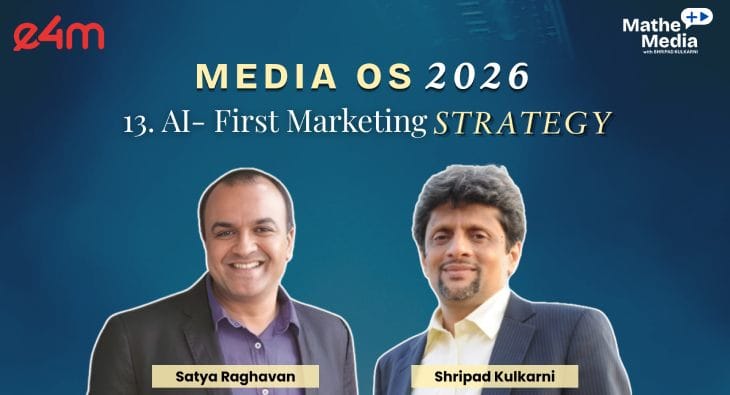

- Satya Raghavan, head of revenue at Google, emphasizes that Google and YouTube have been utilizing AI for over a decade, making them pioneers in the field rather than latecomers.
- He argues that traditional marketing funnels are outdated, as modern consumers engage in multiple activities simultaneously—searching, scrolling, streaming, and shopping—rather than following a linear path.
- Raghavan highlights the importance of first-party data and creative workflows as essential components for marketers to leverage AI effectively, suggesting that the focus should be on data infrastructure and dynamic creative generation.
- He believes that the evolution of AI in advertising will create new opportunities and jobs, enhancing the value chain for brands that adapt early to these changes.
A Decade Ahead of Everyone Else
Google and YouTube were not latecomers to AI. They were its original architects. Satya Raghavan, who leads a revenue function at Google, has spent a decade watching machine learning do — quietly, at scale, beneath the surface of every search result and every video recommendation — what the rest of the marketing industry is only now beginning to understand. When he speaks about what AI makes possible for Indian brands, he is not describing a new frontier. He is describing a more mature version of something he has watched work for ten years.
“We became an AI-first company around 10 years ago,” he says. “Fundamentally, I saw that AI algorithm work under the hood almost 10 years ago.”
The platforms that Indian marketers treat as advertising surfaces were, from their foundations, AI-calibrated content engines. Every recommendation, every search result, every feed served to every user — that was AI at scale, years before it had a name that marketers recognised.
This is not a historical footnote. It is the reason Satya speaks about AI with a different kind of authority — not as a new phenomenon to be excited about, but as a more mature version of something he has watched work for a decade.
The Funnel Is Dead
From that vantage point, what he is seeing now is something that should make every media planner reconsider their craft from the ground up.
"We all grew up with that classic marketing funnel," he told me. "Awareness, consideration, desire, intent, purchase. But people are actually searching in much more interesting manners at this point. Because we have the vantage point of both Search and YouTube, we are seeing that people are doing four things at the same time — searching, scrolling, streaming and shopping — and not in any sequence."
This is not a small observation. The entire architecture of media planning was built on an assumption about how consumers move. That assumption is now demonstrably wrong. The Indian consumer in 2026 doesn't move through stages. She moves through moments. And she is moving through several at once.
Search Has Deepened
Now add this: search itself has deepened. Queries are longer. Conversations are happening with Google — AI overviews, AI mode, multimodal inputs where a consumer photographs a watch she likes and searches for it using that image.
“A much more valuable consumer is emerging at the end of the funnel,” Satya says. “And that is just search.”
The next frontier is one that should have every brand marketer paying very close attention.
"We don't really yet have ads in AI overviews, but that is forthcoming very soon. So, when ads come there, we will not just show ads — we will show ads to a much more valuable consumer."
When advertising enters the AI conversation layer — not as an interruption but as a contextually informed response to a deeply expressed intent — it will represent a leap in precision that makes today's targeting look approximate. The consumer who arrives there has already had a dialogue with AI about exactly what she needs. She is not browsing. She is ready.
Five Generations. One Household.
The complication Satya then adds is the household itself. Who exactly is the person you are trying to reach?
"There are houses in Mumbai, in Andheri, where five generations are staying together in that same house," he says. "Boomer, Millennial, Gen X, Gen Z, and from January 2025 onwards, a new creature has born — Gen Beta. Every one of them has a different context and mindset."
The traditional planning unit — the bullseye consumer — is not wrong, he is careful to say. It is just incomplete. A potato chips brand whose bullseye is a 28-year-old woman is leaving latent sales on the table if it ignores the four other people sharing her home, her app login, and her payment device. The media plan built for one person in one household is, in a house of five generations, a plan that covers a fraction of the opportunity.
So, what should a marketer actually do? This is where Satya's thinking becomes most specific — and most actionable.
The Tools Are Table Stakes
He is clear about one thing first: the tools are no longer the advantage.
“On the performance side of things, leveraging AI, I think it’s a level playing field for all of these people. There is no one advantage that either could have.”
Every brand, every agency, every D2C founder — they all have access to the same AI tools. The tools are becoming parity. What differentiates from here is not which tools you have. It is what you build at the two bookends of your marketing chain.
He has thought carefully about what those two bookends are, and what each one requires.
Bookend 1: First-Party Data
The first bookend is data — specifically, first-party data.
“How can you use AI and data analytics to actually empower yourself to understand your first-party data better — to discover lookalike audiences wherever they are?”
This is not about buying a data platform or building a CRM. It is about a fundamental organisational commitment: move all your data to a cloud, create a unified view of your consumer, and use AI to mine that data for signals that no human analysis could surface. The starting point is not the creative. It is the data infrastructure.
"I would say the right starting point will be to look at that end of the spectrum first."
Bookend 2: Creative Workflows
The second bookend is creative deployment — and here Satya is precise about what has changed. It is not about generating assets faster. It is about workflows.
“The whole thing — it’s not about prompts, it’s actually about workflows. Some of the enterprise engagements that we have with large agencies using VEO — it’s not about prompt engineering at all. It’s about creating workflows. Getting character consistency — that’s a workflow. Getting motion right — that’s a workflow.”
The old paradigm was one approved asset, then versions. Maybe two or three versions. Today, a brand with proper creative workflow infrastructure is dynamically generating the right creative for every individual consumer — and in some cases generating a personalised landing page in the same moment, matched to the specific consumer who clicked, before she has even arrived at it. This is what Satya means when he talks about AI enabling "impossible things." Not faster versions of what was already possible. Entirely new categories of precision.
Between these two bookends — the data infrastructure at one end, the dynamic creative workflow at the other — lies the entire media plan. Platforms, formats, channels, budgets: all of it is operational. Important, but operational. The strategic leverage lives at the ends.
What Comes Next
Satya is not worried about the complexity. He is, if anything, energised by it — and by what he sees coming. Every discontinuity in media history, he notes, has created more surfaces, more opportunity, more value for those who moved early. Printing press. Combustion engine. Computer. Mobile. AI. Each one looked like disruption from the inside and turned out to be expansion.
"I think it will create more jobs," he says. "It will create a richer and deeper value chain. There will be more for everyone to do."
The ball is up in the air. The brands that have placed their bookends correctly are the ones who will reach it first.
Satya Raghavan is a contributor to the Media OS 2026 Report, examining how Indian advertising is being rebuilt from the ground up. This piece has been curated by Shripad Kulkarni based on the conversation for the MatheMedia Podcast Series.
Read more news about Marketing News, Advertising News, PR and Corporate Communication News, Digital News, People Movement News
For more updates, be socially connected with us onInstagram, LinkedIn, Twitter, Facebook, YouTube & Google News
