Building a comms function is about institutionalising trust as a core business asset
In this edition of In the Spotlight, Shalini Singh shares her journey, insights on industry shifts, building communication functions, empowering women in leadership, key lessons learned, and more
 by
by
Published: Mar 23, 2026 5:17 PM | 7 min read
 Follow Us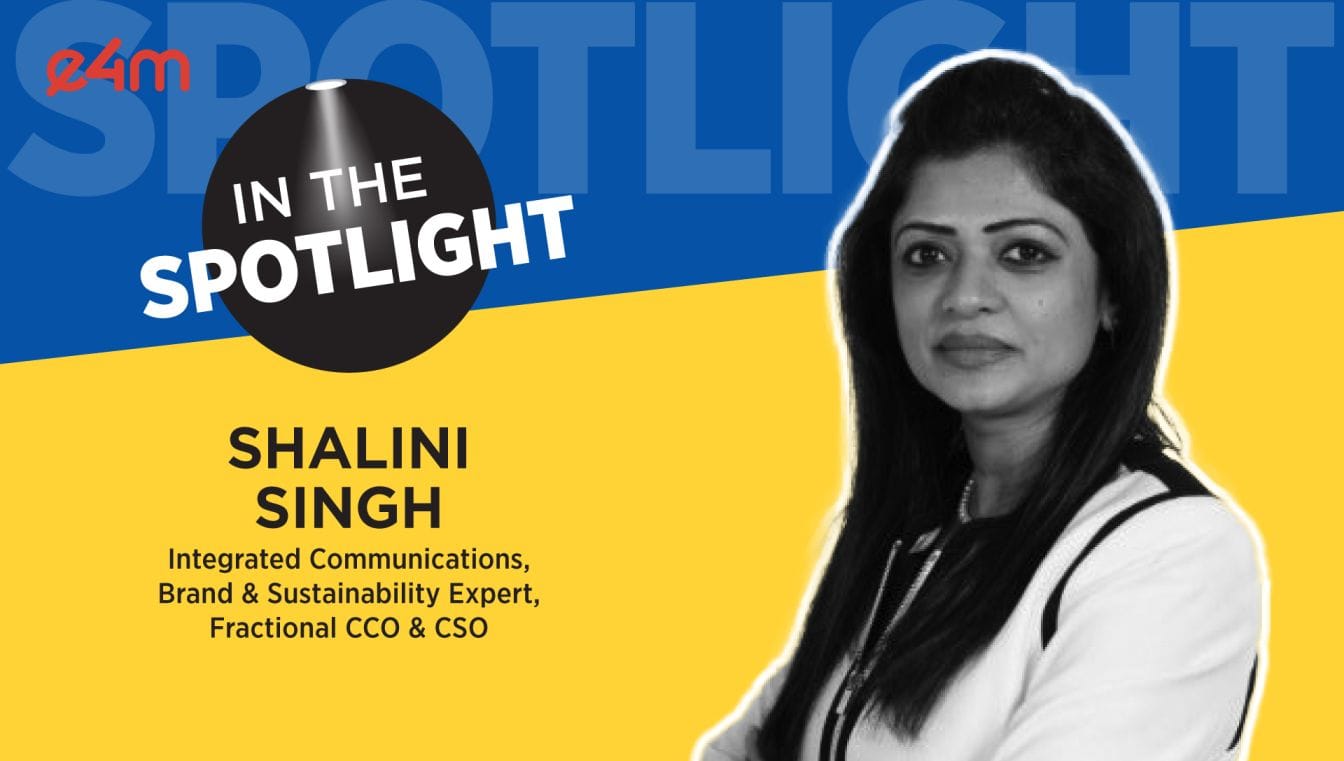

From a support function, communications has become a strategic force, shaping reputation, driving trust, and influencing decisions at the highest levels. Leading this transformation is Shalini Singh, a seasoned communications leader who doesn't just work in communications, she builds the voice behind some of India’s most influential brands.
With nearly three decades of experience, she has worked across industries like renewables, power, cement, automotive, pharma, IT, telecom, and textiles. Her work has set benchmarks globally and made her the recipient of various coveted accolades. From leading brands like RPG Group to heading corporate communications and sustainability at Ambuja and ACC under Holcim India, and driving key initiatives at Tata Power, Singh has consistently set high standards and driven various innovations in the field.
In this edition of ‘In the Spotlight’, Shalini Singh, Integrated Communications, Brand & Sustainability expert, and Fractional CCO & CSO, opens up about her remarkable journey of how she found her way into the communications industry. From navigating industry transformations to building communication functions from scratch, from earning a seat at the boardroom table to championing stronger voices for women in leadership, she shares stories, lessons, and perspectives that today’s and tomorrow’s professionals simply can’t afford to miss.
.jpg)
Excerpts:
What first drew you to the field of communications and brand leadership? How has the role evolved over time?
My journey into communications was both intentional and deeply rooted in academic curiosity. I pursued a Master’s in Communications from M.S. University, Baroda—where I graduated as a Gold Medalist—and that foundation shaped my early understanding of the power of communication to influence perception, behaviour, and societal narratives.
As I stepped into the professional world with organisations like Arvind Mills and later Airtel, I saw that theory come alive—how communication could build brands, drive market entry, and manage complex stakeholder ecosystems.
At that time, communications was largely media-led and execution-focused. Over the past 25+ years, I have seen it evolve into a strategic leadership function at the core of business decision-making at Tata Power and Holcim India (and its two operating companies ACC & Ambuja Cements).
Today, communications leaders are not just storytellers—they are reputation architects and ESG stewards, working closely with CEOs and boards to navigate risk, shape narratives, and build long-term trust. The role has moved far beyond messaging to defining how organisations are perceived, trusted, and valued in an increasingly complex world.
You have built communications functions across leading organisations. What does it take to build one from the ground up?
Building a communications function from the ground up requires a combination of strategic clarity, structural discipline, strong process oriented approach and leadership trust. Across organisations like Tata Power, Holcim India, Airtel and RPG Group, my approach has been to align communications deeply with business priorities and transformation agendas.
At Tata Power, I built an integrated 360-degree communications function and repositioned the company as a future-ready green energy leader. At Holcim India, I institutionalised a shared services model for communications and sustainability, and at RPG Group, I established a Communication Centre of Excellence to drive consistency, capability, and scale.
What truly makes the difference is embedding communications into business strategy, building strong governance frameworks, integrating ESG and digital capabilities, and consistently delivering measurable impact. To sum up, building a communications function is, in essence, about institutionalising trust as a core business asset.
Do you believe corporate communications is underestimated in boardrooms? How can that perception change?
In many boardrooms, communications is still seen through a tactical lens, which limits its potential impact. However, my experience—working closely with CEOs, boards, and serving in governance roles—has shown that perception shifts when communications is positioned as a driver of enterprise value and risk mitigation. Whether it is navigating crises, managing M&A transitions, or driving ESG transformation, communications plays a critical role in protecting market value and sustaining stakeholder confidence.
To change this perception, communicators must speak the language of business, demonstrate measurable impact, anticipate risks, and act as strategic advisors.
.jpg)
Sustainability has been a significant part of your work. When did it become central to your mission?
Sustainability became central to my journey during my time at Tata Power, where I worked at the intersection of business strategy, community impact, and environmental responsibility.A defining moment was conceptualising and scaling Club Enerji—one of India’s largest energy conservation movements—which engaged millions of citizens and delivered measurable impact in energy savings and carbon reduction.This initiative is a case study in IIM Ahmedabad and i was also invited by IIMA for giving a TEDx Talk on this initiative in 2017. That experience reinforced my belief that sustainability is not just a corporate agenda—it is a powerful lever for behavioural change and long-term value creation.
Since then, across Holcim India and its two operating subsidiaries ACC & Ambuja Cements and my advisory roles, sustainability has remained central—not as a parallel function, but as an integral part of business strategy and reputation building. Sustainability, for me, is where purpose meets performance—and where brands earn their right to lead.
What have been the biggest shifts in communications over the past three decades?
Having worked across industries—from textiles and telecom to energy and infrastructure—I have witnessed communications undergo a profound transformation.
At Tata Power and Holcim India, we built a fully integrated, digital-first communications ecosystem, and more recently at RPG Group, we implemented an AI-led transformation within a short span, significantly enhancing engagement and visibility. The industry has shifted from controlled messaging to real-time, stakeholder-driven narratives; from brand-centric storytelling to purpose-led positioning; and from intuition to data-driven decision-making.
The most defining shift, however, is that trust has emerged as the ultimate currency.
.jpg)
You have been recognised among Asia’s top sustainability leaders.You Have What more needs to be done to strengthen women’s voices in leadership?
In the Corporate sector, while progress has been made, there is still a need to move from representation to true influence. Few women in leadership positions is the real issue. Organisations must create structured pathways for women to access leadership roles., especially those with strategic and P&L responsibilities. Sponsorship, inclusive cultures, and bias-free systems are critical enablers.
Through my work in CSR and community initiatives impacting over 3 million lives, I have seen the transformative power of empowering women—not just socially, but economically and institutionally. Empowering women is not just about inclusion—it is about unlocking leadership that drives stronger, more resilient organisations. Similarly as a senior most Women leader in Tata Power, I have steered diversity initiatives to bring in women in leadership positions and advocate systems to accelerate their growth. As a Chairman-POSH Committee in Holcim India and its two operating companies-ACC & Ambuja Cements I have set up various systems to help women navigate tough terrain and issues.
As organisations move toward integrated communications, what skills will define the next generation of leaders?
The next generation of communications leaders will need to be multidimensional—combining strategy, technology, and purpose. From driving digital transformation at Tata Power to integrating ESG at Holcim and building a centre of excellence at RPG, I have seen how the role now demands business acumen, data intelligence, ESG expertise, and digital fluency. Future leaders must be able to navigate complexity, influence leadership, and align purpose with performance. The communications leaders of tomorrow will not just manage narratives—they will shape the future of business itself.
As an independent director and advisor, how do you see your role evolving?
My role today has evolved from execution to governance, stewardship, and strategic counsel. As an independent director and having served on various boards even during my professional tenure at Tata Power (On board of Tata Power's largest subsidiaries-TPDDL and Walwan Solar ltd) and Holcim India (On board of ACC Mineral Resources largest subsidiary of ACC), I focus on embedding ESG, reputation, and stakeholder trust into core business strategy and risk frameworks.
Today as an Independent Director, I see my role as bringing an external perspective, strengthening governance, and mentoring the next generation of leaders.
.jpg)
Read more news about PR and Corporate Communication News, Internet Advertising, Marketing News, Digital Media News, People Movement News
For more updates, be socially connected with us onInstagram, LinkedIn, Twitter, Facebook YouTube & Google News