How last week’s protests hit campaign economics
A week of heightened public attention became an unplanned stress test for India's digital ad economy
 by
by
Published: Aug 1, 2026 8:45 AM | 5 min read
 Follow Us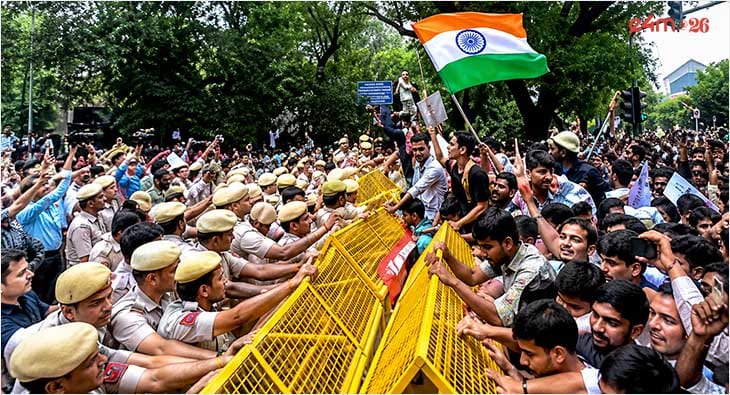

- Recent shifts in consumer behavior during national protests have revealed a disconnect between digital advertising metrics, such as clicks and views, and actual purchasing intent, leading to a decline in return on ad spend (ROAS) and an increase in customer acquisition costs (CAC).
- Marketers observed that while engagement metrics surged due to heightened interest in protest-related content, actual sales and conversions dropped significantly, indicating that consumer sentiment was not aligned with shopping.
- The decline in both paid and organic traffic suggests that when societal priorities shift, both advertising channels are affected simultaneously due to their reliance on consumer attention and intent.
- Industry experts caution against drawing long-term conclusions from this temporary disruption, emphasizing the need for a nuanced understanding of consumer behavior and the importance of measuring intent alongside traditional volume metrics in advertising strategies.
There is an old assumption baked into the architecture of digital advertising, that a click is a click, a view is a view, and enough of them eventually add up to a sale. For years this assumption has held, quietly, almost unquestioned, propping up media plans, dashboards and quarterly reviews. Last week, across a country whose attention turned collectively toward the streets and away from the shopping cart, that assumption cracked.
Return on ad spend fell. Customer acquisition cost climbed. Organic search traffic softened in tandem with paid performance, an unusual and telling coincidence that suggests something deeper than a targeting glitch or an algorithm hiccup was at play. What emerged instead was a live, national scale experiment in consumer psychology, one that marketers are still decoding.
For a brief window, content around the protests generated extraordinary reach. Views climbed, shares multiplied, engagement metrics that agencies usually celebrate lit up dashboards green. Yet the same week, further down the funnel, the numbers that actually matter to a business, purchases, conversions, revenue per rupee spent, told an entirely different story.
Read On: How silence is the new form of protest for several brands
Rahul Raisinghani, Founder at Rare Revenue, put a number to the disruption that many in the industry were feeling but had not yet quantified. “One of my managed accounts saw ROAS fall from 6.28x to 3.59x within days, a drop at roughly fifty percent,” and he says, “the pattern repeated itself across multiple accounts and categories.” His read on consumer behaviour is direct. People kept scrolling and even kept clicking, but the intent to complete a purchase simply was not there, because sentiment in the moment was not oriented toward shopping.
That distinction, between activity and intent, is the crux of what last week revealed. Eyeballs measure attention. They do not measure willingness to act. When a population's collective headspace shifts toward news consumption and civic participation, the funnel does not break at the top, where impressions are recorded. It breaks lower down, at the moment of decision, where a browsing mind is asked to become a buying one.
Gopa Menon, Co-Founder at TheBlurr, notes, “In the geographies most affected, the softness tracked with reduced shopper intent rather than any fault in targeting or platform delivery, and that discovery itself became harder even where outright performance held up.” His framing is useful because it separates two things marketers often conflate, a campaign malfunctioning and a market simply not being in the mood to buy.
Paid And Organic Fell Together
What made the disruption notable was its reach across channel types that typically behave independently. Ashish Bajaj, Co-Founder at 10on10Foods, observed that the impact was not confined to paid media alone. He told, “Organic traffic declined too, with search performance in his category down by close to 6 percent, a shift he attributes to attention moving away from regular browsing and discovery toward news consumption.”
His point cuts to something structural rather than tactical, that when audience priorities shift at a societal level, paid and organic channels absorb the impact simultaneously, because both ultimately depend on the same finite resource, a consumer's available attention and intent.
Not every voice in the industry is willing to draw a straight line from the week's events to a lasting shift in campaign economics, and that caution is itself worth reporting. Nikhil Kumar, a media and technology leader, points, “A week-long dip in ROAS or CAC is too short a window from which to draw firm conclusions, and that industry practice typically calls for at least a month of data before any real evaluation of campaign performance.” He further explains that consumer buying patterns in India often follow a monthly rhythm, stronger at the start and end of the month, which makes a mid-week reading less representative than it might first appear.
Read On: How brands became part of Jantar Mantar protest
Kuamr also flags, “Most campaign benchmarking sits heavily on metro markets, where the visibility of the disruption was highest, meaning any observed decline needs to be viewed against that skew rather than treated as a universal signal.”
Taken together, these perspectives do not contradict each other so much as they layer a fuller picture. The dip was real and measurable. It was also, in likelihood, temporary and geographically concentrated. What it exposed, regardless of duration, is a gap in how the industry currently measures success, one weighted toward volume metrics that are cheap to move and expensive to trust.
The Business Lesson Beneath The Numbers
The quieter recommendation surfacing from this episode is behavioural rather than technical. Menon suggests media plans need built in contingency flex for moments like these, so that budgets are not misallocated chasing a demand signal that has temporarily gone quiet. Raisinghani's counsel to brands watching their numbers slide is similarly restrained, to stay observant, hold the existing strategy, and resist the urge to either panic or scale spend upward in response to a dip rooted in sentiment rather than execution.
For an industry conditioned to optimise toward whatever metric moves fastest, last week offered a rarer kind of data point, a reminder that the health of a campaign cannot be read off reach alone. Intent is slower to measure and harder to dashboard, but it is, as the week's numbers made plain, the only metric that ultimately pays the bills.
Read more news about Marketing News, Advertising News, PR and Corporate Communication News, Digital News, People Movement News
For more updates, be socially connected with us onInstagram, LinkedIn, Twitter, Facebook, YouTube & Google News