Book Review: Desi Disruptors - A refreshing take on Indian marketing
Desi Disruptors by Vispy Doctor and Vikrant Pande is a highly readable account of how some of India's most iconic brands were built, nurtured & turned into market leaders, writes Ganapathy Viswanathan
 by
by
Published: Sep 17, 2026 2:59 PM | 5 min read
 Follow Us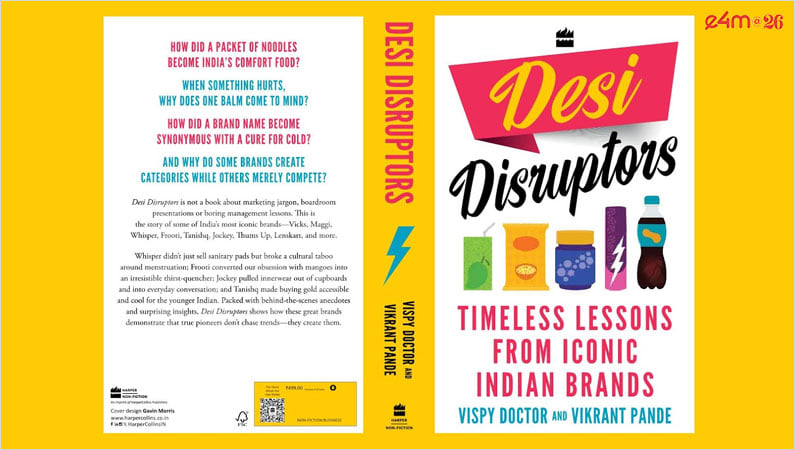

- "Desi Disruptors" by Vispy Doctor and Vikrant Pande offers an engaging exploration of how iconic Indian brands like Vicks, Maggi, and Tanishq were built and became market leaders, focusing on the strategic thinking behind their success.
- The book is structured around four themes: creating a blue ocean, identifying consumer needs, transforming commodities into brands, and competitive leadership, providing insights into brand differentiation and consumer understanding.
- The authors emphasize clarity and accessibility, avoiding jargon and complex frameworks, making the book suitable for both newcomers to marketing and experienced professionals seeking a refresher.
- A key takeaway is the importance of understanding consumer behavior, highlighting that successful branding is rooted in deep insights and strategic decision-making rather than just memorable advertising.
There are marketing books that teach you frameworks, books that bombard you with jargon, and then there are books that simply make you enjoy marketing all over again. Desi Disruptors by Vispy Doctor and Vikrant Pande belongs to the last category.
It is a refreshing and highly readable account of how some of India's most iconic brands were built, nurtured and turned into market leaders. What makes the book particularly engaging is that these are brands we know intimately — Vicks, Maggi, Whisper, Frooti, Tanishq, Jockey, Thums Up, Lenskart and several others. We know the brands, have consumed them and remember many of their campaigns. But the book takes us behind these familiar names to understand the thinking that made them successful.
Four Routes to Disruption
The book is structured around four broad themes: creating a blue ocean, creating a need, turning a commodity into a brand, and creating leaders by beating the competition. Each section offers a different perspective on how brands identified opportunities, understood consumers and built distinctive propositions.
The interesting part is that the authors don't simply tell us that these brands were successful. They try to explain why they succeeded. What was the consumer insight? What was the strategic thought? How did the brand differentiate itself? And how did that thinking eventually translate into advertising and communication?
That makes the book more than a collection of brand stories.
Marketing Without the Jargon
What I particularly liked about Desi Disruptors is its lucidity. The authors don't make marketing sound more complicated than it is. There is no excessive use of terminology, complicated frameworks or theoretical explanations that require a marketing dictionary.
Instead, the lessons emerge naturally from the stories.
Whisper is not merely a story about selling sanitary pads; it is about how a brand entered a culturally sensitive space and helped change the conversation around menstruation. Frooti understood India's enduring relationship with mangoes and turned it into a distinctive and memorable brand proposition. Jockey made innerwear something consumers could talk about openly. Tanishq found a way to make the traditional gold category more contemporary and relevant to a younger consumer.
Each story makes you pause and think about the amount of strategic thinking that goes behind what may eventually appear to be a simple consumer proposition.
The Authors Bring Different Strengths
The background of the two authors also adds an interesting dimension to the book.
Vispy Doctor describes himself as "terminally curious", and that is an apt description for someone whose professional journey has moved across science, business and branding. After doctoral work in physics and an MBA from XLRI, he moved into branding and business consulting. His interests extend beyond business into astronomy, photography, spirituality and farming. That combination of scientific training and curiosity about human behaviour perhaps explains the analytical yet accessible way in which the brands are examined.
Vikrant Pande brings a very different but complementary experience. An IIM Bangalore graduate, he spent twenty-five years in the corporate world before moving into writing full-time. He has translated and authored several books, including The Tatas: The Family That Built a Business and a Nation, which won the Gaja Capital Business Book Prize, and In the Footsteps of Rama. His experience in translating complex stories and ideas for a wider readership is reflected in the easy narrative flow of Desi Disruptors.
The combination of Doctor's branding perspective and Pande's storytelling experience works particularly well.
Behind Every Great Campaign
For someone who has spent years in advertising, marketing and communication, this is perhaps the most enjoyable aspect of the book.
We tend to remember the advertising. We remember the television commercial, the tagline, the packaging or the campaign that became part of popular culture. What we don't always remember is the work that happened before the campaign — the research, consumer understanding, insight, positioning and strategic decisions.
Desi Disruptors reconnects these dots.
It demonstrates that advertising is often the visible expression of a much larger piece of thinking. The strongest brands featured in the book did not succeed simply because they had memorable advertising. They succeeded because the communication was rooted in a clear understanding of the consumer and the market.
A Good Refresher
That is also why the book works at two levels.
For someone new to marketing, advertising or business communication, it provides a very good introduction to how brands are actually built. It shows, through familiar examples, how research can lead to an insight, how an insight can shape strategy and how strategy can eventually become communication.
For experienced professionals, it works as a very good refresher.
And perhaps that is the best compliment one can give a marketing book. You don't feel that you are reading a classroom lesson. The stories keep the book moving and the variety of brands ensures that you don't get bored.
The Consumer Remains at the Centre
The larger takeaway from Desi Disruptors is quite simple: great brands begin with an understanding of people.
Markets change. Media changes. Technology changes. Today we have data, digital platforms, AI and an extraordinary ability to measure consumer behaviour. But the fundamental challenge remains the same — understanding what people need, what they feel, what they aspire to and sometimes what they haven't yet articulated themselves.
That is what makes Desi Disruptors relevant.
It doesn't claim to reinvent marketing. Instead, it does something perhaps more useful. It reminds us of the fundamentals through the stories of brands that got those fundamentals right.
For anyone interested in brands, advertising and the Indian consumer, this is an enjoyable, insightful and refreshingly lucid read.
Disclaimer: The views expressed here are solely those of the author and do not in any way represent the views of exchange4media.com.
Read more news about Digital Media, Television Media, Out of Home Advertising, Print Media, Latest Advertising India
For more updates, be socially connected with us onInstagram, LinkedIn, Twitter, Facebook, YouTube & Google News