How PR & Comms is rewriting the way brands show up during cultural moments
From reactive posts to real-time strategy, comms & PR teams are changing what it means to show up
 by
Published: Nov 2, 2026 2:34 PM | 20 min read
 Follow Us


- The traditional approach to festive marketing in India, centered around major festivals like Diwali, is evolving into a year-round strategy that embraces diverse regional celebrations, requiring brands to engage authentically with local customs and communities.
- Brands are shifting from merely "owning the occasion" to "being part of the celebrations," emphasizing meaningful contributions and cultural relevance rather than opportunistic visibility during festivals.
- The role of creators and earned media is becoming crucial, as they help shape narratives and validate brand participation in festivities, moving away from a single, brand-controlled campaign to a more community-driven conversation.
- Future festive communications will likely integrate AI, focus on hyper-local storytelling, and prioritize genuine human connections, with brands needing to demonstrate authenticity and relevance to stand out in a crowded marketplace.
Brands once treated Diwali as the one big date on the festive calendar. This year, the calendar has dissolved into a year-round run of regional, community-owned moments, and the communicators who manage them say the rules of showing up have changed with it.
There was a time when the festive season in India meant one thing: a big-budget Diwali film, a splash of marigold, exchange of sweets, and sparkle in the packaging, and a discount to close the loop. That template is fading fast. India is a country of festivals from Ganesh Chaturthi, Eid, Onam, Navratri to Durga Puja, Christmas, and Dussehra, each festival demand their own conversation, in their own language, with their own rituals and sensitivities, and audiences have grown quick to tell a brand that belongs from one that has merely turned up.
To understand what is really happening behind the glitter, we spoke to communications leaders: Jyotsna Dash Nanda of the Dharampal Satyapal Group, Akanksha Jain of Swiggy, Jagruti Kirloskar of MICA, Bavani Srinu of Hilton and Sonam Shah of Treize Communications. We asked them where the money, the attention and the credibility are going, and what is working during culture conversations.
The festival is no longer the campaign
The fundamental transformation lies in how brands conceptualize their presence during festivals.
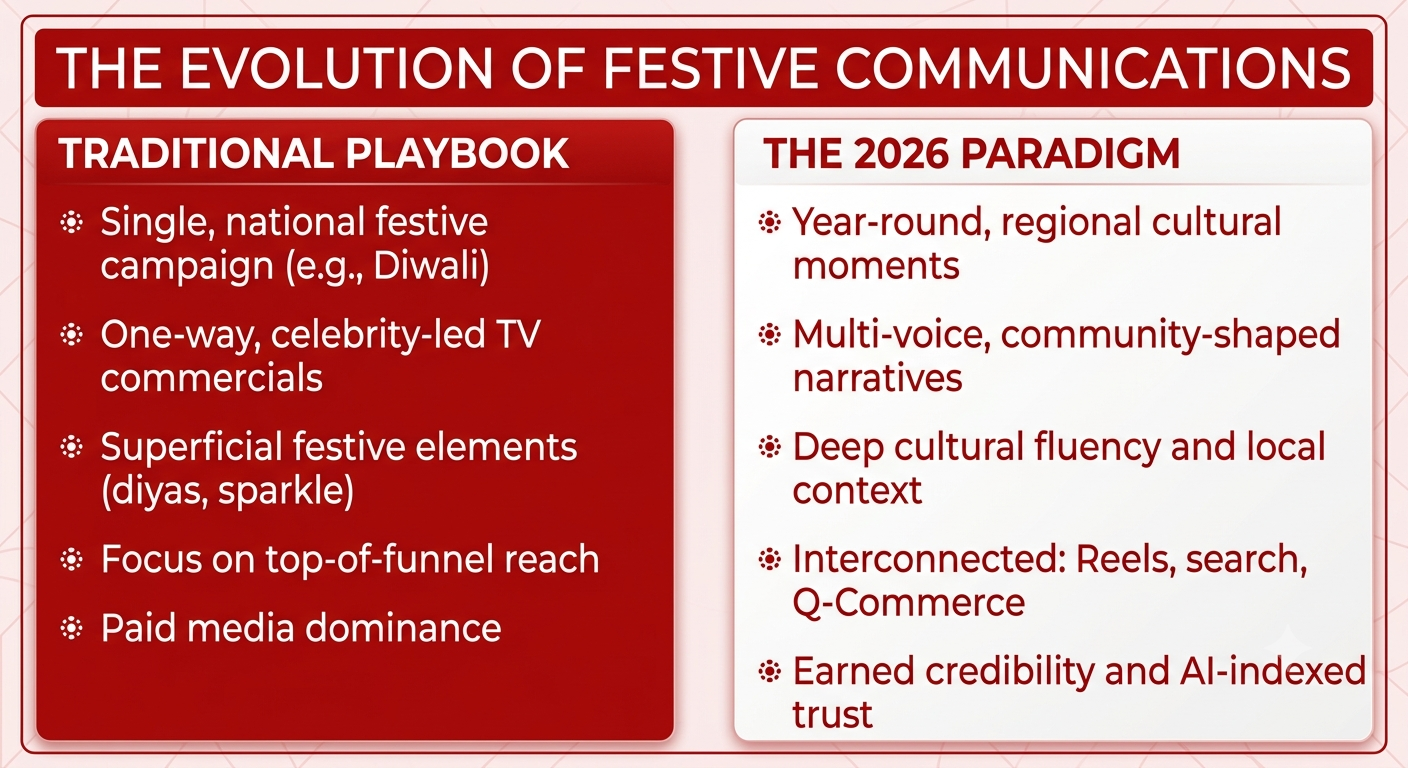
"What has fundamentally changed about festive marketing in 2026 is that it is no longer one single festival like Durga Puja or Diwali-led advertising season, but a series of distinct cultural and regional moments all year round. Every festival/occasion is celebrated. Experience and moments matter today," explains Jyotsna Dash Nanda, AVP Corporate Communications at DS Group.
She describes a consumer who no longer moves in a straight line from ad to shelf. "Consumers discover, evaluate and buy through an interconnected journey. A reel sparks interest, a creator helps affirm trust, search and retail media shape consideration and quick commerce enables immediate fulfilment," she observes. Brands, she points out, are "moving spend earlier to build intent before festive media costs peak, while placing greater emphasis on regional relevance, creator-led storytelling and measurable business outcomes."
For Akanksha Jain, Assistant Vice President, PR and Communications at Swiggy, the change is best captured as a shift in posture. "Festive marketing and communications have transitioned from 'owning the occasion' to 'being a part of the celebrations.' Today, a festival is no longer merely seen as a time when a brand can unveil a new film that is designed to emotionally connect with the audience, add festive packaging and offer a discount," she articulates. "Brands are also involving regional creators earlier and developing narratives around how people actually celebrate locally," she adds.
The ecosystem around the festival has widened too. "Today, the world has moved to a cultural and commerce ecosystem that includes stakeholders like content creators, search, AI-assisted discovery, physical experiences and online commerce," Jain notes.
From the hospitality side, Bavani Srinu, Cluster Director, Marketing & Communications at Hilton, asserts that the old playbook no longer works. "I think the biggest change is that brands can no longer rely on simply showing up during a festival and expect people to engage. Audiences are exposed to festive campaigns from every direction, so what matters is whether a brand has something meaningful to add to the occasion," she stresses.
And for Jagruti Kirloskar, Brand Consultant and Head, Global Alliances & Communications at MICA, the audience itself has changed before the campaign even begins. "Festive marketing today has a new first audience: it's AI. It meets your brand long before your customers do. So by all means, ace your AI strategy, but keep your promises realistic, genuine and human. The brand that stands out will be the one that spots a real need gap and answers it in the most creative way," she cautions.
Earning a place at the table, not borrowing one
If every brand can now be present at every festival, the harder question is whether it should be, and how to tell participation from opportunism.
"It is all about cultural marketing and the starting point is to check on relevance and not mere visibility, to help build respect and trust amongst the audience. Today we ask whether it has a genuine role to play in the festival, whether it can enable a ritual, solve a real festive need, support a community, preserve a tradition or make celebration more meaningful," Nanda underlines.
That requires homework. "Cultural fluency matters: understanding local customs, language, regional nuances and sensitivities is essential, and partnering with local creators, communities or credible voices can help brands earn authenticity rather than merely borrow it. The most effective participation is useful and consistent, showing up before, during and after the moment with actions that match the message," she elaborates. Her closing test reframes the brief itself: "Ultimately, brands should not ask how to appear during a festival, but what they can genuinely contribute to it; when the contribution is real, cultural participation feels natural rather than opportunistic."
"The idea is not to force a brand into every occasion, but to find a natural connection between what the brand offers and what people value about that moment. For us in hospitality, festivals are as much about bringing people together as they are about the celebration itself. At Hilton Garden Inn Bengaluru Embassy TechVillage, Outer Ring Road, understanding the needs of a business-led audience while creating experiences that also appeal to local consumers is an important consideration," reflects Srinu.
Sonam Shah, Founder and CEO of Treize Communications, locates the root of the opportunism problem in how PR itself now works. "The definition of Public Relations has evolved a lot. PR, which has been about creating awareness and news, has significantly moved, or, to say, routed via social media. This core change in how PR functions has got brands to participate in brand moments, to stay topical and visible. Social media entirely is not PR, but this makes way for earned media and mentions in stories," she explains.
The trap, in her view, is the order of operations. "This is where the perception changes, and brands start to look opportunistic. An activity is today done for social media and then used to create PR, rather than highlighting something about the company; which is actually news and adds the right value to the brand," Shah contends.
Her prescription is deliberately unglamorous. "Focus on the brand's core values and long-term vision; build a story that readers truly want to know. Long-format articles and thought leadership should be built via PR, as this showcases more about the company and does not seem opportunistic," she recommends.
Kirloskar offers the unique version of the test, explaining, "Keep your promises realistic, genuine and human."
Early Planning vs. Last-Minute Tactics
PR delivers maximum impact when integrated early into the strategic lifecycle, rather than being treated as a distribution mechanism at the end of a campaign pipeline.
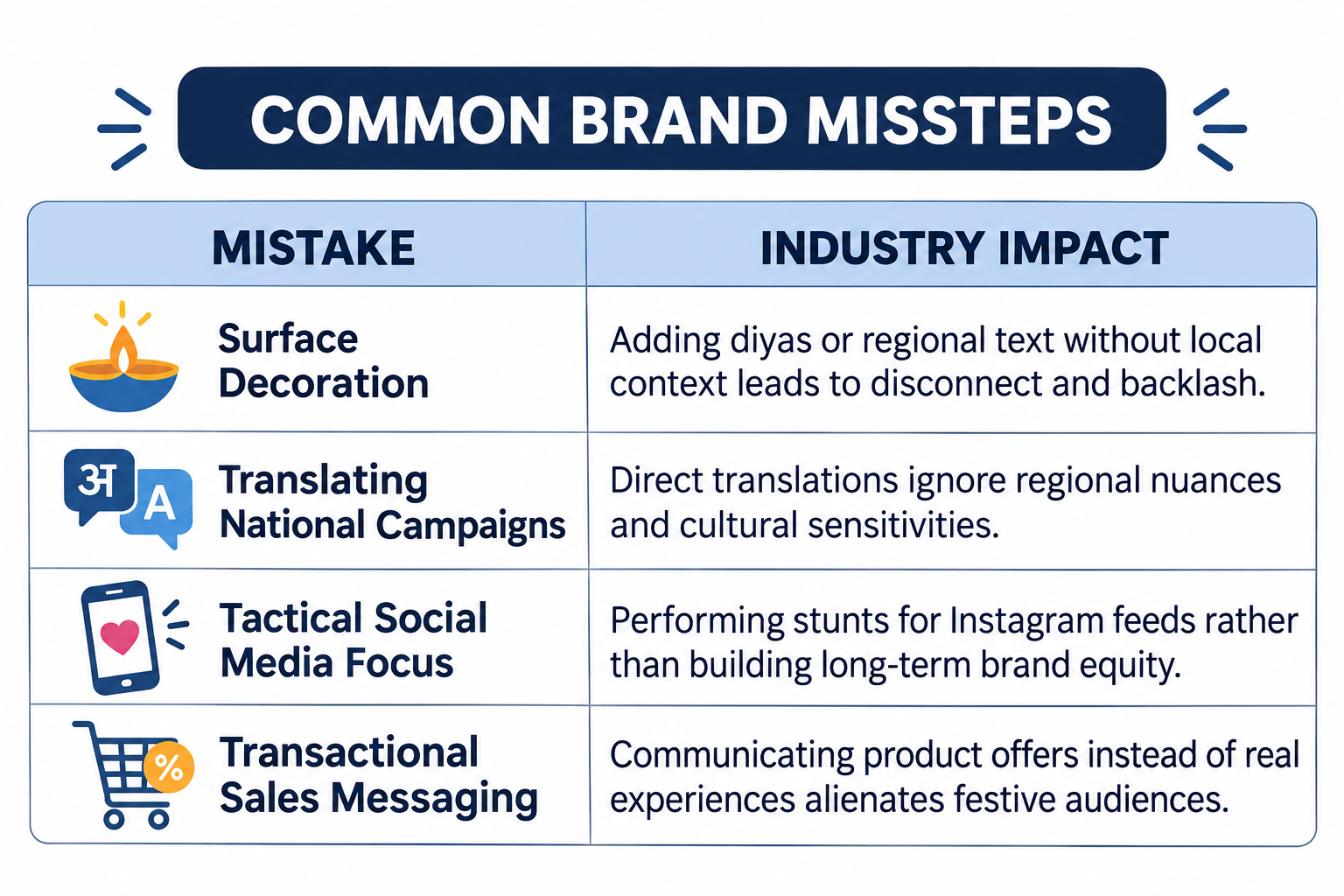
Asked where PR adds the most value, the communicators begin with a gripe about timing. "PR adds the best value when done in a timely manner and is strategically planned. Most clients/brands still look at PR as a last-minute activity and just send a half-baked press release. This adds minimal value, as storytelling, brand identity, core values and long-term vision are missing," says Shah.
She sees a second, subtler error in whose voice leads. "Brands focus more on what users or readers want, vs. what the brand actually wants to convey or should convey. This is a reactive way of communication. Communicating what users want to see on social feeds versus what a brand actually stands for are two different things. The focus should be shifted to what's more important," she argues.
Jain says the old press-release reflex no longer holds. "The approach has moved beyond sending a press release for a new campaign launch. The storytelling around a festive campaign today needs to be more topical and connected to the local culture as well as experiences. It should showcase how the brand is contributing to the overall celebration, whether it is about bringing an untold story to life, or hands-on festive participation," she maintains.
Her list of credible messengers is broad: "This could include creators, customers, a chef, a community focused organization, an artisan, amongst others as seem relevant," she points out. She also warns against the most common shortcut. "Curating a national-level idea and translating it for regional markets may not work anymore. Also, not being mindful of local nuances may lead to negative chatter," she cautions.
Nanda places the start of PR's job well before launch day. "Our role begins well ahead of the campaign, starting from which festival to associate with in which region with insights pertaining to that culture, identifying the risk elements so that the messaging does not hurt any sentiment to ensure the idea is rooted in what people genuinely value during that moment," she articulates. Once the campaign is out, "PR then helps bring authenticity through regional media, local creators, community voices, artisans and cultural storytellers, so that the audience actually relate to it," she continues. The work does not end at launch either: PR "also plays a critical role in real-time listening and reputation management, helping brands read the mood of social conversations, respond quickly to misinterpretation and protect trust in case the audience engagement is not as desired." Her summary of the division of labour is hard to improve upon: "While advertising can create reach, PR helps create permission, relevance and belief."
The biggest mistake, she emphasises, is cosmetic. "When culture is treated like a decoration, for example adding a diya, festive attire, sparkle or regional language to a national campaign assuming it will feel authentic locally, is the biggest mistake a brand can make in today's world. Then there is disconnect and the meaning and context is lost in the process," she warns.
Srinu names a related failure of mindset. "The biggest mistake is treating every festival as another campaign deadline. If the communication is built around what the brand wants to sell, rather than what the audience wants to experience, it will struggle to stand out," she observes. The alternative, she suggests, is giving people "a reason to look beyond the offer and understand the story behind it. A festive dining experience, for instance, becomes more interesting when the conversation goes beyond the menu to the traditions, people and thoughts behind it."
Kirloskar sees PR's role as an extension of the campaign's life. "PR is what gives a festive campaign its second life. It rounds it out, carrying the right message to the right audience in the most authentic way. In a season when everyone is paying for attention, earned media still holds more value," she asserts.
Whose story is it? Creators, earned media and the crowd
Once a festive campaign goes live, it stops being the brand's property. "Once a festive campaign is out, the narrative no longer belongs to the brand. Social conversations rule the roost, and much of the chatter comes from influencers who hit the ground the minute you launch, not from consumers. Earned media is what cuts through that noise with credibility, for people and now for AI," asserts Kirloskar. She leaves communicators with three questions: "Is your message relevant, consistent and compelling? Are you partnered with the right creators? And most importantly, what is your follow-up content strategy?"
Srinu sees the same balance of power from the guest's side of the table. "The audience now has as much influence over a campaign's narrative as the brand does. A creator can introduce an experience through a personal lens, the media can explore the story behind it, and guests can share their own perspectives. Each brings something different to the conversation," she observes. The risk, she cautions, is scripting. "From a marketing standpoint, the challenge is to make sure these voices feel credible rather than overly scripted. In hospitality, where people often rely on recommendations and first-hand experiences before making a booking, that distinction matters. We need to create experiences worth talking about, not just content designed to be talked about."
- From one film to many voices
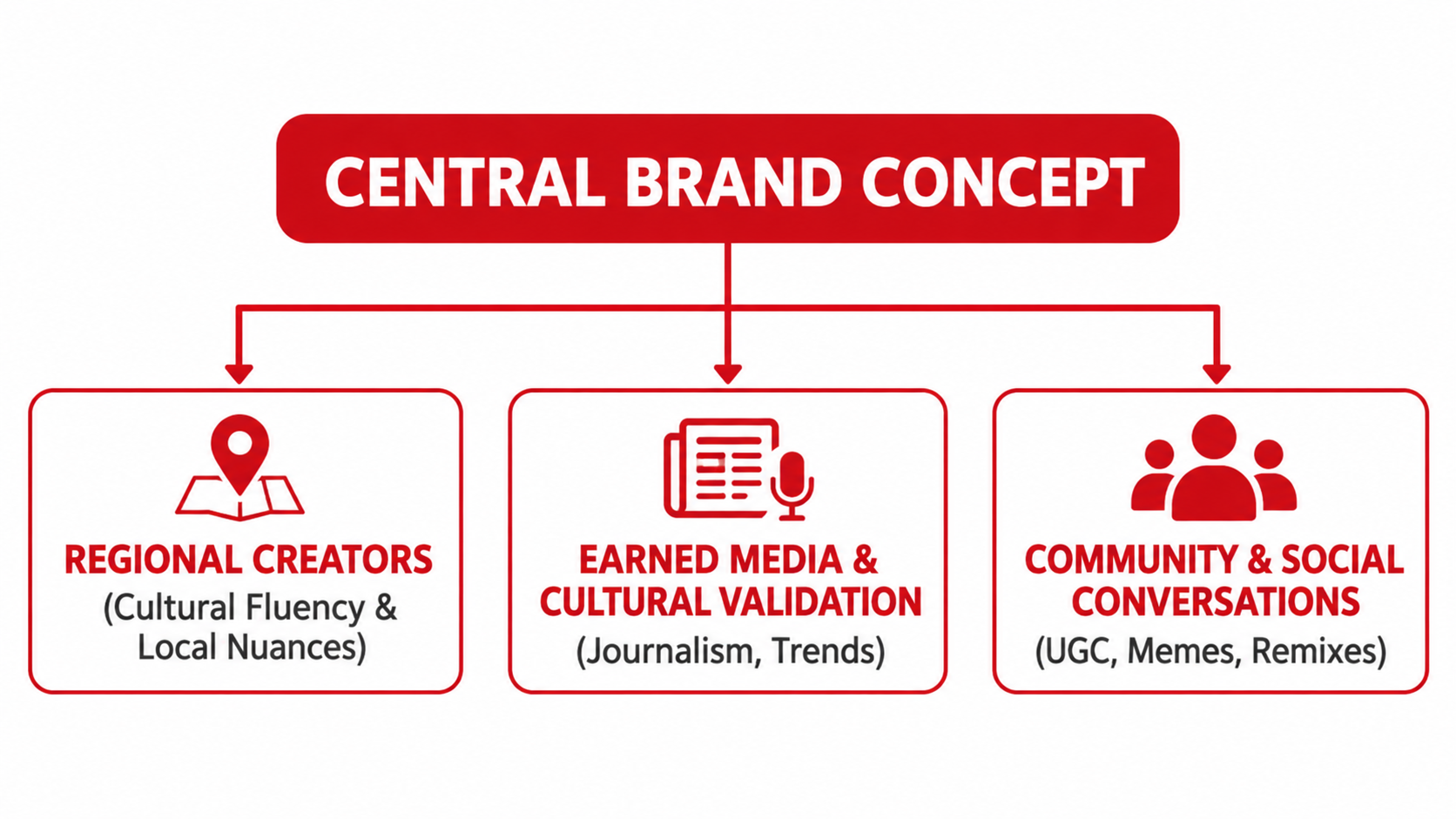
"Creators, earned media and social conversations are changing the festive narrative by shifting it from a brand-controlled, one-film campaign to a community-shaped, multi-voice conversation. Instead of relying solely on a celebrity-led national advertisement, brands now build festive stories through creators who can translate a campaign into local language, regional custom, personal experience and platform-native content," Nanda explains. She points to the money following that logic: "This is especially powerful in India's diverse festive landscape, where regional and Tier-2/Tier-3 creators bring cultural fluency and festive creator spend is projected to touch ₹900 crore this year, making it clear that trust and relevance matter as much as reach."
Jain agrees on who is leading. "Creators are playing an active role around shaping the festive narrative with regional, micro and nano creators who already understand the rituals, humour, food, language and family dynamics of their communities, leading the pack," she notes. The craft lesson, she underlines, is restraint. "With creator-led content, the focus should be a lot more on the culturally native storytelling, rather than following the standard template. Subtle brand plug-ins will work better rather than a pure-play salesy content."
- What earned media is really for
Both Nanda and Jain see earned media shifting from megaphone to stamp of approval. "When a regional publication, community voice, cultural commentator or respected creator picks up a campaign, it validates the brand's participation in the festival rather than merely amplifying through paid media. This earned media coverage then becomes social currency and it is shared, talked about, debated, remixed and reinterpreted across all social media platforms and other community spaces," Nanda articulates. The consequence, she adds: "The festive narrative is therefore no longer finished when the campaign film is released; it evolves through comments, memes, creator responses, user-generated content and public conversation."
"Earned media is moving from only campaign amplification to cultural validation. A press release saying 'Brand X launches its heartwarming Diwali campaign' has limited earned value because hundreds of brands are doing essentially the same thing. PR becomes much more impactful when there is an underlying narrative: a new consumer behaviour, an untold story, original data and trends, an interesting collaboration, a community initiative or an interesting consumer insight," Jain emphasises. The afterlife is lively too: "The festive campaigns are also getting covered across social channels with memes, marketing pages, regional adaptations, customer stories and unique activation ideas driving social conversations for days post the campaign going live," she points out.
Shah, however, notes that big-ticket campaigns still do much of the heavy lifting on earned coverage. "Earned media is still garnered via large campaigns, 360-degree, OOH, or Print, which create chatter on social media. These campaigns now feature creators as they add more relatable value," she mentions.
- Inspiration and sales, in the same scroll
Creators are no longer just storytellers. "Today, creators help drive inspiration and sales. By presenting products through local storytelling, styling or humour, they build interest, while promo codes and affiliate links drive immediate purchases," Nanda highlights. Shah adds detail on what that looks like on screen. "Creators focus more on Instagram, to show festive collections, trends, create GRWM videos showcasing how to use and style festive items. This educates users on using new products and how they can add festive 'vibes'. It allows users to see how the purchase will be used in real life," she elaborates. In her telling, "the festive narrative is built mostly around styling videos, home decor, using new electronics, etc."
Nanda's advice on structure is to succeed during the festive season, communicators must design flexible campaign ecosystems. "For campaigns to be successful, we must give creators the flexibility to adapt it authentically while keeping the central idea intact and let earned media build trust," she recommends.
What format is actually working?
The formats delivering the strongest return on engagement are those native to user celebration patterns rather than standard advertising placements.
On format, the communicators are united in one caution, stating, do not chase what is trending. "I would not choose a format simply because it is trending. The question is whether it helps the audience understand the experience and gives them a reason to engage, visit or make a booking," Srinu stresses. She still sees clear winners. "Short-form video and creator-led content are particularly effective at bringing experiences to life, while editorial stories offer greater depth and credibility. For hospitality, this creates opportunities to tell stories around food, local traditions and the experience of celebrating together," she reflects.
Jain draws the dividing line between formats that carry a festive message and those that live inside the festival. "The strongest engagement is coming from formats that feel native to how people celebrate, rather than formats that merely carry a festive message. Short-form creator video is currently the clearest winner. Reels and Shorts combine entertainment, cultural participation and product discovery in one format," she asserts.
She lists what else is landing:
- Regional creators and language. "Regional creators are also doing well with campaigns built around local culture and language, reporting stronger engagement."
- Useful listicles. "Listicles that are relevant to the festive season are doing well. From shopping and gifting guides, to styling ideas, recipes, product demos to creator recommendations, content that is entertaining is doing well."
- Experiences on the ground. "Festive season is also the time when experiential and outdoor activities do well from a PR standpoint. Interesting on-ground campaigns are of interest to media and social channels."
- Hyperlocal storytelling. "Regional-language and hyperlocal content continues to do well as consumers like to know more about the local traditions, celebrations etc., whether it is Durga Puja in West Bengal or Ganesh Chaturthi in Maharashtra."
- Data stories. "Another interesting PR approach is leveraging interesting and original trends around how consumers celebrated a specific festival: what they ordered, what food they preferred, and how it is changing over time."
Kirloskar's test is the clock. "Attention is scarce, and it moves in a flash. The campaigns that win will always be the innovative ones, witty when the moment allows, that strike a chord in the first few seconds!" she underscores.
The new economics of attention
Behind every format debate sits a more basic problem: attention is the scarcest thing in the festive marketplace, and it is getting more expensive to win.
"People are consuming more media across more screens, but that doesn't mean brands are receiving more meaningful attention. The cost of interruption is rising. Every brand is competing not just with competitors but with friends, creators, entertainment, news, sport, messaging and thousands of other stimuli. Consequently, louder doesn't necessarily win. More frequency can simply produce more avoidance. The scarce resource isn't content anymore; it is innovative storytelling that catches the attention of people," Jain contends.
Her advice is to restructure the story, not turn up the volume. "Today, earned media has a larger and more strategic role to play. The storytelling will need to evolve from just talking about the campaign, to ensuring that brand is seen as a part of the celebration, via an interesting idea, an untold story, a cultural perspective, an experience worth attending, or interesting data," she advises, adding that "social media is an important pillar and communications strategy should include a creator and social leg."
Addressing the fragmented media landscape, Shah, cautions against relying on short-term tactical spikes at the expense of core brand identity. "Communications experts, PR professionals, and PR agency owners are aware of the industry dynamics and the shifts taking place," she notes. "User attention today is across all mediums, making it highly challenging to garner earned media, which holds trust and value. These changing dynamics focus on one thing eventually: for a brand to build strong recall value amongst its target audience, as well as beyond the core TG, they need to have a long-term strategy and a consistent approach."
When the first reader is a machine
Kirloskar adds a layer most festive playbooks have yet to absorb: attention now also flows through AI. "Shoppers increasingly get their answers from AI without ever clicking through the brand website. So many of us click a collaborator ad on Instagram and make the direct purchase. Whatever AI says about you becomes your first impression, and AI repeats what credible sources say. That makes earned reputation more valuable than ever," she emphasises.
What will define the next phase of festive communications?
Looking ahead, festive communications will be defined by the integration of artificial intelligence, hyper-localized storytelling, hyper-connected last-mile fulfillment, and a return to human-centric brand values.
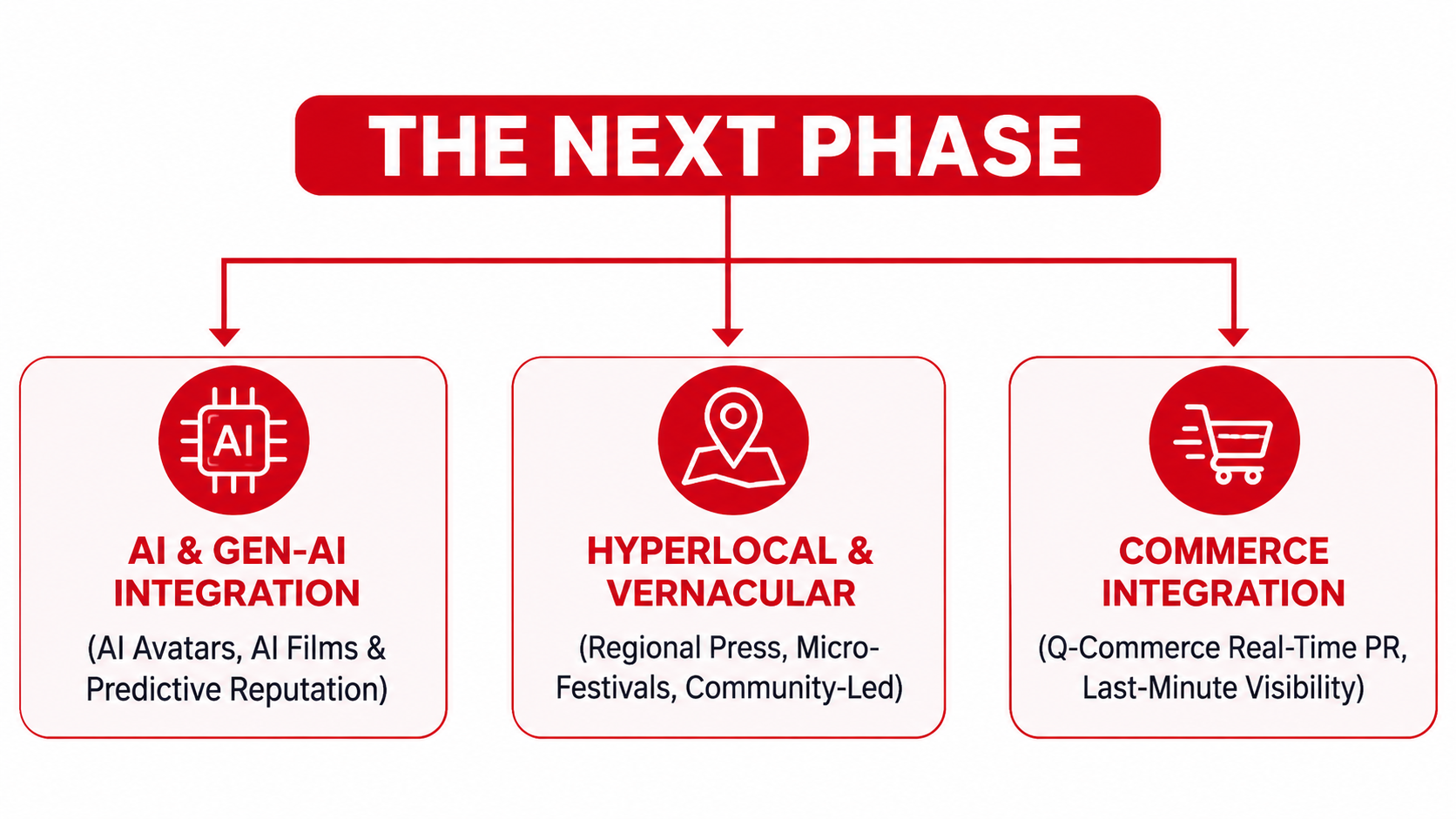
"The next phase of festive communication will be AI-led. Over the next 2-3 years, we will see AI films and campaigns, or AI Avatars taking the lead. We will also see brands focus on intent and cause-driven campaigns," predicts Shah. She also expects last-minute pressure on visibility: "With D2C brands taking the lead and last-minute shopping being done on Q-Comm app, these categories will need the right visibility during the festive season." PR, she adds, "will have a dual role of garnering last-minute media articles as well as focusing on long-term strategy."
Kirloskar offers the counterweight, in a line that reads like a manifesto. "Honest. Humans. And a dash of creativity. AI can make every brand sound perfect, but only the real ones will be felt," she asserts.
Jain sees the future in smaller, sharper moments. "The next phase of festive communications will be defined by a shift from only talking about campaigns built around festivals to being a part of the celebrations. The future will be about leveraging earned media around micro festivals and moments. Vernacular press and regional digital platforms will play a vital role in festive storytelling," she envisions. Behavioral data, she believes, will become a currency of its own: "Innovative content like consumption, ordering trends or consumer behaviour trends will see relevance from the standpoint of innovative storytelling across mainstream media." And she ends where she began: "Experiential storytelling that generates authentic features will work well. Cultural intelligence translating to innovative storytelling will be the key to engaging consumers and communities."
Nanda describes the same destination as a structural one. "Festive marketing has shifted from blanket national campaigns centered on Diwali to a highly targeted, year-round strategy that leverages regional culture, authentic creator partnerships and connected commerce. Brands are now engaging distinct communities across diverse cultural moments like Ganesh Chaturthi, Onam, Durga Puja, Navratri, Dussehra and Diwali with localized, multilingual messaging. Rather than relying solely on paid media reach, trust and social conversations or engagements are important and hence brands engage with micro, nano and regional creators who deliver platform-native, relatable narratives," she outlines.
Srinu believes the field will reward brands that stand apart. "I believe the next phase will be about making festive marketing more distinctive and less predictable. There will always be competition for attention during major celebrations, but brands that understand their audiences and have a clear point of view will have an advantage," she reasons. For hospitality, "that means looking beyond the festive calendar and asking how an occasion can translate into a meaningful dining, social or celebratory experience. It also means connecting communication more closely with business outcomes, whether that is stronger consideration, dining enquiries, event bookings or repeat visits."
She concludes, “Ultimately, the real test is not how visible a brand is during a festival, but whether people remember it for the right reasons.”
The takeaway
Across diverse vantage points, from a food major and a delivery platform to a business school, a global hotel brand and an independent agency, the message is that the festival is a conversation already under way, in local languages, between communities, creators, journalists and now algorithms. Brands that arrive with decoration will be noticed for the wrong reasons. Those that arrive early, bring something useful, and stay after the lights go out may earn permission, relevance and belief.
Read more news about PR and Corporate Communication News, Internet Advertising, Marketing News, Digital Media News, People Movement News
For more updates, be socially connected with us onInstagram, LinkedIn, Twitter, Facebook YouTube & Google News
