Big stars, bigger spends: Are celeb ads enough to create brand recall?
As brands invest in high-profile faces to generate buzz, advertising leaders debate whether celebrity-led campaigns build lasting brand associations or deliver expensive, short-lived visibility
 by
Published: Oct 22, 2026 9:12 AM | 10 min read
 Follow Us

- The Indian sports celebrity endorsement market is projected to reach ₹1,350 crore by 2025, with cricketers dominating nearly 90% of this space, as brands increasingly rely on celebrity endorsements for visibility and media coverage.
- Despite the popularity of celebrity-led campaigns, data shows a decline in their presence in television ads, raising concerns about whether these endorsements effectively build brand equity or merely generate short-term attention.
- Experts warn that focusing solely on virality can overshadow brand identity, leading to campaigns where audiences remember the celebrity rather than the brand itself, emphasizing the need for authentic and relatable partnerships.
- A shift towards measuring long-term brand impact over immediate visibility is emerging, with calls for brands to balance celebrity endorsements with strategic consistency to ensure lasting consumer recall and business success.
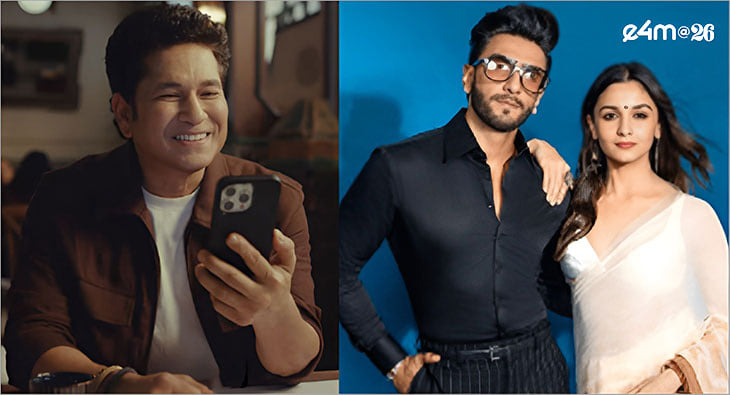
In many agency briefs today, the celebrity conversation begins long before the idea does. A big name offers what every brand wants on launch day: instant eyeballs. A ready-made media story and a fighting chance of surviving the scroll. The money has followed the conversation. Cricketers alone accounted for almost 90% of India’s sports celebrity endorsement market, estimated at ₹1,350 crore in 2025, according to industry estimates. Fresh pairings such as OpenAI signing Sachin Tendulkar to promote ChatGPT in India and the National Payments Corporation of India enlisting MS Dhoni for BHIM point the same way.
Yet the appetite is not without friction. TAM AdEx data showed that celebrities featured in 29% of television ad telecasts in the first half of 2025, down from 32% a year earlier, even as the most visible names kept widening their portfolios. Dhoni, for instance, endorsed 59 brands in 2025, up from 52 in 2024.
The pattern raises a question that creative and commercial heads are now asking in equal measure. Are celebrities being bought to build brand equity or to buy visibility? And is success being measured by the noise a campaign makes in its first 48 hours or by what the brand owns in the consumer’s mind a year later?
When virality becomes the objective
The yardstick has quietly shifted. Celebrity-led films are increasingly judged on how fast they travel, be it first-day views, meme potential, trending hashtags, or the number of reels spun off the back of a hook step. There is nothing wrong with a viral moment. The trouble begins when virality stops being a tool and becomes the outcome, because attention is cheap to rent and expensive to convert.
For Harikrishnan Pillai, Founder & CEO of TheSmallBigIdea, an independent full-service digital agency founded in 2014, the difference shows up in how clients behave. “There are essentially two kinds of clients,” he says, “One understands that viral hits buy attention, people will notice you, talk about you, but they also understand that virality by itself rarely builds something durable. They aim for virality with commercial prudence and brand salience. The other chases virality as an outcome, not as a tool.”
The cycle that follows will be familiar to anyone who has sat through a few CMO transitions. A new marketing head arrives and the cheques go towards celebrities, big flashy films, high-decibel launches and influencer campaigns. For a couple of years, Pillai says, “everything looks great on the surface”, until “the numbers don’t move, the sales don’t follow, and suddenly that CMO is gone.” What comes next is usually a reset towards what he calls “a quieter, more disciplined, more fundamentals-driven approach”, one that may look less glamorous to the industry but is often far more effective.
When the celebrity overshadows the brand
The sharper risk of an attention-first approach is what survives in memory once the buzz fades. A film can win the day on the strength of the face, the joke or the cameo and still fail the logo swap test, where the audience remembers the star and the moment but cannot say who paid for them. The problem compounds in multi-celebrity ensembles, where several famous faces compete for the same 30 seconds and the brand is left to fight for whatever screen time remains. Pillai is blunt about the outcome: “People remember the moment, not the brand.”
Moumita Pal, National Creative Director at Dentsu Creative, sees the same drift from the creative side of the table: “I do think that many celebrity-led ads today are increasingly optimized for immediate attention rather than long-term brand memory. In a fast-moving digital ecosystem driven by short-form content, trends, and algorithmic visibility, grabbing attention often becomes the primary objective. A big-name celebrity can generate instant buzz, social shares, and media coverage but that doesn’t always translate into lasting brand recall or meaningful brand association.”
That recall gap is also why the audience is no longer an easy one to please. Viewers who scroll past dozens of endorsements a day have built a reliable radar for the paid-for smile, and creative teams are being forced to reckon with it. “Audiences are far more discerning today. They can quickly sense when a celebrity endorsement feels forced, transactional, or disconnected from the brand’s core values,” Pal says.
When the celebrity becomes part of the brand
The partnerships that endure tend to share one trait, which is that the star’s persona and the brand’s personality pull in the same direction, so the pairing feels inevitable rather than purchased. Pal argues that the role has to be believable for that to happen: “For celebrity-led advertising to truly work, the role has to be believable. The celebrity must embody a relatable stance and integrate naturally into the brand’s narrative.”
She points to Aamir Khan’s ‘Thanda Matlab Coca-Cola’, Irrfan Khan’s work for Vodafone and Shah Rukh Khan’s long-running association with Pepsi as partnerships that went beyond visibility, and to more recent pairings such as Ranveer Singh and Alia Bhatt for MakeMyTrip, Rahul Dravid for CRED, the 3 Idiots cast for Dream11 and Jackie Shroff with Tiger Shroff for Uber and Ugaoo. In her reading, the common thread is that the celebrities were “woven into narratives that felt entertaining, believable, and aligned with the brand’s personality.”
Sharma goes back to the same Vodafone and Irrfan Khan combination as his benchmark for what a true brand fit looks like: “Vodafone in its glory days did lovely work with Irrfan Khan. It was a brilliant brand fit. The brand and the celeb were both simple, straight and classy. The client used Irrfan's matter of fact style and merged it seamlessly with the uncomplicated nature of Vodafone.”
A famous face isn’t a brand strategy
When the idea is thin, the celebrity ends up doing all the heavy lifting, and that is where many campaigns come undone. It is a pattern creative teams know well: the face is locked first, the script is bent around the star’s availability and the film is built to showcase the talent rather than the product truth.
The celebrity becomes a solution looking for a problem, and the brand’s positioning is reduced to a supporting act. Nakul Sharma, Senior Vice President & Executive Creative Director at VML India, says the trade-off is increasingly visible in how brands behave: “Yes brands are definitely going for short term gains over long term impact. The fact that celebs are changing from one campaign to another is proof of this phenomenon. At times, the celeb is an after thought. Almost like a garnish to attract eyeballs.”
The rotation is easier to spot in the data. When a single name fronts dozens of brands at once, as Dhoni’s 59 endorsements in 2025 suggest, the question is how much of that equity any one advertiser can realistically claim as its own.
Consistency versus the celebrity carousel
Fit, however, is only half the equation. A distinctive brand asset is built through repetition, and a celebrity becomes one only after years of showing up in the same role with the same tone. The carousel model, where a new face arrives with every campaign, resets that clock each time. Every fresh burst of attention may look healthy on the social dashboard while the long-term brand memory keeps starting from zero. Sharma has little patience for the approach: “Ultimately, I see this dying out. There is just no substitute for good old consistency and hammering away with the same celeb face.”
Interestingly, the cricket-heavy endorsement market suggests brands may be changing the kind of famous face they buy rather than the way they use it. Hansa Research’s Brand Endorser Report 2024 ranked Virat Kohli, MS Dhoni and Sachin Tendulkar as the top three celebrities, ahead of Shah Rukh Khan at fourth, and industry reporting suggests that cricket deals are holding up even as brands rethink Bollywood-led spends and move more money towards digital creators. Cricketers often bring longevity and an emotional connect built over decades, which should suit long-haul partnerships in theory. The harder test is whether brands give those partnerships the time and exclusivity to deliver.
Sharma holds up the Irrfan Khan and Vodafone run as proof of what patience can do: “For three years running, Irrfan and Vodafone would join hands and in a truly clutter-breaking way make a point about its offers. It was seamless, creative and most importantly the tone of voice remained consistent and delivered amazing results.”
How should brands measure celebrity ROI?
If consistency is the discipline, measurement is the proof. Views, shares and buzz tell a marketer how loud a campaign was, but they say little about whether it moved anything that matters to the business. The sharper scorecard looks at brand recall, consideration, preference, sales lift and, over a longer horizon, brand equity, and then sets those outcomes against what the talent fee and the media behind it actually cost.
It is a conversation that finance and brand teams are increasingly having together, and one that Pillai believes agencies must be willing to start: “From our perspective, the question is always one of prudence. Does the money being put in make sense relative to what is realistically coming out? We work extensively with celebrities and high-visibility properties, so this isn’t an anti-celebrity or anti-virality argument. It’s about balance.”
When that question goes unasked, he argues, a marketing investment turns into “capital burn dressed up as marketing ambition.” The encouraging sign, in his view, is that marketing leaders are “becoming far more conscious of this now”, which means quick wins and viral moments still matter but are being weighed against how financially sound the journey is.
The celebrity isn’t the problem. The strategy might be.
Celebrity-led advertising is not inherently ineffective, and the work that has stayed in the consumer’s memory for decades is proof of it. What separates those campaigns from the forgettable ones is a coherent line that connects the face, the creative idea, the brand and the business objective, held steady for long enough to compound. Where that line is missing, even the biggest name in the country can only deliver a spike.
Pal sees the balance tilting in the right direction: “So, while attention may still dominate short-term strategy, the balance is slowly shifting toward credibility and relatability. Brands that invest in meaningful storytelling, where celebrities enhance the narrative rather than overshadow it, are more likely to build lasting brand equity.”
For brands still tempted to treat the celebrity as a shortcut, Pillai’s warning is the one worth pinning above the planning table: “Don’t just chase attention, chase business prudence. Because visibility without viability is a very expensive illusion.” Celebrity power, in the end, is a multiplier. It amplifies a strong idea and exposes a weak one.
Read more news about Internet Advertising India, Marketing News, PR and Corporate Communication News, Digital Media News, Television Media News
For more updates, be socially connected with us onInstagram, LinkedIn, Twitter, Facebook YouTube & Google News