Durga Puja’s hidden OOH economy: Is AdEx missing a chunk?
Temporary bamboo structures, pandal branding and local sponsorships are swelling the festive ad market, but much of this spend sits outside conventional OOH measurement
 by
by
Published: Oct 1, 2026 9:01 AM | 13 min read
 Follow Us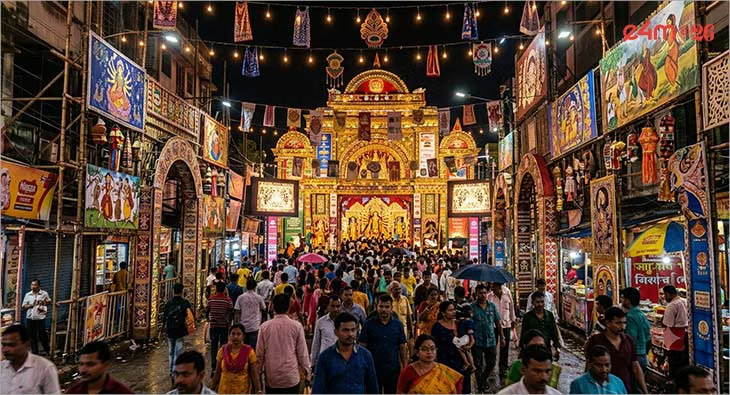

- Durga Puja transforms Kolkata into a vibrant advertising landscape, with brands utilizing various temporary structures for out-of-home (OOH) advertising, including bamboo displays, banners, and LED installations, which complicate traditional OOH measurement methods.
- A significant portion of advertising during the festival is conducted through sponsorships and local contractors rather than conventional media arrangements, leading to a potential underreporting of the actual OOH market size.
- The temporary nature of Puja advertising inventory allows for flexible and responsive advertising strategies, with brands adjusting their spending based on demand and festival dynamics, often categorizing these expenses under activation rather than OOH.
- The advertiser mix during Durga Puja is diverse, with FMCG, food, fashion, and lifestyle brands prominently investing in OOH, while the overall market activity may exceed reported figures due to the fragmented nature of transactions and measurement challenges.
Durga Puja has a way of bringing people back home, and out of their screens.
For a few days, the usual commute gives way to pandal-hopping, long walks through neighbourhoods, food stops and crowded streets. Television takes a back seat, doomscrolling gives way to strolling, and the city itself becomes the place where people spend their time.
For advertisers, that makes Durga Puja a particularly valuable window for out-of-home (OOH) media. But the advertising landscape that emerges during the festival extends well beyond conventional billboards and DOOH screens. Across Kolkata, bamboo-framed displays, banners, arches, gates, pillars, pandal coverings, LED installations and other temporary structures appear around high-footfall areas.
The more interesting question, then, is not whether brands are putting money into these formats, but where that money shows up in the industry's accounting.
Industry executives say a significant part of Puja-specific inventory is transacted through sponsorships, local contractors, Puja committees and activation budgets rather than conventional media-owner arrangements. That means the physical advertising economy created around the festival could be substantially larger than what reported OOH AdEx numbers show.
“Mostly, it is left outside. And that is not a rounding error. It is a structural gap,” said Yuvrraj Agarwaal, Chief Strategy Officer, Laqshya Media.
The OOH that disappears from the numbers
Conventional OOH measurement works best when there is a clearly defined media asset, a media owner, an agency booking and an invoice. Durga Puja complicates that chain.
“Reported OOH AdEx is built around organised, permanent inventory: a media owner, a site, an agency booking, an invoice. Puja inventory breaks all four. The seller is usually the puja committee, not a media owner. The money moves as sponsorship, often through a local branding contractor or a concessionaire. The structure exists for a few weeks and then disappears,” Agarwaal said.
The classification of the expenditure creates another blind spot.
“And inside the brand, the spend frequently sits in the activation, sponsorship or trade budget rather than the media plan, so it is not even tagged as OOH at source,” he added.
Rohan Sengupta, Manager, Product Marketing at Times OOH, describes the Puja market as a parallel layer sitting alongside organised OOH.
“Durga Puja creates a very distinctive OOH ecosystem in Kolkata. Apart from conventional billboards, transit and other organised media, a parallel layer of temporary inventory comes up around the festival — bamboo-framed displays, banners, arches, gates, pillars, pandal surroundings, LED installations, promotional zones and other short-duration formats,” Sengupta said.
“Conceptually, these are all forms of out-of-home advertising. However, the challenge is in how the spends are recorded. Organised OOH revenues are relatively easier to capture, whereas Puja inventory is highly fragmented and can be transacted through local media owners, Puja committees, agencies, fabricators or sponsorship arrangements.”
As a result, he said, “some of this expenditure would get accounted for under OOH, while some may be classified as activation, sponsorship or BTL expenditure.”
“There is also likely to be a portion of the market that does not get fully captured by conventional OOH AdEx estimates. Therefore, during Durga Puja, the actual commercial activity happening on the ground can be higher than what is visible in reported OOH numbers,” Sengupta added.
That distinction matters because even the reported size of India's OOH market varies depending on the methodology used.
Agarwaal pointed to three different estimates for India's 2025 OOH market: PMAR at ₹4,835 crore, Dentsu-e4m at ₹4,724 crore and FICCI-EY at ₹6,690 crore.
“The spread is definitional, and none of the three is designed to capture a bamboo gate outside a neighbourhood puja,” he said.
“Where Puja spend is booked as activation, it sits closer to what FICCI-EY counts under live events than under OOH,” Agarwaal added.
The point is not necessarily that the market is deliberately under-reported. Rather, the way the money is bought and accounted for determines where it appears.
“It is not missing from the market. It is missing from the measurement,” Agarwaal said.
According to Rahul Biswas, Director at Arun Sign Service Pvt. Ltd., an outdoor advertising and brand activation agency based in Kolkata, Durga Puja OOH business at ₹800 crore-₹1,000 crore across West Bengal over 10 days.
But he is clear that this is not an official market measurement.
“There are no official figures ever calculated on this. The total info, shred herewith are based purely on assumptions w.r.t. the volume of business we do & had seen in the past 3-4 years,” Biswas said.
When demand creates the supply
There is another reason Puja is unusual for OOH: the inventory itself is elastic.
A conventional billboard is fixed. Its supply does not suddenly increase because a festival attracts more advertisers. Temporary Puja structures work differently. More sponsorship can mean more structures, more surfaces and more opportunities to sell.
“There is no audited count, and I would be wary of anyone who quotes a precise multiple. What I can give you is the shape of it,” Agarwaal said.
“The supply base is enormous. Kolkata alone has thousands of community pujas, and Bengal has tens of thousands more. Every significant puja wraps itself in inventory: entry gates and arches, bamboo-frame hoardings on the approach roads, backlit pillars, branded tunnels, stalls, selfie zones and, increasingly, LED screens running brand messages on rotation.”
“At the marquee pujas the entire approach becomes a branded corridor,” he added.
That temporary nature makes the inventory particularly responsive to the market.
“The more important point is how it behaves. Permanent inventory is fixed supply. Puja inventory is demand-led supply: the structures get built when the sponsorship money arrives, and not before. That makes it the most elastic inventory in Indian OOH,” Agarwaal said.
He pointed to 2024 as an illustration of how quickly that supply can contract. Following the RG Kar tragedy, brands cut Puja spends by an estimated 25% to 35%, according to his assessment, and many makeshift structures across the city stood empty. In 2025, Puja advertising returned, with estimated growth of 18% to 25%.
“Permanent sites do not swing like that. Temporary supply does,” he said.
This year's regulatory framework also puts temporary advertising structures more clearly under the civic radar. Kolkata Municipal Corporation has introduced a permission process for temporary advertising structures during Puja, including bamboo-frame hoardings, banners and flexes, with applications required ahead of the festival. The civic body's rules specify that such structures can be installed from October 3 and that bamboo structures cannot exceed 22 feet.
The move is significant because it gives the temporary market a more formal administrative footprint, even if it does not automatically solve the industry's measurement problem.
Rahul Biswas estimated that more than 30% of yearly OOH budgets are spent by clients during the festive period and said permanent OOH billboards see 100% occupancy during these days, extending towards Diwali and Kali Puja.
For temporary formats, however, the spending sits differently.
“Temporary structures are not accounted for in OOH exp., rather most clients treat this spend as Activation expenses rather than a proper OOH Campaign,” Biswas said.
“Mostly, what I have learned is that these expenses are used from a proportional budget with an effort to get associated with the local language, people & culture, so treating this as pure OOH spend cannot be true.”
That is the crucial distinction. The market is not simply losing a conventional billboard transaction from its AdEx database. In many cases, the advertiser itself is treating the purchase as an association or activation rather than a media buy.
More inventory, but not necessarily more measurable reach
The scale of temporary inventory also raises a question about what brands are actually paying for.
At the premium end, Puja-specific structures can command significant value because of their position within the visitor journey. But there is no common rate card across the ecosystem, and audience estimates are not uniformly audited.
“At the top end, yes. But the comparison needs care. A conventional site is sold by the month. A Puja structure is sold for the festival, effectively five peak days with a short run-up. On a per-day basis, a gate at a marquee puja costs well above a comparable roadside hoarding. On a cost-per-contact basis it can work out cheaper, because the audience is exceptional,” Agarwaal said.
“A famous puja can draw up to a million visitors over the festival, and they are not driving past at speed. They are standing in a queue, often for an hour or more. Queue time is dwell time. That is what the brand is paying for.”
But this is where the market's footfall claims need to be treated differently from conventional OOH audience measurement.
“I will not put a false percentage on the premium. There is no common rate card; every puja negotiates its own,” Agarwaal said.
“One caution for buyers. Almost none of this inventory has an audited audience. The footfall claims come from the committees. So, price it as what it is: association, sponsorship, experience. Judge it on salience and brand linkage, not on reach numbers nobody can verify.”
The emergence of LED screens could change that to some extent.
“The LED screens are the first real step toward making Puja inventory plannable, with slots, run-of-schedule and proof of play. That is where the premium becomes defensible,” Agarwaal said.
FMCG leads, but the advertiser mix is broadening
The advertiser mix around Puja is broad, although FMCG and food remain among the most visible categories.
“FMCG holds the max pie, apart food categories likely Ice Cream, Biscuits, Chips & liquor spend a lot,” Biswas said.
“Liquor comes in 2nd. Apart, TMT Bars, Electronics, Mobile Phones, Cements have a big spend.”
Sengupta said fashion and lifestyle, retail and FMCG are among the categories that increase their spending during festive periods. “So during the festive periods the categories which increase their spends the most are Fashion and lifestyle which comprise of Apparel brands and jewellery brands, Retail which comprises of retail stores like Bazaar Kolkata, Style Bazaar etc and FMCG,” he said.
The format mix is changing too. Biswas said temporary structures are often preferred because they can be executed quickly and at relatively low cost. “Pandal Branding are very limited as many factors are engaged a the execution time are long. Temporary structures are most preferred as they are simple, last minute execution possible & cheap.”
Premium brands do experiment with more elaborate formats, he added.
“Some premium brands like Cosmetics or Cola brands do some innovations, but they are handful.”
The cost structure also varies sharply by format.
“Per unit cost of any inventory like Banners, OH Gates etc are most common & cheap with compared to a regular permanent OOH media. This year, LEDs are very much into market & it is costly. Clients have a 50-50 choice on it over permanent OOH media,” Biswas said.
So while all these formats compete for the same consumer attention during the festival, they do not necessarily compete on the same commercial terms.
Brands are buying fewer, bigger moments
For brands that rely heavily on digital during the rest of the year, Puja OOH can serve a different purpose.
Suta, for instance, has increased its Kolkata OOH investment from approximately ₹3-4 lakh last year to ₹5-6 lakh this year, a roughly 50% year-on-year increase. It has also invested in OOH in Bhubaneswar as part of its Puja campaign.
But the brand has not simply increased the number of touchpoints.
Last year, its Puja campaign included pole kiosks, train station TV screens and mobile vans. This year, it has moved towards large-format billboards in prime Kolkata locations.
“During Puja, the city itself becomes a media platform. People are constantly moving, meeting, shopping and visiting pandals, so being visible in the right locations allows the brand to become part of that environment,” said Sujata Biswas and Taniya Biswas, Co-founders, Suta.
For Suta, OOH remains a relatively small part of its overall marketing mix.
“OOH still makes up a relatively small part of our overall marketing investment, approximately 3% of our annual marketing spend. Digital, social and performance-led channels continue to account for the majority of our marketing investment. We see OOH as something we activate when there is a strong contextual reason to do so, rather than as an always-on channel,” they said.
Macaw Paints is taking a broader approach, increasing investment across OOH and its wider festive marketing mix.
“Our OOH strategy this year goes well beyond conventional static and DOOH. It brings together premium outdoor placements across India, cinema, pandal branding, large-format installations and festival-led experiences,” said Megha Beriwala, Director of Marketing, Macaw Paints.
The brand is expanding premium OOH across India, with West Bengal at the centre of its festive activity, alongside cinema, pandal branding and mall installations.
“In 2025, our key installation was the life-size Macaw Paint Bucket at Deshapriya Park. This year, we are creating life-size Genie installations in malls, allowing consumers to encounter the character beyond the television screen,” Beriwala said.
Pandal branding is also being expanded, with the Macaw Paints Puja pandal at Central Park, Salt Lake, becoming a larger brand expression than last year.
The strategy reflects a broader change in what festive OOH can mean. Brands are not necessarily choosing between a billboard and a digital screen anymore. They are combining conventional media with sponsorships, installations, cinema and physical experiences.
The market may be bigger than the category
And that is where the Puja OOH story becomes less straightforward than a simple festive-growth narrative.
There is evidence from agencies, outdoor operators and advertisers of increased physical advertising activity around the festival. But the industry's challenge is determining where that activity belongs in the market's accounting.
If an advertiser pays a Puja committee for branding rights, a fabricator builds a bamboo structure and the expense is booked under activation, calling the entire transaction conventional OOH may oversimplify the market.
But leaving all of it outside OOH AdEx has its own consequence: the reported OOH market may not fully reflect how much advertisers are spending to reach consumers in physical environments during the festival.
Sengupta puts the issue simply: “Therefore, during Durga Puja, the actual commercial activity happening on the ground can be higher than what is visible in reported OOH numbers.”
The answer may not be to force every Puja sponsorship, pandal association or temporary structure into one OOH number. A more useful approach could be to make the boundaries clearer: what is conventional OOH, what is temporary inventory, what is sponsorship-led and what is activation.
Because during Puja, the city itself becomes the media platform.
And unlike a conventional billboard, that platform can expand with advertiser demand, change shape from one neighbourhood to another and disappear once the festival is over.
The irony is that the more Kolkata turns its streets, pandals and temporary structures into advertising real estate, the harder it becomes for conventional OOH measurement to tell us exactly how large that market really is.
Read more news about Festive Season, Marketing, PR and Corporate Communication, Internet Advertising, People Movement
For more updates, be socially connected with us onInstagram, LinkedIn, Twitter, Facebook, YouTube & Google News
