Why Context and Creativity Are Becoming Advertising’s New Attention Currency
Industry leaders at the exchange4media and MediaKart roundtable discussed how context, creativity, AI and measurement are reshaping the battle for consumer attention.
 by
by
Published: Sep 29, 2026 4:46 PM | 4 min read
 Follow Us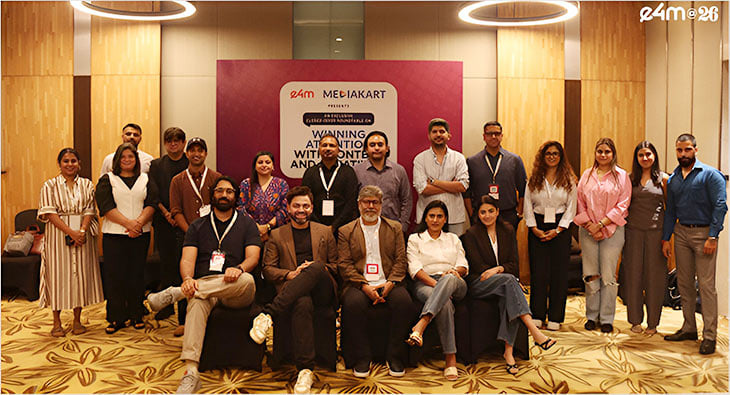

- Marketing and advertising leaders gathered at a roundtable hosted by exchange4media Group and MediaKart to discuss the evolving landscape of consumer attention, emphasizing the importance of context, creativity, and technology in advertising effectiveness.
- The conversation highlighted the need for marketers to focus on meaningful engagement rather than traditional metrics like reach and impressions, stressing the significance of the environment and relevance of advertisements.
- Participants examined the relationship between context and creative execution, advocating for closer collaboration between media planning and creative development to enhance advertising impact without adding to content saturation.
- The role of artificial intelligence in optimizing advertising processes was discussed, with an emphasis on balancing technology with creativity to ensure that communications resonate with consumers and drive desired marketing outcomes.
At an exclusive exchange4media Group and MediaKart roundtable, marketing and advertising leaders came together to discuss how context, creativity, technology and AI are changing the battle for consumer attention.
In an advertising ecosystem where consumers are exposed to an ever-growing volume of content, simply reaching an audience is no longer enough. The bigger challenge for marketers today is whether their communication is actually being noticed, remembered and acted upon.
This changing equation around consumer attention took centre stage at the exclusive roundtable discussion, “Winning Attention with Context and Creativity,” hosted by exchange4media Group and MediaKart at Courtyard by Marriott, Gurugram.
The discussion brought together senior marketing, digital, media and agency leaders to examine how brands can move beyond conventional measures such as reach and impressions and think more deeply about the quality of consumer attention.
Moderated by Shahad Anand, Business Head, Skylight MediaKart, the conversation explored the intersection of context, creativity, media, measurement and emerging technologies such as artificial intelligence.
Reach is only the beginning
One of the central themes of the discussion was the changing way in which advertising effectiveness needs to be understood.
For years, reach, impressions, clicks and other delivery metrics have dominated conversations around campaign performance. But in a fragmented media environment, exposure does not necessarily translate into attention.
The discussion explored why marketers increasingly need to understand not merely whether an advertisement was delivered to a consumer, but whether it was capable of generating meaningful engagement.
This also puts greater emphasis on the environment in which an advertisement appears. Context, content and consumer mindset can influence how communication is received, making placement and relevance important components of the attention equation.
Context and creativity need to work together
Another major theme was the relationship between context and creative execution.
As brands compete across multiple screens, platforms and content environments, creative communication increasingly needs to be adapted to where and how consumers encounter it.
The conversation examined how brands can make advertising more attention-worthy without simply adding more noise to an already crowded ecosystem.
It also highlighted the need for closer collaboration between media and creative functions. Rather than treating media planning and creative development as separate processes, the evolving advertising landscape is creating greater scope for the two to inform each other.
Can attention actually be measured?
The conversation also turned towards one of the industry’s biggest questions: how should marketers measure attention?
While digital advertising has generated enormous amounts of measurable data, the presence of data does not automatically indicate whether a consumer meaningfully engaged with an advertisement.
The discussion explored the need to connect attention with wider marketing outcomes rather than treating it as another standalone metric.
For marketers, this means examining how attention relates to brand recall, consideration, engagement and ultimately business outcomes.
AI enters the attention economy
Artificial intelligence and contextual intelligence formed another important part of the conversation.
AI is increasingly entering different stages of the advertising process, from audience analysis and media planning to creative development, personalisation, optimisation and measurement.
The roundtable examined how these capabilities could help marketers better understand context and deliver more relevant communication at scale.
At the same time, the conversation underscored the continued importance of creativity and human judgement. Technology can improve the ability to identify audiences, environments and opportunities, but capturing attention ultimately depends on whether the communication itself resonates with the consumer.
Industry leaders join the conversation
The roundtable featured Navin Sangwan, Head of Digital Marketing, UNIQLO; Pawan Jagnik, Head of Marketing India, Pladis Global; Shubham Verma, Media and Measurement, Hygiene, Reckitt; Shashwat Varma, Head of Brand Communication & Media, BMW; Ishita Agrawal, Senior Manager, Brand & Category Marketing, Campus Activewear; Gopa Menon, Co-Founder & Chief Operating Officer, Theblurr; Anuj Somani, Marketing Operations, Brand, Retailer, Digital & PR, Volvo Car India; Ashutosh Chaudharie, General Manager, Consumer Marketing and Modern Trade, VI-JOHN Group; Meghana Chandani, EVP, Digital & Social Growth, Social Beat; Kiranpreet Kaur, Deputy General Manager Marketing, Del Monte Foods India; Richa Chugh, Client Partner, WPP; Shradha Aggarwal, Co-Founder & Global CEO, Grapes Digital; and Avinash Tiwary, Managing Partner, Havas Media Network India.
The discussion reflected a broader shift taking place across advertising. As media becomes more fragmented and consumers become increasingly selective about what they engage with, the industry’s challenge is moving from simply buying visibility to creating communication worthy of attention.
For brands, the next phase of advertising effectiveness could therefore depend less on how many times a message appears and more on whether the right message appears in the right context, with creative powerful enough to make consumers care.
Read more news about Marketing News, Advertising News, PR and Corporate Communication News, Digital News, People Movement News
For more updates, be socially connected with us onInstagram, LinkedIn, Twitter, Facebook, YouTube & Google News
