Is “more content” quietly becoming the enemy of better creative?
As brands chase visibility across more platforms and formats, agency leaders debate whether content volume is diluting distinctive creative work
 by
by
Published: Sep 25, 2026 9:39 AM | 10 min read
 Follow Us

- The Indian advertising landscape has evolved into an "always-on" model, with brands producing more content across various platforms, leading to concerns about the distinctiveness of ideas amidst the abundance of output.
- According to the Pitch Madison Advertising Report, India's advertising economy is projected to grow to ₹1,55,105 crore in 2025, with digital media expected to account for 60% of this, increasing to nearly 64% by 2026.
- The influencer ecosystem has surged, with over four million influencers in India, prompting brands to significantly increase their creator budgets, reflecting a shift towards more frequent and diverse content production.
- Industry experts emphasize the importance of strategic content creation, arguing that the challenge lies not in the quantity of content but in ensuring it is relevant and distinctive, with a focus on effective distribution and genuine engagement rather than merely filling content calendars.
The content calendar is no longer a monthly ritual. It’s more of an always-on obligation. Between organic social, paid amplification, creator collaborations, reactive posts, commerce assets, and an ever-multiplying menu of short-form formats, brands today have more opportunities to publish than at any point in Indian advertising history.
The question quietly worrying agency creative leadership is whether this abundance is starting to work against the very thing content is meant to deliver: a genuinely distinctive idea.
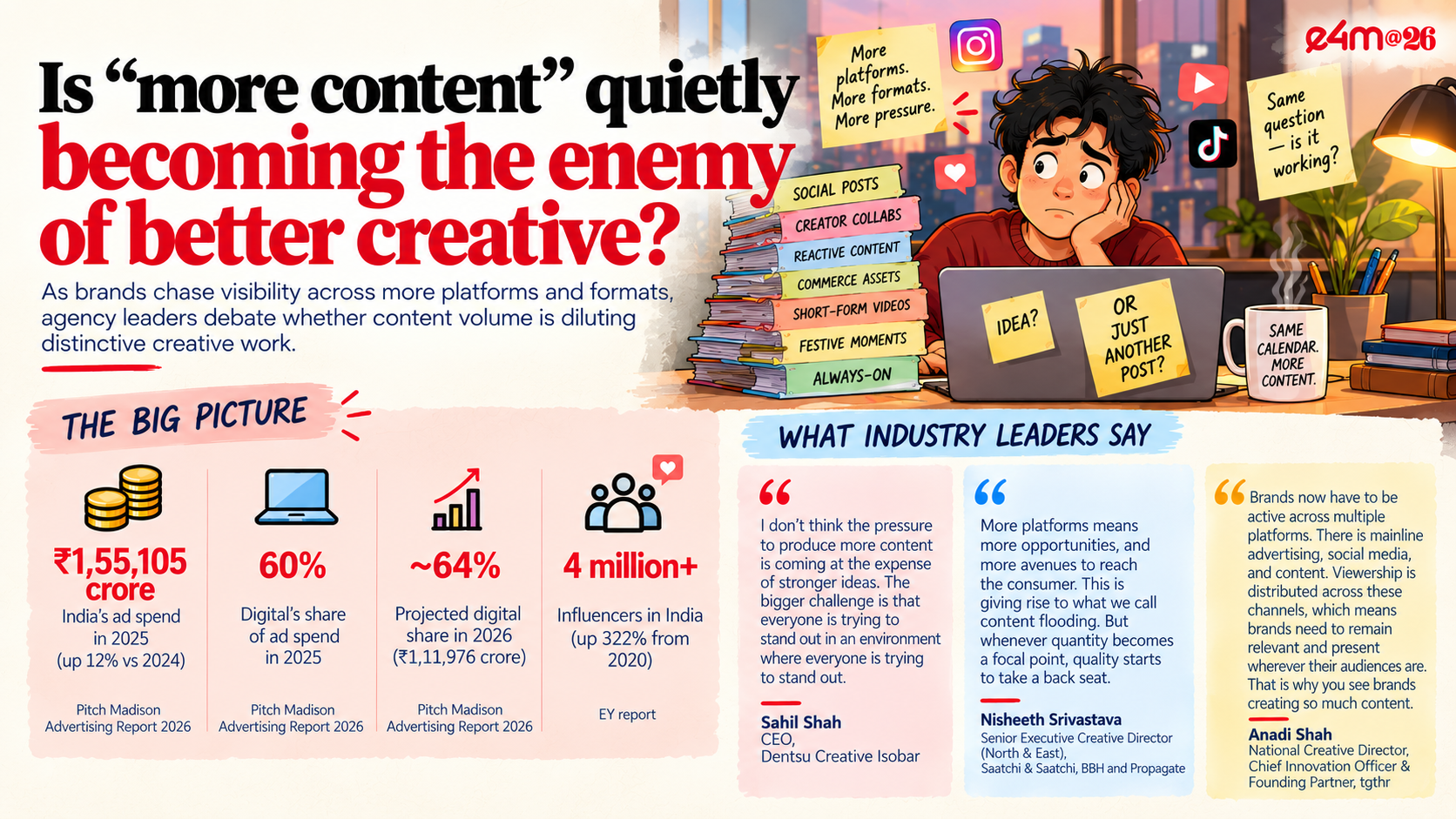
The scale of the shift shows up in the numbers. India's advertising economy reached ₹1,55,105 crore in 2025, up 12% from the previous year, with Digital already accounting for 60% of that pie, according to the Pitch Madison Advertising Report (PMAR) 2026. The report forecasts Digital's share climbing further to nearly 64%, or ₹1,11,976 crore, in 2026, a large chunk of it flowing into search, social, video and ecommerce formats that reward frequency as much as they reward craft.
Feeding this frequency is a creator ecosystem that has grown at a pace few categories in Indian advertising can match. India is now home to over four million influencers, up from roughly 962,000 in 2020, a 322% jump in four years, according to an EY report, with the country's creator economy expected to grow from ₹125 billion in 2024 to nearly ₹500 billion by 2030 at a 25% CAGR. Brands have taken note. A separate BCG study found that 70% of brands expect to increase their creator budgets by 1.5 to 3 times over the next two to three years. This is a clear signal that more voices, more formats and a faster publishing cadence are not a passing phase but the new operating rhythm of Indian marketing.
More platforms, more pressure
For Sahil Shah, CEO of Dentsu Creative Isobar, the digital and experience-led arm of Dentsu Creative in India, the anxiety around volume is somewhat misdirected. He believes the real challenge is not that brands are making too much, but that everyone is trying to occupy the same crowded space at once. “I don’t necessarily think the pressure to produce more content is coming at the expense of stronger ideas. I think the bigger challenge is that brands are trying to stand out in an environment where everyone is trying to stand out,” he said.
Shah’s argument rests on a simple truth of category behaviour: frequency is not uniform. It flexes with what a brand is trying to achieve. “Brands today want to show up on digital in many different ways, organically and through paid media, and the frequency will naturally vary by category, consumer behaviour, seasonality and the role of the brand. Fundamentally, everyone is trying to build a distinctive presence: a strategy and content approach that extends the brand’s personality into the digital world,” he said.
He goes further, arguing that the absence of an obvious content strategy can itself be deliberate for categories where the goal is pure top-of-mind recall. “And sometimes, even having no obvious strategy can itself be a strategy. There are categories where the objective is simply to create enough memorability and association to stay top of mind, particularly where consumers interact with the brand frequently,” he added.
This reading, that the surge in output is a function of a fragmented media landscape rather than creative inflation, finds an echo at tgthr, the full-funnel agency founded by Aalap Desai. Anadi Shah, National Creative Director, Chief Innovation Officer & Founding Partner at the agency, points to the sheer multiplication of touchpoints as the real driver behind the deluge of brand content. “Brands now have to be active across multiple platforms. There is mainline advertising, social media, and content. Viewership is distributed across these channels, which means brands need to remain relevant and present wherever their audiences are. That is why you see brands creating so much content and communication today,” he said.
Crucially, he separates this volume from any dilution of campaign quality. “However, that does not necessarily mean brands are putting out too many advertising campaigns. The increase in output is largely a reflection of the growing number of platforms and touchpoints,” he said.
Flipkart's BBD playbook
Nowhere is this platform-led multiplication more visible, or more fun to track, than in the festive season sales calendar, and Flipkart’s Big Billion Days is the clearest case study of how one hero idea now travels as dozens of pieces of content. This year, working with Leo Burnett, Flipkart built its Big Billion Days push around “Luck Badal Sakta Hai, Yahan Kuch Bhi Ho Sakta Hai,” a single-narrative hero film in which cricketer Rohit Sharma, actors Sreeleela, Jackie Shroff and Aneet Padda, and comedian Samay Raina turn up one after another through the protagonist’s “reset day.” A five-star hero film built this way is designed to be sliced, with each celebrity’s segment naturally lending itself to its own shorter, star-specific cutdown for that star’s own fan base on social, even as the core script and soundtrack carry through.
Hero film: https://youtu.be/AatGYlKbSKs
Shorts: https://youtu.be/GN6_XkGL9F8
https://youtu.be/5vz6UPGNCOs
It is a pattern that repeated from the year before. For its 2025 Big Billion Days, Flipkart worked with creative agency Talented on a hero film titled “Kuch Bhi Ho Sakta Hai.” That hero film ran alongside a fleet of smaller, purpose-built videos: a separate pre-buzz push by marketing agency SW Network for Flipkart’s “iPhone Season,” fronted by actor Archana Puran Singh and built around comparisons of iPhone sales to Delhi Metro ridership and airport flight numbers; a film with veteran maths educator Dr. RD Sharma turning shoppers’ quirky problems into festive offers; and two digital films for luggage brand Nasher Miles, starring content creators Sakshi Shivdasani and Ayush Mehra. Different scripts, different purposes, sometimes the same faces resurfacing across formats, but all of it stitched under one umbrella idea and one sale.
Hero film: https://youtu.be/cqgvtN5yMx8
Shorts: https://youtu.be/BHocYAh-WMg
https://youtu.be/Dv-V6TLEFx0
This is precisely the tension Nisheeth Srivastava, Senior Executive Creative Director (North & East) at Saatchi & Saatchi, BBH and Propagate, three Publicis Groupe creative agencies now operating under common leadership in India, has in mind when he describes the current environment as “content flooding.” “More platforms means more opportunities, and more avenues to reach the consumer. This is giving rise to what we call content flooding,” he said. He does not see the flood as an inevitable death sentence for craft, though. “But whenever quantity becomes a focal point, quality starts to take a back seat. However, with some method to the madness and astute use of AI, it can be delivered with finesse while delivering a fine balance between conceptualisation and execution of the content,” he said.
Zomato's Khali moment
If Flipkart shows what a hero campaign splintering into many shorts looks like, Zomato shows what an always-on, episodic content engine looks like, built less around a single campaign and more around a running bit that keeps finding new occasions to punch. The brand’s latest instalment came at HYROX Mumbai, the fitness racing event that has drawn thousands of competitors to the city since it arrived in India. Zomato brought in WWE legend The Great Khali for an on-ground activation tied to its Healthy Subscriptions proposition, putting participants through playful challenges against him, including watermelon crushing, thumb wrestling and high-fives, with winners walking away with ₹5,000 worth of Zomato Healthy Subscriptions.
https://www.instagram.com/reel/DdeYftKzfF6/?stkn=MzRlODBiNWFlZA==
https://www.instagram.com/reel/DdlM68GTN6Y/?stkn=MzRlODBiNWFlZA==
https://www.instagram.com/reel/DdlM4V0zIiS/?stkn=MzRlODBiNWFlZA==
The stunt was shared by the Eternal company on their social channels, and each of the resulting shorts carried its own small punchline, whether it was a protein pun, a food delivery gag, or a straight-up dad joke, while all of it stayed tethered to the same core message about high-protein meals reaching consumers faster. It is the same reflex that had Zomato hijacking Mumbai metro station announcements in 2024, turning “Agla station Ghatkopar” into “Agla station (Chaat)kopar” to push a discount, a stunt that worked precisely because it behaved like a bit a creator would post, not a campaign a brand would approve through six rounds of sign-off.
This is exactly the muscle Sahil Shah wants more Indian brands to build. “There is a lot that brands can learn from creators here. Creators also want to remain relevant and keep producing, but the best ones understand the codes of social. Their content often feels authentic, raw, immediate and emotional. Brands need to think more like creators and build genuine influence rather than simply treating social as another publishing channel,” he said.
Distribution is now part of the idea
Where Shah pushes the conversation further is on the idea that creative and distribution can no longer be treated as separate jobs. “We also need to think about how that content gets distributed creatively. We often talk about this as the ‘second life’ of a campaign, or even the second life of an always-on narrative,” he said, arguing that social platforms reward brands that let their point of view travel through creators, communities and conversations rather than simply broadcasting into a feed. “Visibility without distinctiveness is just noise. But memorability without distribution can also mean that a great piece of creative is experienced by very few people,” he said.
That instinct for restraint, knowing when a brand genuinely has something to say versus when it is simply filling a slot on the content calendar, is where Anadi Shah’s caution about forced relevance becomes useful. He is wary of brands manufacturing a connection to a moment they have no real stake in. “What matters is that the reason behind a campaign is strong and authentic rather than force-fitted. For example, if a brand has no meaningful connection to an occasion such as Raksha Bandhan, creating a campaign around it may not make sense. There needs to be a genuine and credible connection for the communication to resonate,” he said.
He is equally sceptical of using awards as a proxy for whether more content is hurting quality. “When it comes to awards, they cannot be the sole parameter for judging whether a brand is producing good work. Several factors come into play, including jury perspectives and the specific context in which campaigns are evaluated,” he said.
Not more versus less, but whether it works
Strip away the different vantage points and the three arrive at a similar place. None of them believe the answer is to simply make less. As Sahil Shah put it, “So, I don’t think the answer is necessarily ‘make less content to create great content’. Brands do need to be active. But they need to be active with relevance and purpose with the right content, the right idea and the right role for that content within the overall brand strategy.”
What separates a Flipkart hero film that spins into a season’s worth of relevant shorts, or a Zomato stunt that turns a fitness event into a week of protein-and-pun content, from a brand simply posting to fill a slot, is exactly the distinction Shah draws between content with a job to do and content that exists only because the calendar demanded it. “The problem isn’t that we are making too much content. It’s that sometimes we are making content without enough of a strategy or an idea behind it to make it stand out,” he said.
As generative AI makes the actual act of producing content cheaper and faster for every agency in this story, that difference between output and idea is quickly becoming the only one that matters.
Read more news about Marketing News, Advertising News, PR and Corporate Communication News, Digital News, People Movement News
For more updates, be socially connected with us onInstagram, LinkedIn, Twitter, Facebook, YouTube & Google News