#e4mXplains: Everyone wants to be a media company. McDonald’s just made it obvious
McDonald’s $1-bn ad business plan is the latest sign that retail media has escaped retail: if you have first-party data, consumer attention, surfaces to sell ads, you too can become a media company
 by
by
Published: Sep 25, 2026 9:35 AM | 6 min read
 Follow Us

- Financial influencer CA Sarthak Ahuja proposed monetizing land by converting it into an EV charging station and selling advertising, reflecting a broader trend in advertising strategies.
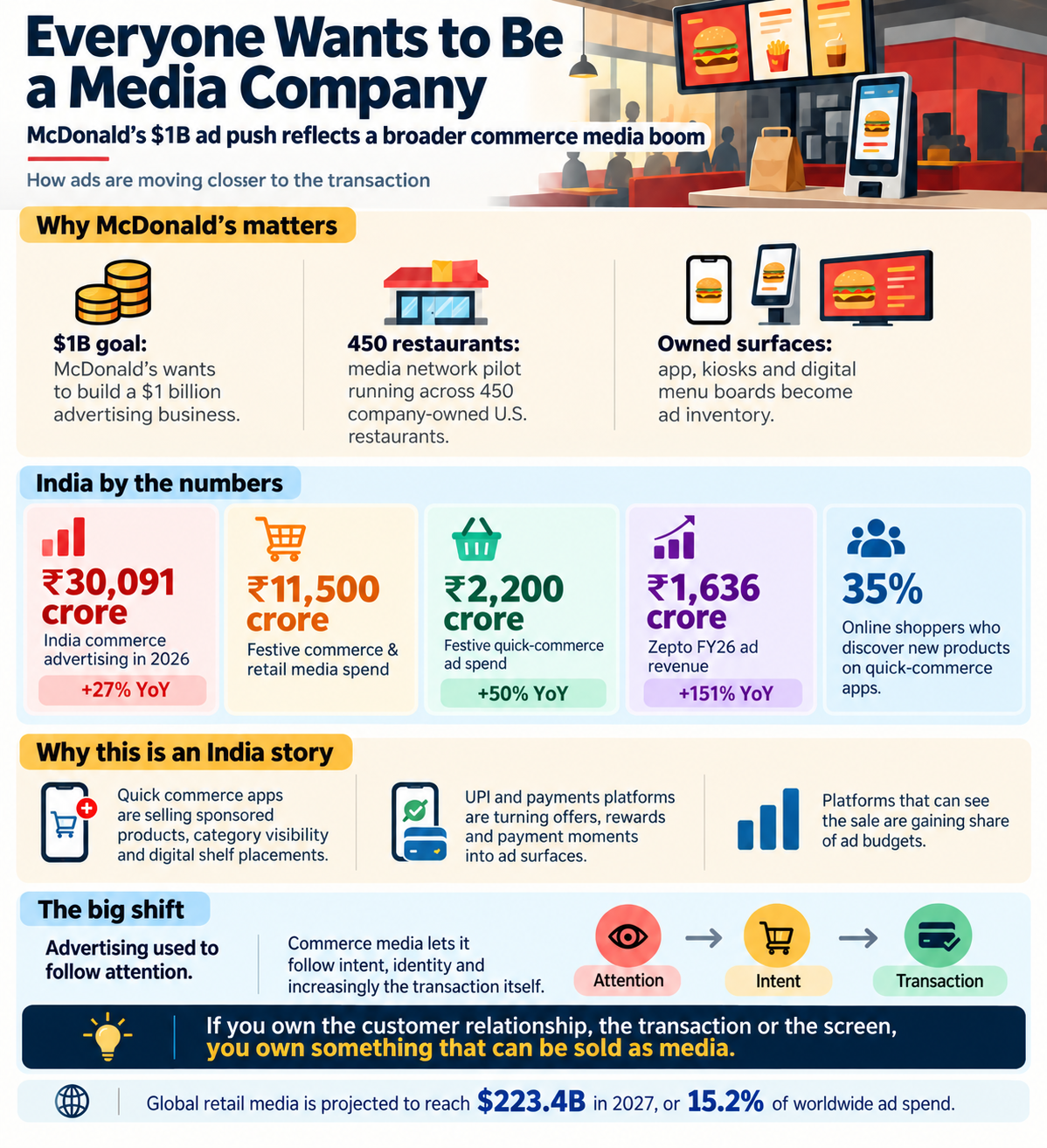
- McDonald's announced the launch of its media network, aiming to generate $1 billion in advertising revenue by utilizing digital platforms within its restaurants, such as apps and kiosks.
- In India, commerce advertising is projected to grow significantly, with platforms like Zepto and Blinkit creating advertising environments that capitalize on consumer shopping behavior, leading to increased brand visibility.
- The shift towards commerce media is evident globally, with retail-media advertising expected to reach $223.4 billion by 2027, as companies leverage consumer data and purchase intent to enhance advertising effectiveness.
When financial influencer CA Sarthak Ahuja suggested converting a piece of land into an EV charging station, he said the most effective way to quickly monetise the business might be to put up billboards and sell advertising to the increasingly captive audience. In the US, one YouTube influencer is going rather further: getting small companies’ logos tattooed on his body to help pay off his debt, then using his considerable social-media clout to boost their branding.
And yesterday, McDonald’s, while warning investors about softer customer traffic and announcing about $8.5 billion in franchisee support through 2036, almost casually revealed another growth engine: it has hatched a fledgling media network that it hopes will take wing as a $1 billion advertising business. The McDonald's Media Network is here.
The company began piloting the network across 450 company-owned US restaurants in August, using surfaces including its app, kiosks and digital menu boards.
The philosophy seems to be: if you have a space, or a following, you too can be an advertising heavyweight. Or presumably a featherweight, if you are small in size and therefore have less advertising acreage.
What sounds like opportunism, however, is increasingly an industry model. And India is already living through it.
AI selling ads of its own. Read more
Commerce advertising in India is expected to rise 27% to Rs 30,091 crore in 2026, more than twice the growth rate of the overall advertising market, according to Datum Intelligence’s September Festive AdEx report. During the festive season alone, commerce and retail media are expected to account for about Rs 11,500 crore, while quick-commerce advertising is forecast at roughly Rs 2,200 crore, up 50%.
That money is increasingly going to platforms that are not merely places to shop, but places to advertise while people shop.
Blinkit, Zepto and Instamart have effectively created their own media environments around the digital shelf. Sponsored products can appear when a consumer searches for biscuits, shampoo or soft drinks. Brands can pay for visibility within categories, banners and recommendations. Unlike an ad encountered while scrolling through unrelated content, these placements appear when a user is already close to buying something.
Can ad loads rise without breaking the TV experience?
Zepto shows how material that business can become. Its advertising revenue jumped 151% to Rs 1,636 crore in FY26, with more than 2,400 brands using its in-house advertising platform. Advertising accounted for 7.8% of its net revenue value.
The economics are seductive. Building dark stores, employing staff and delivering groceries in minutes is expensive. Once the platform has already attracted the shopper, however, selling a brand a more prominent position on the screen is a comparatively asset-light additional revenue stream.
And quick commerce is beginning to influence discovery rather than merely capture transactions. Datum found that 35% of Indian online shoppers discover new products through quick-commerce apps, putting them alongside conventional advertising as a discovery channel.
What exactly is commerce media?: Read here
Payments companies show how much further the logic can stretch.
PhonePe already sells brand advertising across its homepage, Offers and Rewards surfaces. Its proposition explicitly includes targeting based on factors such as location, spending power and category affinity. The value of the app, in other words, is not merely the eyeballs looking at it but the commercial context surrounding those eyeballs.
Paytm has taken an even more literal approach. Its Soundbox (the hotly debated little device originally built to tell a merchant that a UPI payment has arrived) has itself become advertising inventory. Paytm Ads lets brands play short audio messages immediately after a successful payment, with regional and language targeting. A utilitarian payments notification has been transformed into a miniature ad break at the point of transaction.
That is why a decision taken at McDonald’s headquarters in Chicago is not merely an American fast-food story.
Its opportunity is not merely that it happens to own some screens. It owns a sequence of commercial touchpoints. A customer may open the app, browse offers, enter a restaurant, order at a kiosk, scan a loyalty account, pay and then return days later. Each interaction generates some combination of attention, identity, intent and transaction data. The restaurant provides physical inventory; the app and kiosk provide digital inventory; the loyalty programme helps connect those interactions.
Once those surfaces can be packaged and sold to advertisers, McDonald’s can monetise not only the burger but access to the person buying the burger.
So when McDonald’s talks about building a $1 billion media business, the proposition is effectively the same one Amazon, Zepto, or PayTM are making in different contexts: we know something unusually valuable about what this consumer may buy, or has just bought, and we own somewhere to reach them. Why should somebody else capture all of the advertising value?
The common asset is no longer simply an audience. It is an audience whose commercial behaviour the platform can see.
That distinction helps explain why the sector is expanding so quickly. Datum estimates commerce platforms have gained four percentage points of India’s digital-ad-spend share between FY24 and FY26, even as Google and Meta remain dominant. Its description of the shift is succinct: the platforms that can record the sale are taking share.
Globally, the same migration is happening at enormous scale. WARC expects retail-media advertising to reach $223.4 billion in 2027, representing 15.2% of worldwide advertising expenditure. Yet there is already a warning sign: excluding Amazon, growth is expected to slow to 9.8%, suggesting that simply declaring oneself a media network does not guarantee an advertising goldmine.
Because not every screen is valuable inventory and not every customer database is a viable advertising business.
A successful media network still needs reach, useful signals, advertiser demand and credible measurement. There is also a limit to how many surfaces consumers will tolerate being commercialised before the underlying experience begins to deteriorate (watch this space for more for an upcoming related story).
But the direction is clear.
Advertising used to follow attention. Commerce media lets it follow intent, identity and increasingly the transaction itself.
Zepto knows what entered the basket. PhonePe knows something about how consumers spend. Paytm can reach them at the instant payment is completed. McDonald’s knows what somebody just ordered and increasingly owns the digital and physical surfaces surrounding that purchase.
If you own the customer relationship, the transaction or the screen, you increasingly own something that can be sold as media.
Which makes McDonald’s becoming an advertising company considerably less strange.
The stranger question may soon be why any sufficiently large consumer business isn’t one.
Read more news about Internet Advertising India, Marketing News, PR and Corporate Communication News, Digital Media News, Television Media News
For more updates, be socially connected with us onInstagram, LinkedIn, Twitter, Facebook YouTube & Google News