e4m D2C Summit: Rethinking D2C from quick commerce to stores
What happens when a D2C brand moves beyond its website? It comes down to understanding how consumers shop across stores, platforms and channels
 by
by
Published: Sep 14, 2026 12:18 PM | 11 min read
 Follow Us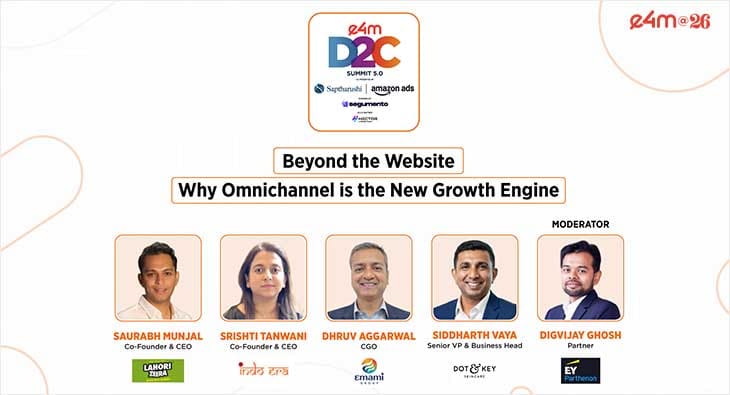

The shift from online to offline is giving D2C brands access to a different kind of consumer understanding, while the growing number of channels is making the journey harder to piece together. At the e4m D2C Summit 2026, brand leaders discussed how businesses are navigating stores, general trade, modern trade and quick commerce while trying to keep the consumer experience connected.
Moderated by Digvijay Ghosh, Partner, EY Parthenon, the session titled “Beyond the Website: Why Omnichannel is the New Growth Engine” featured Saurabh Munjal, Co-Founder & CEO, Archian Foods (Lahori Zeera); Srishti Tanwani, Co-Founder & CEO, Indo Era; Dhruv Aggarwal, CGO, Emami; and Siddharth Vaya, SVP & Business Head, Dot&Key.
Tanwani opened the discussion by describing what changes when a brand steps offline after building entirely online. Online data shows what is selling; a store reveals why. This matters even more in apparel, she said, "when you talk about apparels and the different body fits that Indian garments have, you need to have that experience through an offline channel."
Therefore, for Indo Era opening stores is highly dependent on understanding what brings a consumer into a physical space after years of interacting with the brand online. The questions extend from what they buy to why they buy it, what they have looked at before entering the store and what they expect once they are there.
A brand spends heavily to win a customer, on pricing and styling built for specific occasions, and that same customer is shopping online, offline and on quick commerce all at once. "You have to understand this behaviour when you're allocating products across the different formats," she mentioned.
This also changes the role of the physical store. With 13,000 designs across six sizes, putting everything on the shelf is simply not possible. “You have to curate,” Tanwani shared. “The most important thing becomes what the consumer is actually looking for, not what we want to offer and be everywhere.”
The conversation then moved to Lahori Zeera, where the journey has largely been the reverse. Munjal described the brand’s approach to expansion as simple by choice. They began by understanding where beverages sell, identified the target consumer, and then determined which channels reach those consumers.
General trade still dominates his thinking, since it accounts for roughly 70 per cent of FMCG sales in India. Building that network, he admitted, "is probably the most sophisticated last-mile retail network that India carries. And it's pretty bloody difficult, to be honest with you."
The question of being present across channels led Munjal to draw a distinction between multi-channel and omnichannel. “Everybody says that, I think, without really understanding that they’re talking about multi-channel and not omni-channel,” he said. Simply being available everywhere does not, in his view, make a business omnichannel. To him, omnichannel only earns the name when a brand uses what it learns in one channel to sell more in another.
Quick commerce is one such source of information. While general trade can tell a brand which retailer is selling its product, it is difficult to know who the end consumer is. Quick commerce can provide more visibility into who is buying, when they are buying and which SKU mix is performing in a particular micro-market.
“If I can utilise the information on who’s buying me in a certain micro-market in the Delhi area, and what SKU mix is selling better to optimise my inventory, then that can be called omni-channel,” Munjal said.
Vaya picked up the same issue from the beauty category, where consumers use different channels for different purposes. A consumer browsing Nykaa may be exploring a new brand or trying to understand a routine, while someone using quick commerce may simply be replenishing a product they already know.
“What you list, what kind of assortment you have, I think those are the things that change in the case of beauty,” Vaya discussed. “What does not change is how your brand comes across. And that needs to remain consistent across every channel and every touchpoint.”
He also questioned the way channels are typically classified, arguing that a well-run beauty store within general trade can offer a shopper an experience as rich as an online platform, complete with product trials and colour matching from someone who knows the category, and that the walk-in customer looking to try something new and speak to the owner wants largely the same thing an online browser wants. "So when you start looking at it from a consumer continuum rather than a channel continuum, I think you make far more holistic decisions when you do this," he said.
Acquisitions gave Aggarwal a different vantage point. Emami has made roughly six moves into newer D2C names, including True Native, The Man Company, Brillare, Aloe Fruit, Vedix and Skincraft. What can they learn from the speed and flexibility of smaller D2C brands? "We're not really buying scale. We're buying the speed at which these brands are reacting," he stated, describing how quickly these teams respond to an e-commerce platform, a quick-commerce listing or a general trade distributor.
Emami's role, as he framed it, is to absorb the parts founders never wanted to run in the first place. "How many of you started your company because you like doing GST filings? Probably no one. But we take that boring stuff away. We keep the craziness, we keep the agility. That’s how we grow.”
The discussion then turned to innovation, and the pressure that comes with having to keep pace with consumer demand. For Tanwani, this is more intense because in fast fashion, the number of launches and the timing of seasonal collections leave little room for error.
“For any fast fashion brand today, the pressure is high. You have to deliver 250 designs every month. The launches need to be on time. You can’t miss the deadlines, be it before a festival or a special day,” she said.
Rather than let internal taste drive design, Indo Era built what she called "data designing," starting from what consumers were actively searching for and checking whether the products being surfaced even made sense for them. Her example was a shopper in a tier-three city searching for an office kurta and being shown something priced at Rs 2,000. The brand set out to fix this kind of a mismatch from day zero.
The approach also extended to inventory risk. Instead of producing large quantities and waiting to see what sold, Indo Era began with smaller MOQs (Minimum Order Quantity), allowing it to test more styles with less exposure.
“Roughly half of our early bets missed, but design accuracy has since climbed above 83 per cent,” Tanwani declared.
Access to information has changed the starting point for product development, particularly in beauty and skincare. Brands can now track ingredient trends, Google searches and products that are gaining attention globally.
“That part is now more democratised. I won’t say it’s easy,” Vaya said. The difficult step comes afterwards, when they have to take that information and translate it into the right packaging, language and brand expression.
“At Dot & Key, for example, one of the things that’s worked phenomenally well for the brand is that we keep figuring innovations out well in advance,” Vaya noted. “We always make sure that when we think of an innovation, we always think of how it’s going to land for the consumer in India, for our climate, for their skin type, in the pack that we want, in the colours that we want.”
Munjal sees a parallel shift on his side of the business. “QuickCom gives you the absolute last mile,” he highlighted. “Now you can go right to the point that a packaging of four might make more sense because it’s not there. Or how you sell it, what you sell it with, what are the features that actually matter more to a customer.”
All this information, Munjal argued, is changing how brands think about differentiation. Earlier, founders could look at what legacy players were doing and make incremental changes to packaging, pack sizes or MOQs. With more granular consumer data available through quick commerce, they can start making those decisions based on what is actually happening at the point of purchase.
The panel then moved from product innovation to the consumer experience around products, particularly in food and beverages. The question was how brands could build the kinds of associations that become part of an occasion, the way a particular food can immediately bring a particular beverage to mind.
Munjal’s approach was to first understand the product and its place in the consumer’s life. “Any consumer good brand should not try to start creating an experience immediately. First you need to figure out the right product-market fit. Try to understand what and why the consumer is trying to or wanting to consume you.”
Lahori Zeera began with the familiarity of zeera, already present in Indian households. The differentiation came through its form and factor, alongside an accessible price point and a focus on general trade.
“We kept things simple and focused on one thing,” Munjal said. The brand then watched what consumers did with the product, including the occasions and patterns around consumption. People were liking the product and talking about it and creating their own moments and occasions of consumption. The brand used those observations to shape its communication.
“We doubled down on it by integrating all of that into everything that we say, that the brand says,” he explained.
Aggarwal agreed, differentiating between food and beverages and categories where the product experience takes longer to establish. “Unlike BPC, when it comes to food and beverages, the moment you taste it, that very instance, you know whether or not you’re going to like it.”
Taste itself can take years to shift, he added, which makes familiarity important when introducing something with a point of difference. Emami’s aloe vera juice with chunks offered one example, with the brand identifying occasions where consumers particularly liked the product.
“It’s more of a dinner drink or a travel beverage. So, we target those occasions.”
Brands can map occasions, identify audiences and decide how different elements of the communication should appear. Data now allows them to go much further, including understanding when people buy, how quickly they want products and what quantities they prefer.
That brought the conversation to loyalty, and whether loyalty programmes themselves are enough to create repeat behaviour in categories such as fashion and skincare.
Tanwani sees loyalty through the breadth of a consumer’s relationship with the brand. A customer who first buys Indo Era for office wear may later return for her sister’s wedding and then for her own wedding. The indicators are also visible in how the consumer’s price point and basket size change over time.
“Because today in India, the consumer is not just buying once or twice, they are buying at least 12 times. And if we don’t serve them for their different needs, somebody else will do it,” Tanwani noted. This has made Indo Era evolve from everyday fashion towards a broader range of occasions.
Vaya brought the discussion back to the skincare purchase cycle, where loyalty is tested each time a consumer finishes a product and has to make another purchase. “For a skincare product, I think loyalty is questioned every month when you run out of your pack of sunscreen,” he pointed out. Dot & Key operates at roughly a 50% repeat rate, with product experience playing a central role in whether consumers return.
Pricing across channels can then become another point of friction. “The second big breaking point for loyalty is typically friction at the point of purchase, which usually in a category like BPC is disrupted by pricing mismatches,” he said.
Keeping those discrepancies under control becomes important as consumers move between platforms and channels. If the brand remains consistent, the purchase experience is smooth and the consumer knows what to expect, the likelihood of conversion rises.
“So I think that hygiene from a business and a model standpoint is very critical if you want to get it right,” Vaya said.
Read more news about Marketing News, Advertising News, PR and Corporate Communication News, Digital News, People Movement News
For more updates, be socially connected with us onInstagram, LinkedIn, Twitter, Facebook, YouTube & Google News