The Hindu's Dera Ad Row: Can a disclaimer soften Front Page blow?
The Dera ad generated significant criticism and The Hindu described it as ‘deeply offensive’, while tendering an unconditional apology
 by
by
Published: Sep 14, 2026 9:32 AM | 9 min read
 Follow Us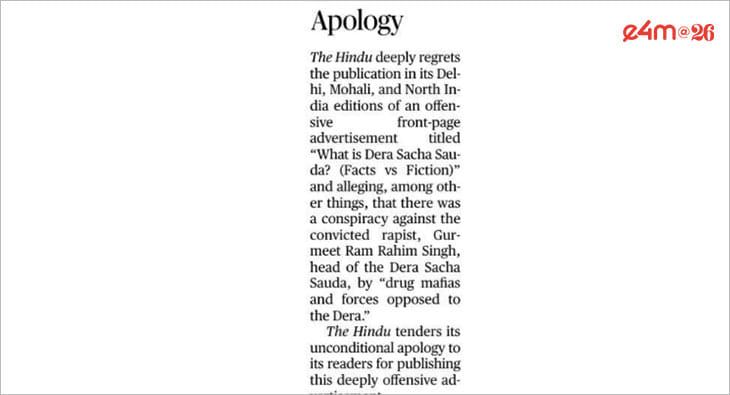

The Hindu apologised after carrying a front-page advertisement that defended convicted rapist Gurmeet Ram Rahim Singh. The controversy raises a larger question for print: does identifying paid content as an advertisement absolve a publisher of responsibility for what it chooses to carry?
For generations, the front page of a newspaper has represented more than premium real estate. It is where a publication exercises its most visible editorial judgement, deciding what deserves prominence, what readers should know first and, by extension, what appears beneath the authority of its masthead.
On Saturday, September 12, much of that space in The Hindu's Delhi, Mohali and North India editions was occupied by a full-page advertisement for Dera Sacha Sauda.
Titled “What is Dera Sacha Sauda? (Facts vs Fiction)”, the advertisement ran almost the entire length of Page 1 beneath The Hindu masthead. A small label at the top identified it as an “ADVERTISEMENT.”
What followed was not a conventional institutional advertisement.
The page sought to counter criticism surrounding Dera Sacha Sauda and its chief, Gurmeet Ram Rahim Singh. One prominent section posed the question “Was there a conspiracy against Guru Ji?” and answered: “Yes, absolutely.” It went on to allege that people opposed to the Dera had attempted to implicate Singh through false witnesses. Another section defended the parole and furlough granted to him, while large portions of the advertisement highlighted the organisation's claims around de-addiction, blood donation, tree planting, cleanliness drives and housing for the poor.
The advertisement subsequently generated significant criticism and, a day later, The Hindu itself described it as ‘deeply offensive’ while tendering an unconditional apology.
The facts surrounding Gurmeet Ram Rahim Singh
Any discussion of the advertisement needs to begin with a distinction that can easily become blurred amid the several criminal cases involving the Dera chief.
Gurmeet Ram Rahim Singh is a convicted rapist.
In 2017, a special CBI court convicted him of raping two women disciples. He was sentenced to 20 years in prison and continues to serve that sentence. He is presently outside prison on a 21-day furlough.
There have also been two major murder cases, but his current legal position in those matters is different.
Singh was convicted in 2019 for the 2002 murder of journalist Ram Chander Chhatrapati and sentenced to life imprisonment. In March 2026, however, the Punjab and Haryana High Court acquitted Singh in that case. The acquittal has been challenged by Chhatrapati's son before the Supreme Court, which last month listed the matter for final hearing.
He had separately been convicted in connection with the murder of former Dera manager Ranjit Singh, but the Punjab and Haryana High Court acquitted Singh and four others in that case in 2024. An appeal against that acquittal is before the Supreme Court. A separate prosecution concerning allegations of forced castration of Dera followers is also continuing.
Those distinctions matter.
But one fact does not depend upon the outcome of any pending appeal: Singh's convictions for raping two women remain in force, and he continues to serve the resulting 20-year sentence.
Is writing 'Advertisement' on top enough?
This is where the episode moves beyond Gurmeet Ram Rahim Singh and becomes a question about the business of journalism.
There was no attempt to pass the material off as a news report. “ADVERTISEMENT” was printed at the top of the page. The creative also carried a disclaimer at the bottom stating that The Hindu had no editorial or journalistic involvement in its creation.
So the reader was formally informed that this was paid-for communication.
But is disclosure alone the test?
There is a difference between establishing that content is an advertisement and deciding whether that advertisement should be accepted at all and, perhaps more importantly, whether it should occupy almost the entire front page.
That distinction becomes especially relevant for The Hindu, a newspaper whose brand has for decades been associated with institutional seriousness and high editorial standards.
A newspaper's Page 1 is not an empty billboard until the editorial department fills it. It derives its value precisely from the credibility of the publication surrounding it.
An advertiser buying that space isn't merely buying square centimetres of paper. It is buying visibility underneath a masthead whose reputation has been accumulated over generations.
Does the publisher therefore have a responsibility that extends beyond correctly identifying who paid for the space?
The economics behind Page 1
There is, inevitably, a commercial context.
Premium newspaper positions command a significant price, and Page 1 is among the most valuable pieces of inventory a print publisher can sell.
Publicly available advertising rates for The Hindu's Delhi market put ordinary colour advertising in the hundreds of rupees per square centimetre, with substantial premiums applying to preferred positions. Actual transactions can vary considerably because agencies and large advertisers negotiate discounts, packages and multi-edition rates.
Based on the approximate size of this execution, publicly available rates and normal Page 1 premiums, an advertisement of this scale in Delhi alone could be worth several lakhs of rupees.
Since The Hindu subsequently confirmed that the advertisement appeared in its Delhi, Mohali and North India editions, industry estimates suggest that a multi-edition Page 1 execution of this nature could potentially represent a minimum of ₹20–25 lakh media buy.
The figure is an estimate based on prevailing market rates, not the confirmed amount paid by Dera Sacha Sauda.
And that commercial context matters because of what is happening to the economics of print.
Print’s paradox: revenues under pressure, credibility still valuable
Print has spent years confronting structural pressure on its traditional revenue model.
Advertising money has increasingly moved towards digital platforms, search, social media, video and other measurable forms of media. Audience habits have fragmented. Publishers have responded by building digital products, events, subscriptions, branded content and other revenue streams.
Yet print continues to possess an advantage that is increasingly difficult to manufacture: credibility accumulated over time.
The printed word still carries a certain gravitas.
A claim appearing in a newspaper can acquire a different psychological weight from the same claim appearing as a social-media post, a banner advertisement or a forwarded message. And the effect can become even stronger when that claim appears on Page 1.
That is precisely why premium print advertising remains valuable.
But it creates a paradox for publishers: if credibility is one of print's most valuable remaining assets, how far can that credibility itself be monetised before the transaction begins to weaken the asset?
The question isn't whether newspapers should accept advertising. Advertising remains fundamental to the economics of the industry.
The question is whether there must still be a line.
And if there is one, who draws it?
The public reaction
The advertisement quickly became the subject of criticism on social media, with journalists and readers questioning both the decision to accept it and the prominence it received.
Journalist Piyush Rai criticised the decision to give front-page space to a convicted rapist to present his defence. Others questioned The Hindu's management and editorial leadership over how such an advertisement cleared the publication's internal processes.
The criticism was particularly pointed because the advertisement's claims sat beneath the masthead of a newspaper known for rigorous editorial standards.
There was another layer to the controversy. The Hindu itself had reported on Ram Rahim's repeated periods outside prison through parole and furlough. The September 12 advertisement, meanwhile, contained an entire section rejecting the suggestion that the parole and furlough granted to him constituted VIP treatment.
The juxtaposition made the distinction between editorial content and paid content even more consequential.
*Then came The Hindu's apology
By Sunday, September 13, the newspaper had responded.*
It published the following apology:
Apology: “The Hindu deeply regrets the publication in its Delhi, Mohali, and North India editions of an offensive front-page advertisement titled “What is Dera Sacha Sauda? (Facts vs Fiction)” and alleging, among other things, that there was a conspiracy against the convicted rapist, Gurmeet Ram Rahim Singh, head of the Dera Sacha Sauda, by “drug mafias and forces opposed to the Dera.”
The Hindu tenders its unconditional apology to its readers for publishing this deeply offensive advertisement.
The language leaves little ambiguity about the newspaper's assessment after publication.
It did not merely acknowledge that the advertisement had caused offence. The Hindu itself called the advertisement “offensive”, then “deeply offensive”, and offered its readers an “unconditional apology.”
The apology was not restricted to the editions that had originally carried the advertisement.
- Ram, Director of The Hindu Publishing Group, said on X that the apology was published on the front page of all editions of The Hindu, according to a report by the Free Press Journal.
That is an important corrective and an unusually public acknowledgement from a legacy newspaper that an advertising decision had crossed a line.
But it also raises the question of how it crossed that line in the first place.
The smallest words on the biggest page
At the very bottom of the original advertisement was a disclaimer.
It read:
“Disclaimer: The Hindu has no editorial or journalistic involvement in the creative and shall not in any manner be liable/responsible for the content published, including the views/opinions expressed herein, only for representation purposes.”
The disclaimer establishes a separation between the advertiser's claims and the newspaper's journalism.
But the controversy demonstrates the limits of that separation.
An advertising department may not create an advertisement. An editor may not write it. A publisher may expressly distance itself from every assertion contained within it.
Yet someone still decides to accept it.
Someone decides where it will appear.
And when that decision places the advertisement across almost the entire front page, underneath one of Indian journalism's most recognisable mastheads, the question becomes difficult to reduce to a disclaimer printed along the bottom.
If a newspaper chooses what enters its pages, chooses where it appears and commercially benefits from that decision, is declaring that it had ‘no editorial or journalistic involvement’ enough to wash its hands of responsibility for what it publishes?
Read more news about Print Media, TV Media, Advertising India, Digital Media, Marketing
For more updates, be socially connected with us onInstagram, LinkedIn, Twitter, Facebook, YouTube & Google News