The missing link between beauty education and business outcomes
Beauty brands are weaving education into creator and performance marketing, but proving its commercial impact remains a challenge
 by
Published: Oct 30, 2026 8:46 AM | 8 min read
 Follow Us


- Beauty brands are increasingly prioritizing educational content in their marketing strategies, recognizing that consumer understanding of product ingredients, benefits, and application is crucial for informed purchasing decisions.
- Companies like O3+ Professional and Avon emphasize that while traditional advertising methods remain important, education-led content helps consumers make confident choices and connect product discovery with practical use.
- Brands are not entirely shifting budgets away from celebrity endorsements; instead, they are adopting a balanced approach that combines visibility from celebrity campaigns with credible information from dermatologists and experts.
- Measuring the effectiveness of educational content presents challenges, as brands must assess its impact on various stages of the consumer journey, beyond immediate sales, to understand its role in building trust and encouraging repeat purchases.
Beauty marketing has traditionally relied on aspiration, visibility and recommendations to capture attention. But when a product requires consumers to understand its ingredients, application and expected benefits, a compelling advertisement may only be the beginning of the conversation.
For beauty brands, particularly those operating in skincare, the question is increasingly about what happens after a consumer sees an advertisement or watches a creator recommend a product. Does the consumer understand what the product does, why it might suit their needs and how to use it correctly? And can that understanding influence the decision to purchase?
Read On: More festive touchpoints, but murkier attribution: Measurement trouble in beauty biz?
These questions are bringing education into the centre of beauty communication. From ingredient explainers and dermatologist-led content to application tutorials and clinical evidence, brands are incorporating information into campaigns that were once primarily designed to generate visibility or product discovery.
Pretty promises aren't enough anymore
Vidur Kapur, Director of O3+ Professional, explained why the brand considers education an integral part of its communication strategy. "We are seeing consumers become more conscious of ingredients, product benefits and the right way to build a skincare routine."
The same thinking is reflected at Avon, where education is viewed as a way to connect product discovery with informed decision-making. Snigdha Suman, GM - Marketing & Business Development at Avon said, "While celebrity endorsements and conventional advertising remain valuable for building awareness and aspiration, today’s consumers are equally interested in understanding a product, its ingredients, benefits and how it fits into their everyday routines. This is where education-led content makes a real difference, turning curiosity into confidence and recommendations into informed choices."
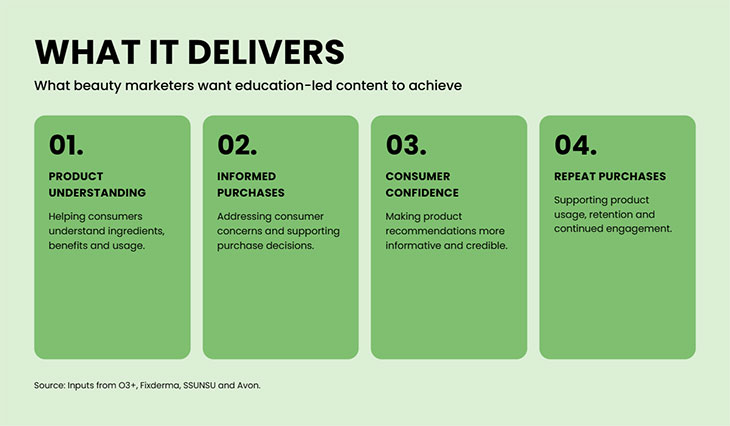
The distinction is important: visibility may introduce a product to a consumer, but product understanding gives the brand another way to communicate its value.
Read On: Science over stardom? Skincare brands are changing the face of beauty marketing
Education joins the media plan
If education is gaining importance, does that mean brands are shifting budgets away from celebrity endorsements and conventional advertising? The responses suggest a more nuanced picture.
Fixderma and FCL, for instance, sees value in combining broad visibility with expert-led communication. Celebrity associations can help brands reach wider audiences, while dermatologists and skin experts provide an avenue for addressing specific consumer concerns.
Shaily Mehrotra, CEO and Co-Founder of Fixderma and FCL, defined how the company approaches this balance. "I believe brands are moving towards a more balanced approach rather than shifting their budgets away from celebrity endorsements or conventional advertising. We have explored both sides through collaborations with personalities like Neelam Kothari, Soha Ali Khan and Bhavana Pandey, which help us build visibility and connect with a wider audience. At the same time, our collaborations with dermatologists like Dr. Aanchal Panth and other skin experts help us address consumer concerns through credible, informative content.”
“We see education-led content as an integral part of our overall marketing strategy," she added.
The approach illustrates why education need not be treated as a competing format. A brand can use celebrity-led communication to build awareness while incorporating expert perspectives to explain product benefits and address questions that a conventional advertisement may not have the space to explore.
Read On: India’s beauty boom moves beyond the D2C playbook
For marketers, this raises a practical consideration. If education is integrated into existing campaigns, its contribution must be assessed alongside the objectives of those campaigns. The question is not simply how much a brand spends on educational content, but what role that content plays in the wider marketing strategy.
The ROI test gets more complicated
The case for education becomes more complicated when brands have to demonstrate marketing effectiveness. Reach, engagement and conversions do not necessarily measure the same outcome, and comparing formats solely on immediate sales can overlook their different roles in the purchase journey.
Kapur believes campaign performance must be evaluated with that distinction in mind. "Each format serves a different purpose. Celebrity endorsements can deliver scale and visibility, while conventional campaigns build brand awareness. Creator recommendation reels offer relatability and product discovery; education-led content adds depth, addresses concerns and supports informed purchase decisions. Media costs, customer acquisition costs and conversions vary by execution and audience. We evaluate performance through campaign-level data rather than assuming one format consistently delivers superior ROI."
Read On: With beauty & personal care mkt nearing $40Bn, quick commerce emerges as ad battleground
SSUNSU, a Korean skincare brand, offers a more assertive perspective on the economics of educational communication. For the brand, the distinction extends beyond how quickly a campaign generates attention to the quality of the customer it attracts.
"Each format does a different job, so a straight ROI ranking can mislead. Celebrity campaigns buy reach quickly, but the cost per informed customer is very high, and the attention moves on when the celebrity does. Recommendation reels are cheap and fast. The catch is that they drive impulse trials, and impulse trials have the weakest repeat behaviour of any cohort we track," said Puja Punj, Director of SSUNSU.
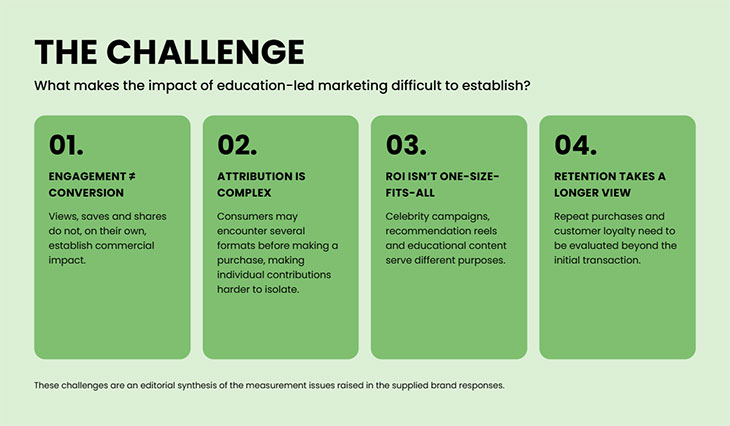
Punj argued that education-led content can take longer to deliver returns, but says the brand sees value in the subsequent customer journey. "Education-led content costs more to produce and takes longer to pay back. It also wins on almost every metric that matters after the first click. Customers who come to us through ingredient explainers, dermatologist-led content or our clinical data add to cart with fewer touchpoints. They return far less often, and they come back for a second product rather than a second discount. Our repeat purchase rate has averaged around 32% over the last six months, and a large part of that comes from customers who understood the product before they bought it."
Can education turn a first-time buyer into a repeat customer?
Educational content also raises questions about measurement across the marketing funnel. A tutorial might attract attention, an ingredient explainer might help a consumer evaluate a product, and application guidance might support the experience after purchase. Each interaction serves a different purpose, making it important to look beyond views alone.
Read On: A Scientific Makeover: Why beauty ads today read like chemistry lessons
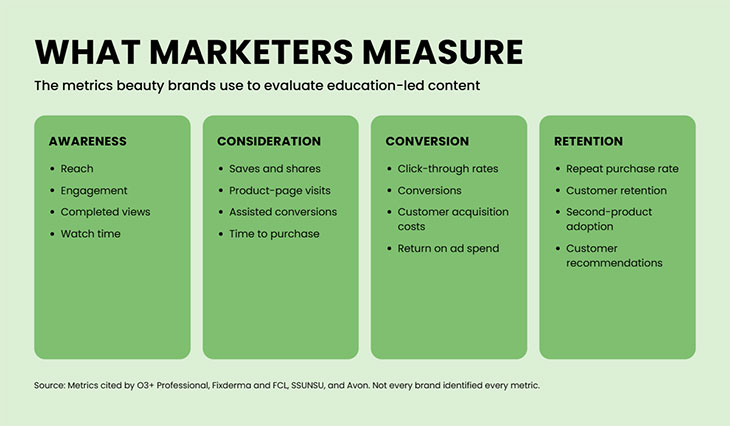
At Fixderma, the approach involves matching metrics to the stage of the consumer journey. "We look at reach and engagement for awareness, saves, shares and product-page visits for consideration, and conversions and customer acquisition costs for purchase. Repeat purchases and retention help indicate whether the overall experience is building lasting trust. Where possible, brands should also use attribution models and controlled tests to measure incremental sales. Ultimately, in skincare, helping consumers understand their needs and make informed decisions can strengthen the entire purchase journey, not just drive a single transaction," said Mehrotra.
This approach makes attribution particularly relevant. When a consumer encounters multiple advertisements, creator recommendations and educational posts before purchasing, identifying the contribution of an individual interaction becomes more difficult. Brands must distinguish between content that attracts attention and content that assists a purchase decision.
SSUNSU's Punj described how the brand approaches this challenge, including the use of clinical evidence in its communication. "When we published results from our 56-day, double-blind clinical study on 108 Indian participants, we didn’t keep it in a press kit. We turned it into content and ran it across every stage of the funnel. Proof has become our most effective creative."
The example illustrates how evidence can become a communication asset rather than remaining confined to technical documentation. However, the effectiveness of that approach still needs to be assessed against the outcomes a brand seeks to achieve.
The challenge is proving what education delivers
The broader implication is that education is not limited to persuading someone to buy. It can also help communicate product usage and reinforce the relationship between the brand and the consumer after the transaction.
Read On: How beauty brands are expanding their packaging palette
Avon's Suman put the emphasis on assessing educational communication alongside other marketing activities. "We believe that every marketing format serves a different purpose and its return on investment must be measured against the role it plays in the consumer journey."
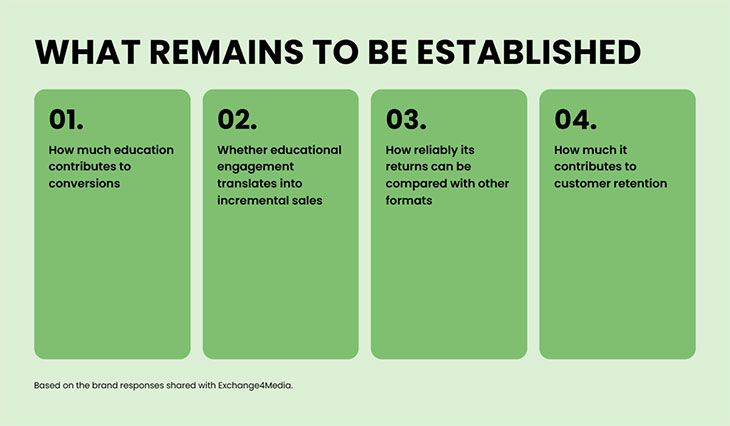
The distinction between engagement and business impact remains central. Saves, shares and watch time can indicate that consumers find content useful, but their significance depends on whether they contribute to consideration, purchase or continued engagement with the brand.
"While advertising builds visibility and performance campaigns drive action, education builds the trust that can influence both. Our approach is to measure its impact through a combination of reach, engagement quality, saves, shares, click-through rates, conversions, customer acquisition costs and repeat purchase behaviour. The focus is on looking beyond vanity metrics to understand how content influences consumer confidence, purchasing decisions and sustained business growth," Suman added.
The brands' approaches suggest that education is becoming part of a wider marketing framework. As this approach develops, the question is whether brands can consistently demonstrate that better-informed consumers also deliver better business outcomes. For beauty marketers, the challenge is therefore twofold: making education accessible and engaging, while establishing its contribution to measurable outcomes.
Read more news about Marketing News, Advertising News, PR and Corporate Communication News, Digital News, People Movement News
For more updates, be socially connected with us onInstagram, LinkedIn, Twitter, Facebook, YouTube & Google News