#e4mXplains: Google is a verb. So why is Search now just 49.7% of Alphabet's revenue?
Google Search contributes less than half of Alphabet's quarterly revenue. As AI changes how consumers discover, is Google fighting to preserve the habit that built its advertising empire?
 by
Published: Oct 30, 2026 8:42 AM | 9 min read
 Follow Us


- Google advertised during the IPL to maintain its presence in a changing digital advertising landscape, where traditional search queries are increasingly being supplemented or replaced by AI tools like ChatGPT.
- Despite commanding a 96.63% share of India's search engine market, Google's advertising revenue from search has declined to less than half of Alphabet's total revenue for the first time, indicating a shift in consumer behavior and advertising dynamics.
- The rise of platforms like YouTube and AI assistants is altering how consumers discover and consider products, challenging Google's traditional role in capturing consumer intent at the moment of search.
- Google's significant advertising investment during the IPL, which included promoting its AI Mode, reflects a strategic effort to adapt and secure its position in the evolving digital marketplace, where consumer decision-making is increasingly happening outside of conventional search.
Why did Google advertise in the IPL?
This is a very strange piece to be writing for a respected trade publication. But this is a journey we need to go on together, so please trust me.
You, dear readers, are experts in media, advertising, and the mathematics of marketing. And me? I glance at television screens and ask dumb questions.
Why is Google advertising during the IPL?
Top-of-mind advertising, duh. Except Google commands 96.63% of India's conventional search-engine market, across devices, according to Statcounter's September 2026 figures.
To make a point? What point? Ninety-seven has very few points left to make up.
ChatGPT, and its growing army of users? Close, but not quite.
I have a suspicion those advertisements were not really for your customers, your employees and coworkers, not for you, and definitely not for me.
Kids. And...
Cohorts
Kids (pretend to) watch cricket with their families. It's a ritual, an appointment. They hear adults talking about ChatGPT and Claude. They watch a generation that no longer simply Googles everything, and they are growing up in an internet where asking a question does not necessarily mean typing it into a search box.
I don't watch cricket anymore. I used to, as a family exercise.
I do remember the ads.
Fevikwik would get you fish/things if applied judiciously. Happydent made your teeth (and your jagir) shine. Desh ka namak was Tata, obviously. There are a dozen others I could name.
I chew Happydent. If something needs fixing around the house, I point the person towards the Fevikwik. I cook with desh ka (pink) namak. And there are probably a dozen advertisements you, dear reader, worked on personally that have become part of somebody else's everyday life.
That's what advertising does. It creates associations that survive long after we've forgotten the programme they interrupted.
You're very, very busy. Why am I wasting your time with this?
Well, 49.7%.
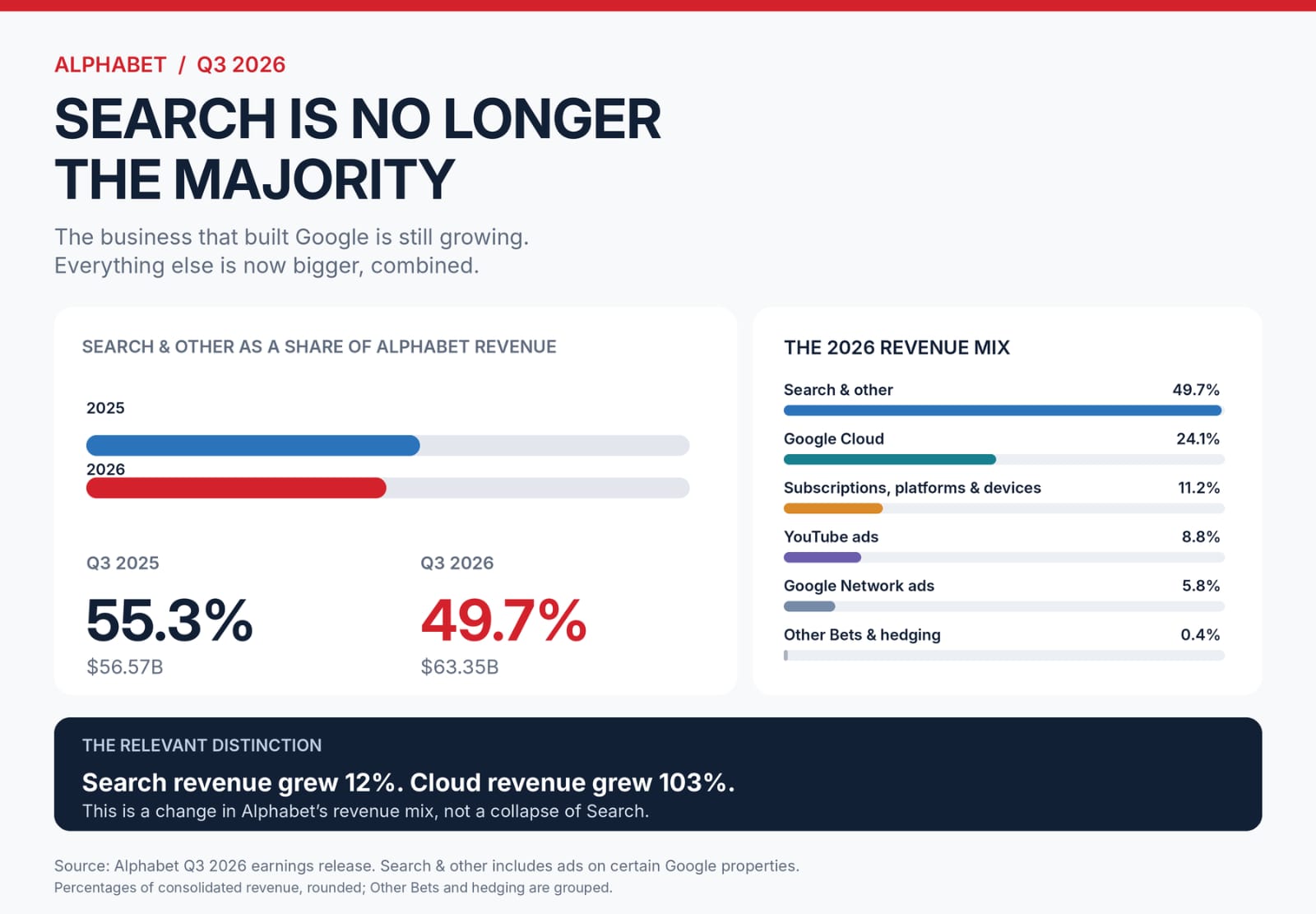
In the third quarter of 2026, Google Search and other advertising generated $63.35 billion out of Alphabet's total revenue of $127.58 billion. For the first time since Alphabet began separately reporting the category in 2018, Search and other accounted for less than half its quarterly revenue.
Just 49.7%.
A year earlier, that figure was 55.3%.
Before anyone points out that a declining percentage does not mean declining revenue, quite right. Search and other advertising actually grew 12% year-on-year, from $56.57 billion. Google's overall advertising business brought in $82.01 billion, still accounting for 64.3% of Alphabet's revenue.
Google Cloud, meanwhile, grew 103% to $30.71 billion. Alphabet's total revenue increased 25%.
The mathematical explanation is straightforward. Search is growing. Cloud is growing vastly faster. The denominator is changing.
But the historical context is worth remembering. In 2003, advertising accounted for 97% of Google's revenue. By 2004, it was 99%. Those figures covered all advertising, including Google's network business, not Search alone. Nevertheless, advertising transformed Google from a search engine into one of the most valuable companies in history.
Read more: Google searching for answers in a world it helped create
And now, for the first time in the comparable quarterly record, the revenue category most closely associated with that original business is no longer the majority.
The Thing
This is not a breakdown of quarterly results of the world's largest attention company. This is not a report on the vagaries of platforms and content.
This is a story about advertising. Digital advertising. You've already seen everything that came with it.
Because Google's great commercial achievement was not simply helping people find information. It was building an extraordinarily profitable business around the moment they decided they wanted something.
Read e4m Explainer on Google's money from ads
For much of the internet's commercial history, we arrived at Google with a question. Which phone should I buy? Where should I go on holiday? Which hotel is worth staying at? Every question was another opportunity for an advertiser to appear at precisely the moment we were considering spending money.
Google didn't have to create the desire. It merely had to be there when we expressed it.
But what happens when we express it somewhere else?
Consider planning a holiday. I recently spent weeks doing precisely that, except I began with ChatGPT.
When Google put Search on Front Page. Read more here
Destinations, budgets, weather, hotels, itineraries, alternative plans, cancellations and occasional despair. A great deal of deliberation, much of it involving things somebody somewhere would have been delighted to advertise to me.
The place
By the time I returned to Google, several decisions had already been made.
Google may still receive the final hotel search or the Maps request. It may still show me an advertisement, and I may even click it. But a substantial part of the consideration process has happened without Google being invited.
That is the opportunity cost.
And it isn't entirely anecdotal. YouGov's India Web Search and AI Report 2026 found that 27% of surveyed AI-search users described AI assistants as their starting point for information. Another 36% used them after other search tools, while 26% moved between AI and other sources.
This doesn't establish that Google is losing advertising revenue to ChatGPT. But it does suggest something conventional search market-share figures cannot tell us.
Google can control almost the entire market for search engines without controlling almost every occasion on which somebody decides to find something out.
And now for the advertising part.
According to the dentsu-e4m Digital Advertising Report 2026, paid Search accounted for 23% of India's digital advertising expenditure in the report's 2025 spending breakdown. Social media commanded 29%, while online video accounted for another 28%.
Let that sink in.
Google commands nearly 97% of India's conventional search-engine market. But paid Search, across providers, accounts for less than a quarter of India's digital advertising expenditure.
Those are two entirely different measurements. They should not be confused, and neither proves the other.
More importantly, paid Search's share has remained around 23% for several years. This is not evidence of advertisers suddenly abandoning Search.
It is evidence that the wider advertising economy has long been bigger than the search box, even if Search was once its most powerful expression of commercial intent.
The question is no longer simply where advertising money is going. It's where the decision to spend money begins.
A product appears in an Instagram Reel. A creator recommends something on YouTube Shorts. An AI assistant compares three hotels and eliminates two. A quick-commerce app suggests something you hadn't intended to purchase until thirty seconds earlier.
Discovery, consideration and even the decision to buy can increasingly happen before a conventional Google search.
Which brings us, inconveniently for this argument, back to Google.
The business
Because Alphabet owns YouTube.
In India, Google says shopping-related watch time on YouTube grew more than 55% year-on-year, while more than 19 million videos have been tagged with affiliate products since YouTube Shopping launched. A creator can introduce a product, demonstrate it, recommend it and direct a viewer towards a purchase, without a conventional Google search ever taking place.
Search captures intent. YouTube can help create it.
And that is a formidable defence against any suggestion that Alphabet is becoming irrelevant to digital advertising. The company may be losing some of its privileged position at the beginning of the search journey while developing entirely different ways of entering the consumer's consideration process.
Indeed, Google may be better positioned than almost anybody to profit from both.
But Google's response within Search itself is revealing.
During IPL 2026, Google was the largest advertiser by volume, accounting for 11% of linear television advertising and 13% on connected TV, according to TAM Sports. Google Search Engine was the most advertised individual brand, accounting for 7% of ad volume on both platforms.
The company was promoting AI Mode, an entirely legitimate reason to advertise a new product. But advertising does not merely explain products. It creates habits, associations and future preferences. Surely the people who sell advertising understand that better than anyone.
On October 28, Google announced that advertising within AI Mode was expanding to India and nine other markets. In the United States, it is also introducing advertisements across successive questions in AI Mode conversations.
Google is rebuilding its advertising proposition around the very conversational behaviour that threatens to move some consumer decisions away from traditional Search.
There is a financial reason to do so.
Sundar Pichai told investors that year-on-year Search query growth was its strongest in five years, including commercial queries. AI Mode questions average three times the length of traditional queries.
Yet Search revenue growth slowed from 17% in the preceding quarter to 12%. Chief Business Officer Philipp Schindler acknowledged that AI Mode currently monetises less effectively than traditional Search. He identified currency movements as the biggest reason for the slowdown, alongside sector-specific spending patterns.
Alphabet's overall revenue missed market expectations, and its shares fell roughly 10% in extended trading. Quarterly capital expenditure reached $51.36 billion, while free cash flow was negative $9.07 billion.
More searching. Longer questions. Extraordinary infrastructure investment. And a new search experience still learning to monetise itself as effectively as the old one.
None of this proves that Google is losing consumer intent. Search revenue is growing. Commercial queries are growing. YouTube is an increasingly powerful commerce environment, and Cloud's extraordinary expansion means Alphabet is becoming less financially dependent on Search.
Perhaps the company is simply doing what successful businesses are supposed to do: adapting before somebody else forces them to.
I have no access to Google's internal calculations, nor do I know what Sundar Pichai sees on his dashboards. The numbers are public. The connections I'm drawing between them are entirely my own.
And I keep coming back to those IPL advertisements.
The Money
For two decades, Google enjoyed something more valuable than market share. It enjoyed a reflex.
You didn't decide to use Google. You Googled.
That reflex created one of the most successful advertising businesses ever conceived, because it put Google in the room when consumers first began thinking about what they wanted.
Now those conversations can begin in a dozen different places, including platforms Google does not own.
Google built its advertising empire by being the first company to hear what consumers wanted. For the first time in a generation, that privilege is becoming contestable.
And Google, the company that made billions charging advertisers to appear at the moment of intent, is spending money to ensure that the moment of intent still belongs to it.
Perhaps that is what those IPL advertisements were really buying.
Not awareness. Not reach. Not even market share.
The next generation's first question.
Google can still serve you the click.
But what if you've already made up your mind?
Read more news about Digital Media, Internet Advertising, Marketing News, Television Media, Radio Media
For more updates, be socially connected with us onInstagram, LinkedIn, Twitter, Facebook, YouTube & Google News
