Meta's ad prices rise 14% globally in Q3, just 1% in APAC: The India equation
As Meta's advertising revenues surge, industry experts examine why India remains among its cheapest major markets, and whether AI-led efficiencies can improve advertiser profitability
 by
Published: Oct 23, 2026 9:05 AM | 6 min read
 Follow Us


- Mark Zuckerberg's year has been marked by significant legal challenges, including a potential $18.59 billion settlement related to teenage mental health and ongoing lawsuits worldwide, despite Meta's strong business performance.
- Meta's AI assistant Muse gained over 10 million users within six weeks, and the company's third-quarter revenue rose 26% year-on-year to $64.6 billion, primarily driven by advertising.
- Regional disparities in advertising performance were noted, with average ad prices increasing by 23% in the US and Canada but only 1% in Asia-Pacific, highlighting different market dynamics.
- While India's advertising costs remain relatively low compared to global benchmarks, the effectiveness of these ads in driving customer acquisition and profitability is questioned, emphasizing the complexities of the advertising landscape.
Mark Zuckerberg is having an interesting year. Not necessarily a pleasant one, but interesting nonetheless.
There have been lawsuits, multibillion-dollar legal liabilities, uncomfortable questions about what Facebook and Instagram have done to their youngest users, and even a sequel to The Social Network. In August, Meta reached an agreement with US attorneys general from several states over litigation concerning teenage mental health and social media, involving potential payments of up to $18.59 billion. Other litigations continue in courtrooms around the world.
Apparently, even $18 billion doesn't buy an entirely quiet year. But business, as they say, is business. And for Zuckerberg, business is booming.
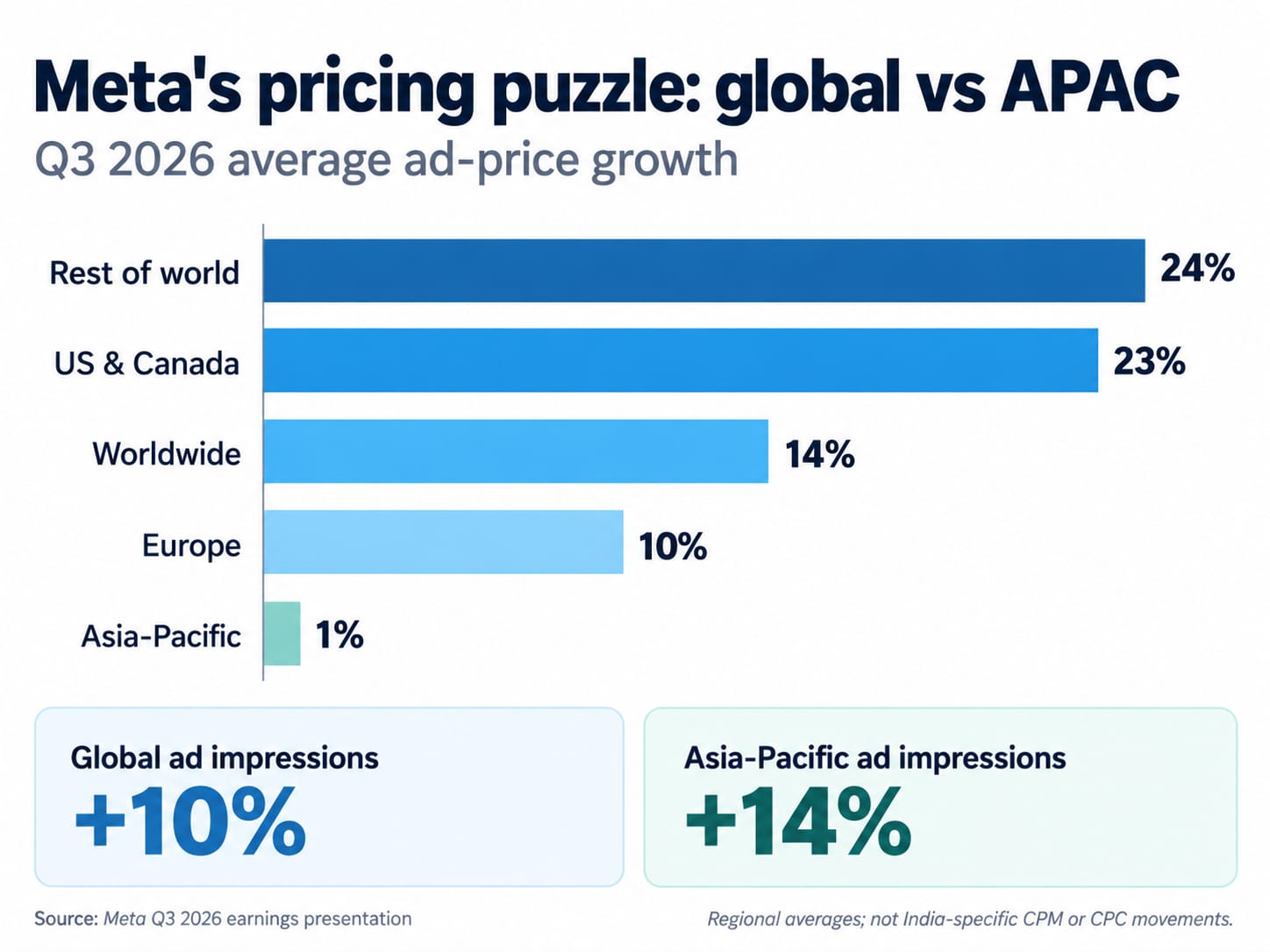
Meta's newly launched AI assistant Muse has attracted more than 10 million users in the US and Canada in six weeks, while third-quarter revenue surged 26% year on year to $64.6 billion. Advertising accounted for $63.1 billion, also growing 26%, as global ad impressions increased 10% and average advertising prices climbed 14%.
There is, however, an interesting geographical wrinkle. While Meta's average ad prices increased 23% in the US and Canada, they rose just 1% across Asia-Pacific. Zuckerberg's advertising business is making more money.
But the economics look rather different for Indian advertisers.
Also Read: How much is one more scroll worth? Meta trial puts attention economics under scrutiny
Why India is a stress test for agentic commerce
How new e-commerce rules could reshape brands' online advertising strategies
A tale of two advertising markets
Meta's Q3 earnings presentation reveals considerable regional differences. Worldwide average ad-price growth accelerated from 12% in Q2 to 14% in Q3, while Asia-Pacific remained at 1% for both quarters. Europe recorded 10% growth and the rest of the world 24%.
Asia-Pacific also saw ad impressions increase 14%, compared with 10% globally, suggesting that expanding inventory remains a significant driver of regional advertising growth.
These are regional averages, not India-specific CPM or CPC movements, and reflect changes in advertising mix, demand and monetisation rather than uniform increases in individual campaign costs.
“I would be careful about applying Meta's global 14% price increase directly to India. In fact, its Q3 numbers show a very different picture for Asia-Pacific, where average ad-price growth was substantially lower,” says Anil Pandit, Founder, Advantage Insights.
However, competitive categories including D2C fashion, beauty, electronics, financial services and app-based businesses can experience higher CPMs and CPCs as advertisers compete for overlapping audiences, particularly during festive periods.
How cheap is cheap?
India remains among the comparatively inexpensive major markets for Meta advertising, although actual inventory costs vary substantially.
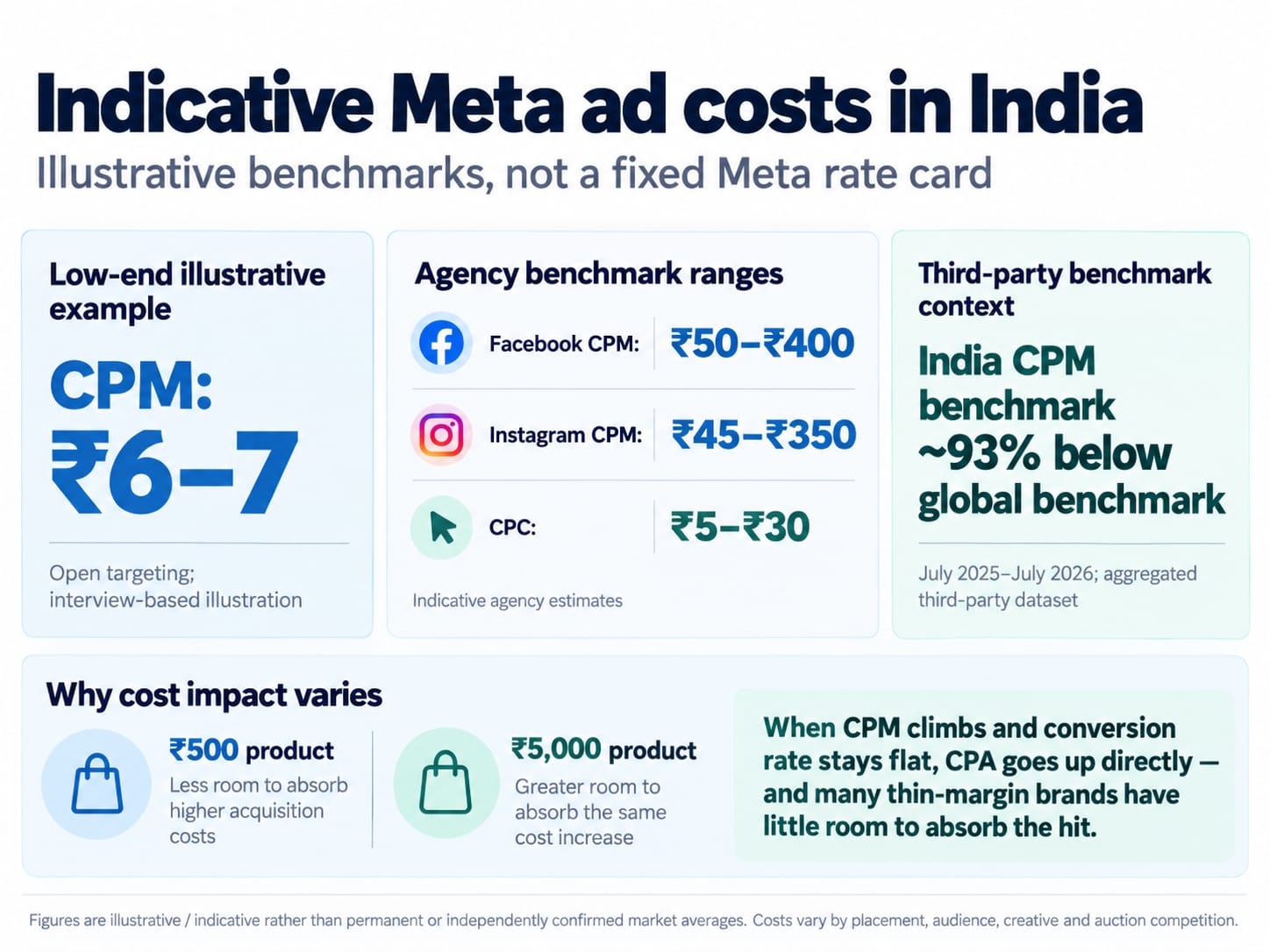
Advertising analytics platform Superads, drawing on aggregated advertising expenditure exceeding $3 billion, reports India's average monthly median CPM at approximately 93% below its global benchmark over July 2025–July 2026. Its dataset also places India considerably below the US, UK and Brazil, although country-level sample composition and currency reporting are not fully documented.
Indian agency estimates illustrate the wide range of costs. AdiAnsh Media's 2026 guide puts Facebook CPMs between ₹50 and ₹400, Instagram CPMs between ₹45 and ₹350, and CPCs between ₹5 and ₹30. These are indicative estimates, not independently audited market averages.
Rahul Vengalil, CEO and Co-founder, tgthr, offers an even lower illustration.
“My CPM on Meta, for open targeting, for example, can be as low as Rs 6–7,” he says. “Meta had already subsidised advertising rates in India to such low levels that even a 10% increase in the overall cost, or a 10% increase in my CPM or CPC, doesn't really impact the advertiser.”
He cautions that he cannot establish whether Indian CPMs have increased meaningfully, noting, “Every year, there is a correction in CPM, CPP, CPC, etc., across Google, Meta and other platforms. This year, it must have happened as well. Then there is an additional correction and inflation that typically happens during the Diwali period.”
The contrasting benchmarks reflect different targeting conditions, placements and campaign objectives in a dynamic auction marketplace without a fixed rate card.
The stakes are considerable. According to the dentsu-e4m Digital Advertising Report 2026, India's digital advertising expenditure reached ₹71,621 crore in 2025, growing 19% year on year. Social media accounted for ₹21,057 crore, approximately 29% of digital spending.
The conversion conundrum
Low impression costs, however, do not necessarily translate into inexpensive customer acquisition.
Pandit cites a D2C brand selling a ₹999 product, where even modest acquisition-cost increases can erode contribution margins after discounts, logistics, returns and fulfilment expenses. Businesses selling ₹500 products also have different capacities to absorb rising acquisition costs than those selling ₹5,000 products.
This is where Meta believes artificial intelligence can improve the equation.
During its earnings call, Meta reported that expanding its GEM advertising-ranking model increased conversions by 1.7% for offsite conversion campaigns and 9.6% for app advertisements. Improvements to its Andromeda retrieval system reportedly increased Facebook conversions by 1.4%.
Meta also estimated that advertisers adopting recommendations from its AI Business Assistant generated nearly 5% more conversions at unchanged cost per conversion, while increasing advertising investments by 9% compared with similar non-adopters.
These are platform-reported improvements across specific applications, not evidence of equivalent returns for every advertiser.
“A conversion reported by the platform is not necessarily an incremental sale, and a better reported ROAS does not always translate into better margins,” Pandit explains.
He also identifies a potential complication: better algorithms could direct competing advertisers towards the same high-intent consumers, absorbing some efficiency gains into higher auction prices.
Vengalil remains cautious about Meta's conversion claims but acknowledges the operational benefits of automation, particularly for smaller businesses.
“What this is basically doing is saving a lot of time for small companies, SMEs, MSMEs and startups. They don't really need an entire advertising agency or a third-party outsourcing partner's overall structure to actually drive results,” he says.
For mature brands, however, he believes agencies remain important for understanding consumers, purchase journeys and broader brand strategy. “Where this really matters is once you are evolved, and you have to really get into the nitty-gritties of who the consumer is, what the consumer journey is like, and what the brand represents in that consumer journey. At the time of such conversations, you will have to have those external parties.”
exchange4media approached advertisers across sectors, company sizes and market positions for this report. Those contacted universally declined to comment on Meta's quarterly performance or their own commercial arrangements with the platform.
The real return on investment
Meta's earnings demonstrate stronger global monetisation, but its regional figures suggest that pricing pressures are far from uniform. India's relatively inexpensive inventory remains an advantage, although competitive auctions and thin product margins complicate the relationship between advertising costs and profitability.
The question is whether improvements in Meta's targeting and delivery systems translate into genuinely incremental business, rather than simply stronger platform-reported performance.
As Pandit puts it: “AI can help you buy media more intelligently. It cannot automatically make your business economics work.”
Zuckerberg has plenty of reasons to celebrate Meta's advertising performance. Whether Indian advertisers are equally enthusiastic about the bills (and the returns) is another matter.
Read more news about Digital Media, Internet Advertising, Marketing News, Television Media, Radio Media
For more updates, be socially connected with us onInstagram, LinkedIn, Twitter, Facebook, YouTube & Google News