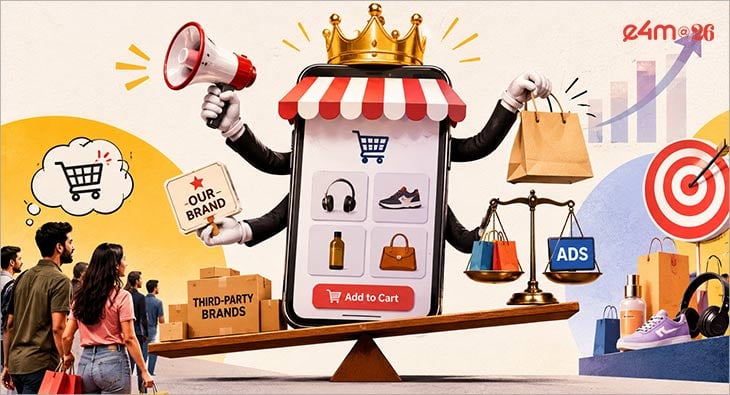
What happens when the marketplace owns both the brand & the ad slots?
As e-commerce and Q-comm players expand private labels, the dual role as brand owners and retail-media businesses raises questions about competition, visibility and access to consumers
 by
Published: Oct 23, 2026 9:11 AM | 8 min read
 Follow Us

- India's online shopping platforms are evolving from mere marketplaces to brand owners, developing their own products and acquiring existing brands across sectors like beauty, fashion, and groceries.
- Nykaa's owned-brand business exemplifies this trend, with its House of Nykaa portfolio generating significant growth in gross merchandise value, indicating a shift towards platforms building competitive brands.
- Quick commerce platforms like Swiggy and Zepto are also launching their own brands, enhancing their product offerings and influencing consumer purchasing decisions through strategic visibility on their apps.
- The rise of platform-owned brands raises competitive concerns for independent brands regarding visibility, advertising costs, and data access, prompting calls for transparency and fair competition practices in the digital commerce landscape.
India's online shopping platforms are increasingly doing more than bringing brands and consumers together. They are building brands of their own, acquiring existing businesses and using their retail ecosystems to take products from discovery to purchase. The shift is visible across beauty, fashion, groceries and quick commerce, where platforms are seeking to build differentiated assortments alongside the brands they already sell.
For some, this means developing products around gaps in existing categories. For others, it involves acquiring brands with established consumer appeal and scaling them through digital distribution, physical retail and marketing. The strategies differ, but the direction is similar: the platform is becoming a brand owner in its own right.
The scale of Nykaa's owned-brand business illustrates the opportunity. According to FSN E-Commerce Ventures' FY2025-26 integrated annual report, its House of Nykaa portfolio generated ₹3,176 crore in gross merchandise value (GMV), growing 49% year on year. Its beauty brands contributed ₹2,788 crore, an increase of nearly 65%, while its fashion brands generated ₹388 crore. The portfolio included 13 brands across beauty and fashion as of March 2026.
The numbers point to a business that is becoming more than an extension of a retailer's product assortment. Owned brands are emerging as a significant growth engine, raising questions about how platforms compete, market products and monetise consumer attention.
From beauty retailer to brand owner
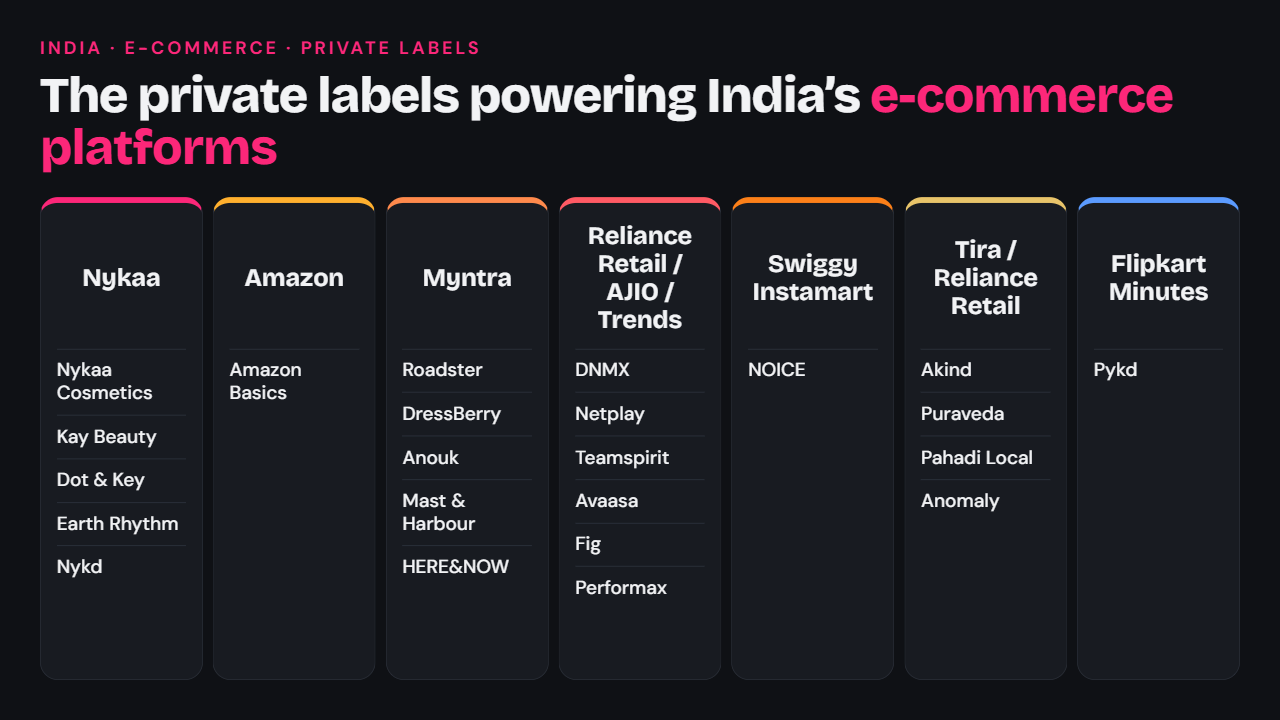
Beauty offers one of India's clearest examples of this transition. Nykaa's portfolio spans Nykaa Cosmetics, Kay Beauty, Dot & Key, Earth Rhythm and Nykaa Wanderlust, among other brands. The business combines brands developed internally with acquisitions. Dot & Key, for instance, was acquired in 2021 and has since expanded across skincare categories and retail channels.
In FY2024-25, Dot & Key recorded GMV of ₹900 crore, while Nykaa Cosmetics generated ₹350 crore and Kay Beauty crossed ₹240 crore, according to the company's disclosures. The portfolio's growth demonstrates how a platform can move beyond selling third-party products to building brands that compete for consumer spending across categories.
Read more: The visibility equation: How Q-comm is monetising every pixel
Reliance Retail's Tira is pursuing a related strategy. Alongside distributing established beauty brands, it has expanded its own-brand portfolio with Akind, a skincare brand co-founded by Mira Kapoor, and Puraveda, its Ayurvedic beauty offering. Reliance Retail also acquired the Pahadi Local brand and business in March 2026, adding another label to its beauty and wellness portfolio. These represent different routes to portfolio expansion: launching a brand, developing one with a partner and acquiring an existing business.
For independent beauty and skincare brands, the expansion of platform-owned labels adds another layer of competition. Visibility and pricing can influence which products enter a consumer's consideration set, particularly when shoppers compare several alternatives within the same category.
Radhika Dang Gambhir, Founder & CEO of Wildflower Naturals, believes independent brands need to differentiate themselves beyond price and visibility. “Platform-owned brands are transforming how consumers discover, research, compare and buy products across e-commerce and quick commerce. With these brands benefiting from strong visibility, competitive pricing and platform-led discovery, there is greater pressure on independent beauty and skincare brands to differentiate themselves,” she said.
Quick commerce moves beyond delivery
The shift is also becoming more visible in quick commerce. Swiggy Instamart has built NOICE, a clean-label food brand launched in 2025, and Nectr, its fresh-produce brand. In its October update, Swiggy said one in every 10 Instamart baskets contained a NOICE product. The company also reported that the brand had reached more than nine million customers and was working with 75 food entrepreneurs. These are company-reported metrics, but they indicate that NOICE has become a meaningful part of the platform's assortment.
Zepto's Daily Good, which spans groceries and pantry essentials, offers another example of a platform-associated label available through quick commerce. Meanwhile, Flipkart Minutes has entered gourmet grocery with Pykd.
In categories such as snacks, where purchases can be frequent and impulse-driven, a product's position on the app can shape what consumers discover. “The digital shelf on digital commerce platforms is increasingly becoming an important part of the consumer decision-making process. A consumer may come to a quick-commerce platform looking for a familiar snack and discover something new simply because it appears at the right place on the app at the right moment,” said Karan Korke, Co-Founder and CMO of The Healthy Binge.
This makes visibility valuable to both established brands and emerging labels. “As platforms build their own brands alongside retail-media businesses, we believe that the focus should be on enabling consumers to make informed choices while allowing brands to compete on product quality, relevance and value,” he added.
The model predates quick commerce. Amazon and Flipkart have historically used private labels to compete in categories including electronics, home products and everyday essentials. Amazon Basics, for instance, spans consumer electronics and household products, while Flipkart has developed labels including MarQ and Billion.
Fashion platforms offer another variation. Myntra's assortment includes labels such as Roadster and DressBerry, while AJIO combines third-party brands with its own-label and exclusive offerings.
Across these categories, private labels allow platforms to exercise greater control over product development, pricing and positioning. They can also help platforms differentiate their assortments and build additional revenue streams. The competitive question becomes more complex, however, when the same platforms sell advertising to third-party brands competing for consumer attention.
But what happens when the retailer is also the media owner?
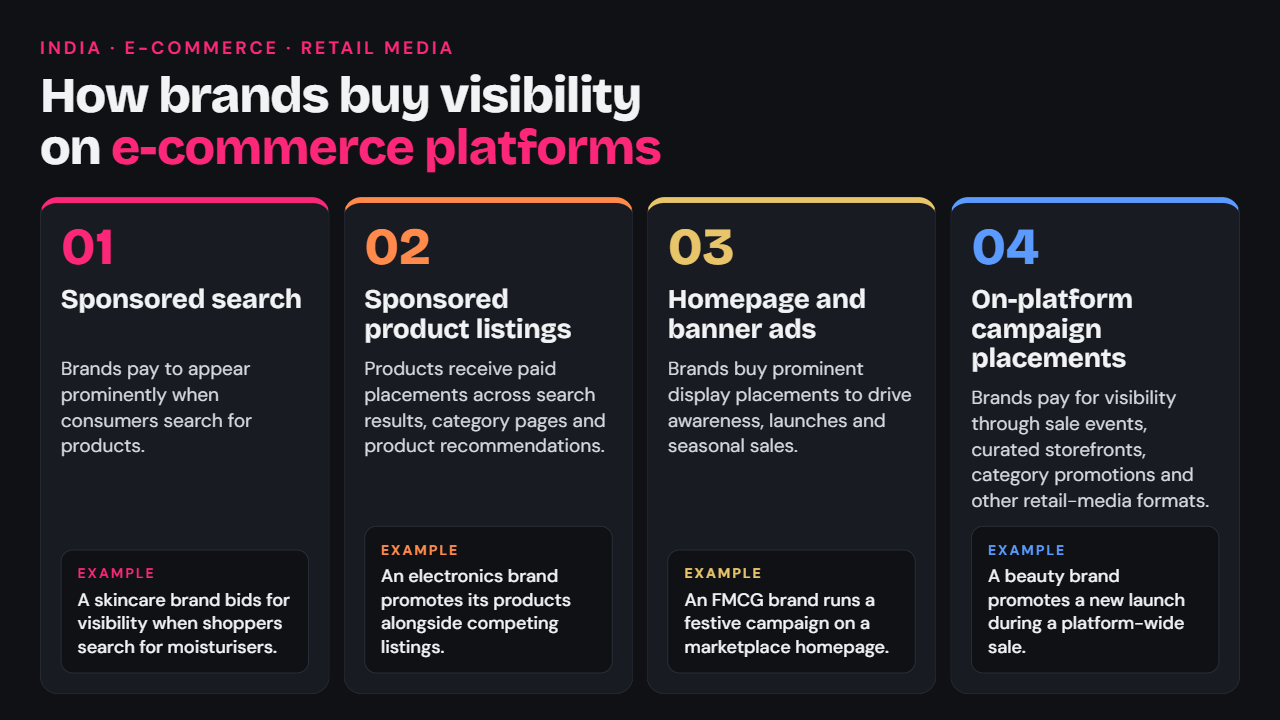
Online marketplaces are no longer just places where products are listed and sold. Many also operate retail-media businesses, selling sponsored search placements, promoted listings and other advertising opportunities to brands seeking visibility at the point of purchase. As platforms expand their private labels, this creates a more complex competitive environment for third-party sellers advertising on the same platforms.
Syed Amjad Ali, Brand Consultant, who has worked extensively across e-commerce, quick commerce and D2C platforms, pointed to his experience handling Homefoil, which competed with Amazon's Solimo Aluminium Foils. He recalled that Amazon identified Solimo upfront as its own brand and said the product recorded significant sales before eventually disappearing from the app. He said he is unsure why it was removed.
Ali believes the objective should not be to prevent platforms from building successful private labels, but to ensure those brands succeed on their merits. “The challenge arises when the platform owning the brand also controls its discoverability, visibility, ranking, promotions, reviews and access to all kinds of data,” he added.
The question of how brands compete for visibility also extends to advertising costs. Chirag Taneja, CEO & Co-founder of GoKwik, illustrated the challenge through a typical marketplace search. “Search for a phone charger on most large marketplaces today, and the first screen often shows a sponsored listing, a platform-owned alternative, and then another sponsored listing. That is the shelf D2C founders are competing on.”
For Taneja, the issue is not the existence of private labels but the concentration of control over discovery, advertising and sales. “Private labels are a legitimate business. The problem starts when one company owns the shelf, sells the ad space on it, sees every search and cart, and also competes for the sale.”
He argued that this can put pressure on independent brands' customer acquisition costs (CAC), as they bid for advertising inventory alongside platform-owned alternatives. Access to aggregated consumer data adds another dimension to the debate, raising questions about how seller information is handled when the platform also competes in the same categories.
Taneja said a fair marketplace needs “clear labelling of sponsored and platform-owned listings, rankings driven by relevance and ratings, and a real firewall between seller data and private-label teams.”
Aniket Aggarwal, Deputy Manager, Ecom at Maliao Cosmetics, added that independent oversight could help strengthen accountability. He said, “There are real possibilities for advertising and discovery through retail media, as long as proper competition is practiced and well-documented. Independent oversight and transparency in seller policies would also be additional ways to build trust in the digital commerce industry.”
The concern is not that platforms should refrain from promoting their own products. It is how competing brands gain access to consumers, how advertising and organic discovery are distinguished, and what safeguards govern the use of seller data.
For D2C brands, competing on marketplaces is only one part of the equation. Taneja argued that businesses need to diversify their routes to consumers rather than depend entirely on third-party platforms. “To thrive long-term, D2C brands cannot rely solely on third-party channels. Diversifying into brand-owned storefronts (D2C websites) provides full ownership over customer relationships, data, and unit economics,” he said.
He also pointed to brands building first-party data and direct customer relationships through their websites and WhatsApp, alongside emerging AI-led discovery channels. These routes can give brands additional ways to reach consumers, although marketplaces continue to offer access to shoppers close to the point of purchase.
The challenge for platforms is to sustain advertisers' confidence in retail media as their own brand portfolios grow. The commercial opportunity is clear, but the long-term value of the ecosystem depends on brands believing that advertising delivers credible access to consumers and that competition is governed by transparent policies.
Read more news about Marketing News, Advertising News, PR and Corporate Communication News, Digital News, People Movement News
For more updates, be socially connected with us onInstagram, LinkedIn, Twitter, Facebook, YouTube & Google News