Outsource machinery, not consumer: What does it take for legacy brands to go the D2C way
Industry experts say D2C specialists can accelerate execution, but the brand must continue to own the consumer & data, retain ownership of the proposition and organisational learning
 by
by
Published: Sep 8, 2026 8:48 AM | 6 min read
 Follow Us

- Colgate-Palmolive India has partnered with Bombay Shaving Company to manage the direct-to-consumer (D2C) and ecommerce aspects of its Palmolive brand, while retaining control over product innovation and supply chain decisions.
- This partnership raises concerns about the extent to which legacy brands can outsource their consumer relationships without losing strategic insights into customer behavior and preferences.
- Industry experts suggest that while specialized partners can enhance operational efficiency in D2C, brands must maintain ownership of consumer data and insights to inform broader marketing and product strategies.
- The D2C landscape in India is rapidly evolving, with significant growth projected, highlighting the importance of integrating consumer feedback into brand strategies rather than treating digital commerce as a separate entity.
Colgate-Palmolive India’s decision to hand the direct-to-consumer and ecommerce business of Palmolive to Bombay Shaving Company late last month is more than another partnership between an established FMCG company and a digital-native challenger.
It raises a question that legacy consumer businesses are increasingly having to confront: how much of the digital commerce engine can be outsourced before a brand begins outsourcing its relationship with the consumer itself?
Under the arrangement, Bombay Shaving Company will manage Palmolive’s consumer-facing advertising and customer relationships across D2C and ecommerce, while Colgate-Palmolive will continue to manage the brand across general and modern trade. Product innovation, quality and supply-chain decisions will also remain with Colgate. The two companies already have a financial relationship: Colgate-Palmolive Asia Pacific acquired a 14% stake in Bombay Shaving Company in 2018.
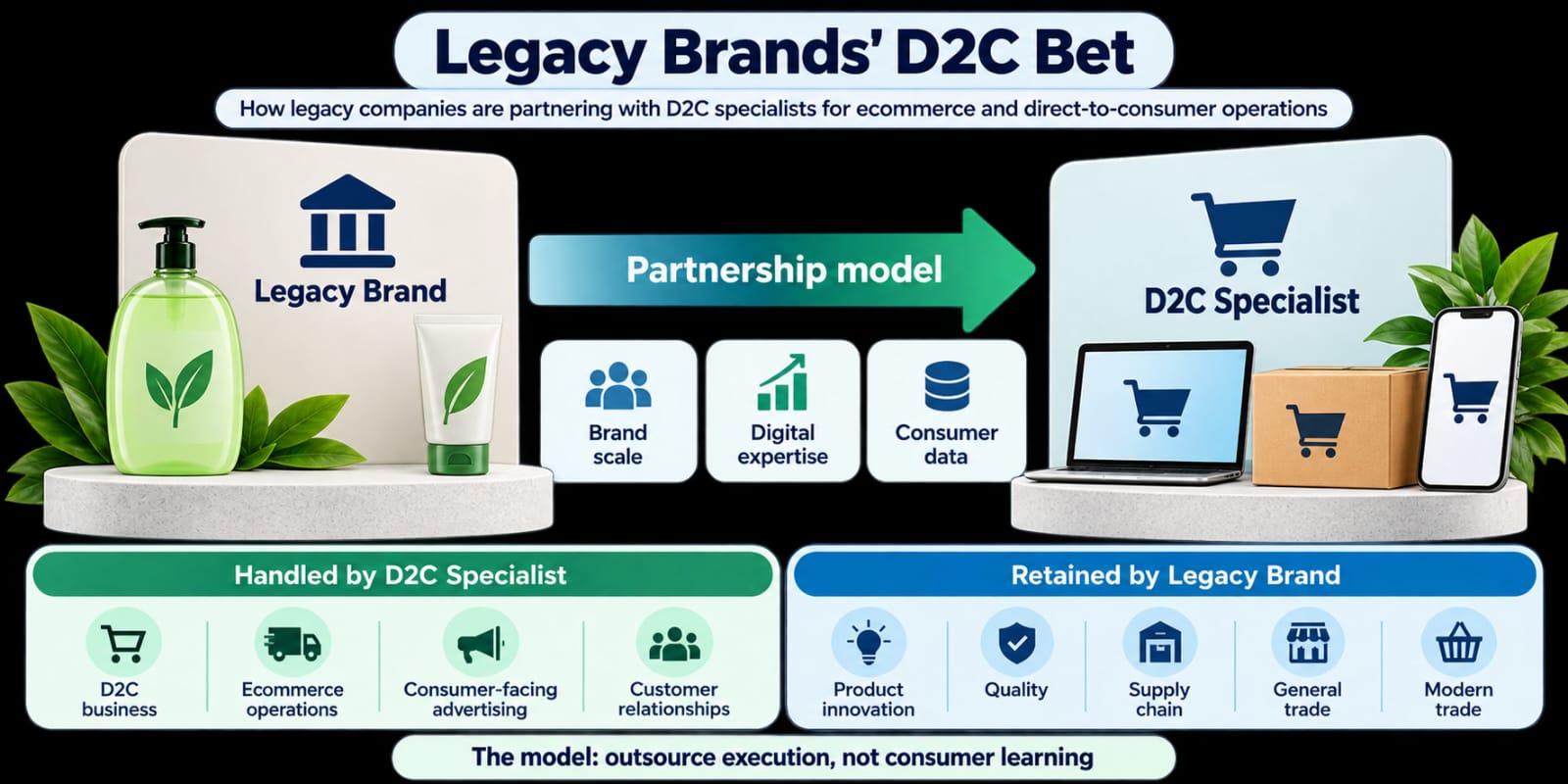
Explaining the move at the company’s investor day, Colgate-Palmolive India MD and CEO Prabha Narasimhan had acknowledged that the “flywheel” of a D2C business differed from the traditional brand-building model and that the company’s own attempt had not been best in class.
Read more on retail media grows from ad channel to digital shelves
For industry executives, however, using a specialist is not necessarily an admission that a large organisation has failed to develop digital capability internally.
Sumeet Bhojani, Head – Brand & Strategic Insights, Godrej Enterprises Group, said specialised partners can help companies enter or scale D2C without having to recreate capabilities already available in the ecosystem.
“Everyone doesn't need to reinvent the wheel,” Bhojani said, adding that such partnerships can be a “win-win” as long as their terms are clearly defined and both sides bring distinct strengths. At the same time, he pointed out that digital commerce is increasingly a source of consumer intelligence rather than merely a transaction channel, with online behaviour capable of informing product innovation, customer experience and brand strategy.
That distinction (between outsourcing execution and outsourcing learning) may ultimately determine whether such partnerships strengthen a legacy brand or create a new dependency.
Swagat Sarangi, Co-Founder, Smytten, separates digital commerce into two layers. Functions such as warehousing, marketplace operations, catalogue management, performance marketing and returns have increasingly become specialised operational capabilities which companies need not necessarily build themselves.
The second layer, however, comprises the signals generated by consumer behaviour: why somebody bought once but did not return, how customers interpret a product, or whether an unexpected cohort is adopting it.
Sarangi described this as “research arriving disguised as a sales channel”. If the information returning to the brand consists only of metrics such as ROAS and GMV, he argued, the partnership may be succeeding commercially while failing strategically.
The danger is particularly relevant when digital commerce is treated as a separate business rather than integrated into the wider organisation.
What exactly is commerce media? Read more here
India’s D2C ecosystem has now moved well beyond its startup phase, although estimates vary depending on what qualifies as a D2C brand. Statista puts the country at 800-plus D2C brands, while D2CStory, a commercial database updated in September 2026, tracks 1,555 verified Indian D2C brands across 46 categories. The variation reflects the lack of a uniform definition of what constitutes a D2C brand, particularly as digital-native companies expand offline and traditional companies build direct channels of their own.
Operationally, the universe is larger still: Unicommerce’s 2026 D2C report draws on transaction data from 6,000-plus brands and more than 410 million shipments, underlining how widely direct and digital-first commerce practices have spread beyond the best-known venture-backed names.
The size of the market similarly depends on definition. A February 2026 McKinsey study estimates that sales through direct-to-consumer channels themselves currently account for $10-12 billion in India, with that figure potentially reaching $60 billion by 2030.
More importantly for legacy FMCG companies, McKinsey estimates that D2C adoption is growing at nearly three times the pace of traditional ecommerce marketplaces; in its survey of 1,049 Indian MSMEs, 53% preferred D2C routes compared with 47% using marketplaces. That growth makes control of customer data and feedback increasingly strategic rather than simply an ecommerce execution question.
Ekta Dutta, Head of Marketing at BIBA, similarly argues for a hybrid structure. Specialist partners can run much of the digital commerce machinery, she said, but brands cannot give up understanding why consumers purchased, returned or rejected products.
Those insights can eventually affect decisions far beyond ecommerce, including what products get designed, repeated or corrected. “Specialists can accelerate execution, but the brand must continue to own the consumer, the data and the learning,” she said.
The value of retaining that information becomes clearer at the level of individual consumer actions.
Vipin Yadav, Vice President and Head of Marketing, DriveX, said specialists can provide expertise in performance marketing, marketplace management, technology, experimentation and conversion optimisation. But moving digital commerce completely outside the brand organisation could simply create “a new version of the very silo” companies are attempting to eliminate.
Instead, Yadav sees the emerging model as one of integrated capability, in which specialists provide speed and technology while brands retain ownership of the consumer, proposition and organisational learning.
Keyur Dhami, SVP – Customer Success (Key Accounts) & CoE at WebEngage, pointed to a customer repeatedly searching for a particular variant without purchasing it. Such behaviour could signal problems with pricing, availability, positioning or communication. Similarly, knowing which recommendations or offers produce repeat purchases can feed back into both marketing and customer experience.
According to Dhami, an external partner can manage storefronts and campaigns while the behavioural data generated through those interactions is integrated into the company’s broader consumer strategy.
For D2C-native businesses themselves, that feedback loop is central to the operating model.
When did CRM quietly become marketing. Read more
Shaily Mehrotra, CEO and Co-Founder of Fixderma and FCL, said digital businesses look beyond first transactions at metrics including repeat behaviour, CAC payback, contribution margins and lifetime value. While specialists can provide speed and platform expertise, she argued that “consumer relationships and the learning generated from them cannot be completely outsourced.”
The Colgate-Palmolive–Bombay Shaving Company partnership therefore illustrates a broader shift in how large consumer businesses may approach D2C. The choice is becoming less binary than building everything internally or handing the entire digital business to an external operator.
Specialists can provide the technology, talent and execution velocity that legacy organisations may find expensive or slow to reproduce. But the strategic test is whether the consumer signals generated by that machinery continue to travel back into the organisation.
The emerging model is not simply outsourcing D2C. It is outsourcing parts of the engine while ensuring the brand still knows who is sitting in the passenger seat.
Read more news about Marketing News, Advertising News, PR and Corporate Communication News, Digital News, People Movement News
For more updates, be socially connected with us onInstagram, LinkedIn, Twitter, Facebook, YouTube & Google News