Beyond Print: How publishers are rewriting the economics of news
Non-print revenue at newspaper groups has grown rapidly post-Covid and now accounts for around 25–30% of overall revenue, with events, digital subscriptions and OOH emerging as key growth levers
 by
by
Published: Sep 8, 2026 8:15 AM | 5 min read
 Follow Us

- Indian newspaper groups are transitioning from traditional print-centric models to diversified media businesses, generating 25-30% of their revenue from non-print sources such as events and digital advertising.
- A CRISIL study indicates that non-print revenue for major Indian dailies is expected to grow from 13% in FY19 to around 25% by FY25, while traditional print revenue growth is slowing.
- The diversification trend is seen as an opportunity for Indian publishers to build resilience and avoid severe job cuts faced by their Western counterparts, as the core newspaper business remains relatively strong.
- While new revenue streams are emerging, profitability in non-print sectors remains a challenge, with margins expected to stay around 12-13%, highlighting the need for sustainable growth in these areas.
For decades, the newspaper was the business. Everything else—events, digital platforms and branded properties—was built around it. That equation is changing.
India’s largest newspaper groups are increasingly becoming diversified media businesses, monetising assets built over decades: trusted brands, advertiser relationships, regional reach, consumer communities and the ability to bring audiences together, both online and offline.
Publishers are now making 25-30% of their revenue from businesses beyond print, helping make the core newspaper business more sustainable, industry leaders say.
.jpg)
Also Read: Why is news traffic falling across the globe?
Is traffic the real success metric for news publishers?
Videos, Events, B2B Services & Bot Paywalls: Publishers rewrite playbook amid traffic loss
According to Vikram Sakhuja, Chairman of the Media Research Users Council India (MRUCI) and Partner and Director at Madison World, “sponsor-led events, digital advertising and outdoor advertising portfolios of newspapers have grown rapidly over the last 4-5 years.”
Most newspapers, including the regional ones, organise multiple events and awards each year, generating sponsorship and registration revenues running into crores. Some film and women’s magazines also generate substantial revenues from a single event—often matching or even surpassing their annual advertising and subscription revenues.
Pradeep Gairola, Chief Digital Business Officer, The Hindu Group, says, “Indian news publishers are in a fortunate position: we have the opportunity to build new revenue streams while the newspaper business remains strong. The opportunity is to diversify from a position of strength rather than respond to a rapidly declining core business.”
“If this trend continues, Indian publishers could potentially avoid some of the severe job cuts and existential pressures faced by the news industry in the US and Europe. The opportunity is to use this period of relative stability to build a more diversified and resilient news business,” Gairola explains.
e4m had reported about this trend earlier this year. The numbers put the scale of this transition into perspective. A recent CRISIL study of five of India’s most widely circulated dailies estimates that non-print businesses will contribute around 25% of revenue, up from about 13% in FY19.
CRISIL expects non-print revenue to grow 10–12% annually between FY25 and FY27, compared with 2–3% growth for traditional print.
For publishers, the significance is larger than the numbers suggest. They are not simply finding replacements for declining print revenue. They are monetising assets built by the newspaper business over decades—trusted brands, advertiser relationships, regional reach, physical infrastructure and large consumer communities.
The change is being accelerated by the limitations of digital as a straightforward replacement for print. For publishers, the implication is clear: the answer to print’s gradual erosion may not be another single medium. It may be a portfolio.
India still has time to diversify
The Indian publishing market remains structurally different from the West. CRISIL estimates that print circulation and advertising account for around 75% of revenue for Indian newspaper majors. By comparison, print circulation and advertising contribute approximately 23.8% at The New York Times, and an estimated 10–15% at the Financial Times, 15–20% at The Economist Group and 10–15% at Wall Street Journal/Dow Jones, as per a study by WAN-IFRA.
That gives Indian publishers something their Western counterparts increasingly lack: time to diversify while the core business remains relatively resilient.
But the pressure on that core is already visible. The circulation base of large newspaper companies fell to around 10 million in 2025 from roughly 15 million in 2019, while print-related revenue declined at an estimated 1–2% CAGR over the past seven years.
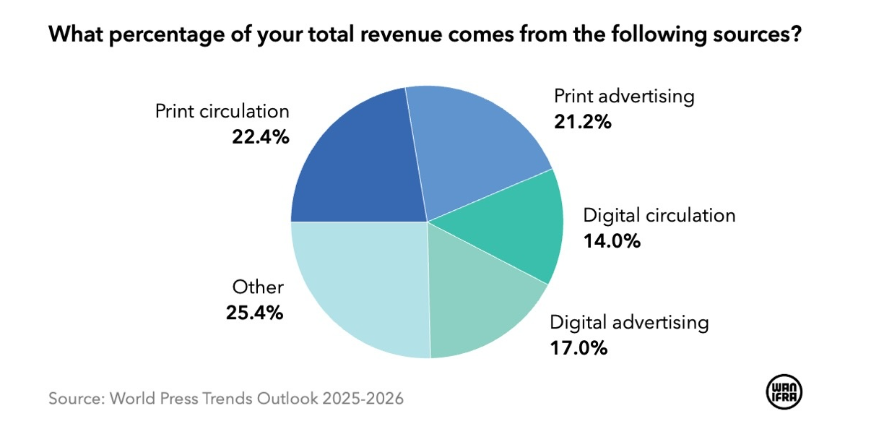
Globally, the direction of travel is similar. WAN-IFRA’s latest World Press Trends Outlook, based on more than 170 senior media executives across 66 countries, found print circulation and advertising now account for 43.6% of publishers’ revenue, down from 56.2% five years ago. Digital circulation and advertising contribute 31%, while other activities such as events, B2B services and e-commerce account for 25.4%.
“Publishers are innovating and adapting in the face of relentless change,” says Dean Roper, Director of Insights, WAN-IFRA, in the report.
From selling pages to solving business problems
The diversification is also changing the publisher-advertiser relationship. Print still offers credibility, mass reach and high-impact communication. But advertisers increasingly want to extend that impact through digital, OOH and experiential properties, says Sajal Gupta, CEO, Kioas Marketing.
The pitch is therefore moving from an individual media product to an integrated proposition: print for awareness and credibility, digital for targeting and engagement, OOH for physical visibility and frequency, and events for direct consumer interaction.
This plays to the natural advantage of large newspaper groups, which already have advertiser relationships, local presence, physical assets and established brands.
India’s OOH market itself grew 4% in 2025 to ₹4,835 crore from ₹4,650 crore, according to the Pitch Madison Advertising Report 2026. For publishers, OOH and events are consequently not just new revenue lines. They are extensions of existing relationships.
Sandeep Amar, Founder, PDlab.me, says, “Standalone newspaper buys are weakening as brands increasingly respond to integrated packages combining events, print, OOH and the credibility of a news brand. Such packages can offer advertisers access to celebrities, policymakers, stakeholders and audiences alongside conventional media visibility.”
That also explains the expansion into other businesses — from book publishing and education to training, content syndication, IT solutions and affiliate marketing. The individual businesses may be smaller, but collectively they reduce dependence on a single revenue engine.
Diversification buys time, not immunity
There is, however, a catch. New revenue does not necessarily mean equivalent profitability. CRISIL expects margins for non-print businesses to remain around 12–13% this fiscal, with OOH and events carrying higher variable costs and greater competition than traditional print.
The objective, therefore, is not necessarily to replace every rupee of lost print revenue with an equally profitable rupee elsewhere. It is to build enough alternative revenue streams to make the eventual decline of print financially manageable.
The real test is whether those businesses can grow fast — and profitable enough — to ensure that when print becomes a smaller part of the equation like the US and other parts of the world, the publisher itself does not become smaller with it.
Read more news about Print Media, TV Media, Advertising India, Digital Media, Marketing
For more updates, be socially connected with us onInstagram, LinkedIn, Twitter, Facebook, YouTube & Google News