After Modi’s Reels push, cabinet ministers turn up their Instagram game to woo Gen Z
Instagram activity for 30 Cabinet ministers jumped 13% in a week of the PM's social media push, as political communication moves from speeches to Reels, personality-led content & engagement with youth
 by
by
Published: Sep 8, 2026 8:14 AM | 7 min read
 Follow Us

- Following Prime Minister Narendra Modi's call for ministers to adopt modern communication strategies, there has been a notable increase in social media activity among Cabinet ministers, with a 13% rise in Instagram posts within a week.
- Politicians are shifting from traditional political communication to creator-style content, utilizing formats like vertical videos and direct-to-camera communication to engage younger audiences, with over 80% of followers for some ministers being aged 18 to 34.
- The evolving landscape of political communication is prompting a reevaluation of the role of influencer marketing, as independent creators may offer unique regional insights and community credibility that national political accounts cannot replicate.
- The increase in social media engagement by government officials has raised regulatory considerations, leading to discussions about establishing a social-media code of conduct to define acceptable online behavior for public officials.
Did you see Chirag Paswan's recent reel on GenZ? In a matter of days, it clocked 463k views, an audience comparable to, and in some cases larger than, what an average brand film manages to accumulate through a paid media push.
Or take Jai Shankar’s reel on National Sports Day The short-form video has already generated 1.6million views, 191k likes and 3680 shares.
These are not isolated viral moments.
A month after Prime Minister Narendra Modi urged his Union Cabinet colleagues to move beyond conventional political communication on X and use formats such as Instagram Reels to connect directly with Gen Z and Millennials, ministers appear to have taken the message seriously.
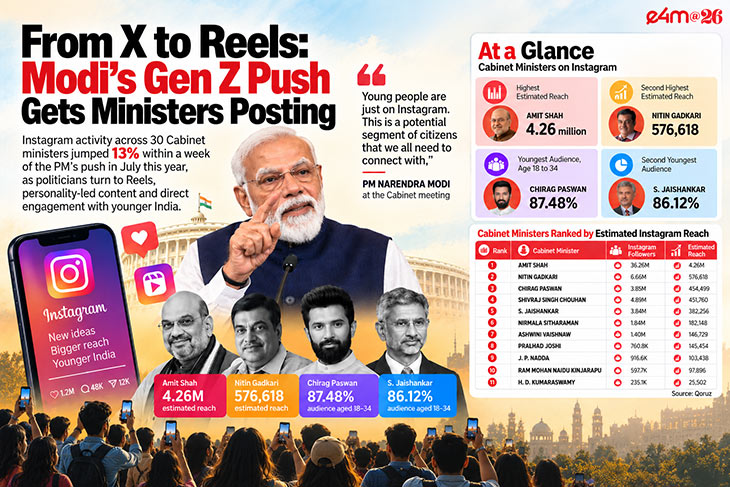
Data verified by exchange4media from influencer marketing intelligence platform Qoruz shows that Instagram posting across 30 Cabinet ministers increased 13% within just seven days of the Prime Minister's push back in July.
The change is significant not merely because ministers are posting more, but because of what they are increasingly posting.
The political social media feed, traditionally dominated by press releases, event photographs, speech clips and official announcements is increasingly borrowing from the creator playbook: vertical videos, direct-to-camera communication, behind-the-scenes moments, personality-led posts and platform-native storytelling designed to travel beyond an existing political follower base.
In other words, politicians aren't simply becoming more active on social media. They are beginning to behave like creators.
From follower base to audience base
The audience they are building is also considerably younger than conventional perceptions of political communication might suggest.
Among 11 senior Cabinet ministers analysed through Qoruz, six have Instagram audiences where more than 80% of followers are between 18 and 34 years old.
Food Processing Industries Minister Chirag Paswan has the highest concentration of 18-to-34-year-olds at 87.48%, alongside the third-highest reach among the ministers analysed.
External Affairs Minister S. Jaishankar has the strongest presence among the youngest cohort, with 32.14% of his audience aged 18–24, while Civil Aviation Minister Ram Mohan Naidu Kinjarapu leads among 25-to-34-year-olds, who account for 59.26% of his audience.
Home Minister Amit Shah, meanwhile, leads the group on overall estimated Instagram reach at 4.26 million.
The numbers suggest an important shift for political communication teams: social media is no longer simply a distribution mechanism for material created elsewhere. The politician's own account is increasingly becoming a media property in itself.
Abhijith Radhakrishnan Nair, State Social Media Convenor, BJP Keralam, argues that this also changes the role of agencies working with political leaders.
“Politicians don't necessarily need agencies to manage their work. But if a politician doesn't have the time to manage their communication, they can tell their narrative to an agency, and the agency can create content around it in a positive and engaging way. If the content is strong enough, it will get shared organically, there is no need to artificially push it,” he said.
More importantly, Nair argues that political influence cannot be reduced to follower counts.
“For political branding, I don't think the number of followers really matters. A politician can develop followers over time. There are politicians like S. Jaishankar who have a very wide reach. Ultimately, it is about the strength of the content and what you want to convey to the youth. You don't need millions of followers if the content itself has enough strength to attract an audience,” he added.
That distinction is becoming increasingly visible.
Prime Minister Modi himself demonstrated the ability of personality-led content to travel far beyond a politician's conventional follower ecosystem when a selfie-style video addressing students during the paper leak controversy generated 271 million views, 16.8 million likes and 1.5 million comments, according to the data reviewed for this story. His Instagram account gained nearly one million followers within a day of the post.
For political communication strategists, the implication is straightforward: the politician is increasingly both the message and the distribution channel.
Politics discovers the creator playbook
The change is not limited to posting frequency.
Political figures are increasingly experimenting with formats that would once have sat firmly within entertainment or creator culture.
Politician and Janshakti Janata Dal chief Tej Pratap Yadav, for instance, stars in Bhojpuri Bawaal, an unscripted reality format on Colors TV and JioHotstar. Rather than relying on political debates or formal interviews, the format places him alongside regional personalities and mainstream celebrities, including Mallika Sherawat, in a pop-culture environment designed for both television and digital circulation.
It is an extreme example, but one that illustrates the direction in which political communication is moving: away from simply broadcasting political activity and towards creating content around political personalities.
Anup Sharma, PR & Political Communications Advisor and Co-Founder, Quivora Advisory, believes younger audiences are accelerating that change.
“Social media is no longer just a top-down megaphone for political parties; recent Gen Z movements show that young audiences use memes, livestreams, and platform-native formats to create their own narratives and mobilise decentralized power. Because Gen Z can instantly spot artificial political posturing, governments must adapt to direct, informal, and conversational communication, otherwise, they risk losing control of the narrative to an audience that builds its own influence,” Sharma said.
If politicians have reach, where do influencers fit?
The rise of politicians as creators creates another question for the influencer-marketing ecosystem.
If a Cabinet minister already commands millions of followers, with more than 80% of that audience in some cases falling between 18 and 34, why should governments pay independent creators for additional reach?
Increasingly, the answer may be not more reach, but different reach.
Independent creators can offer something a national political account cannot easily reproduce: geographic concentration, regional languages and dialects, community credibility and access to highly specific audiences.
Bihar's move towards performance-linked payouts of up to ₹1 lakh per video for creators promoting government schemes is one indication of this emerging model. Uttar Pradesh and Odisha have also experimented with influencer partnerships, while MyGov empanelled four influencer-marketing agencies in 2023.
Shudeep Majumdar, Co-Founder & CEO, Zefmo, explained that while a message from a Union Minister can achieve rapid national distribution, converting that visibility into action, such as scheme adoption or enrolment in a particular district, can require hyperlocal creators who understand the linguistic and cultural context of that community.
“The expansion of government creator programs directly parallels the commercial advertising world's push for performance-linked accountability and strict ROI. Far from being a mere experiment, empaneling hyperlocal creators signals that creator marketing is becoming an institutional channel for public outreach, where performance metrics must balance viral distribution with strict standards around disclosure, factual accuracy, and genuine audience authenticity,” Majumdar said.
Sharma similarly sees government communication moving towards workflows that increasingly resemble those of consumer brands.
“Government communication is undergoing a fundamental structural shift: earned visibility through traditional journalism is giving way to direct creator partnerships, hybrid digital anchors, and paid commercial models. Modern public relations for the state now requires brand-like agency workflows, spanning audience mapping, creator vetting, commercial negotiations, and performance tracking , which will inevitably redirect a significant share of traditional media budgets toward independent creators,” he said.
More activity also means more scrutiny
The rapid expansion of social-media communication across the political and government ecosystem is beginning to create regulatory questions as well.
As government employees and officers become increasingly active on Instagram, Facebook and X, the Centre is considering a dedicated social-media code of conduct defining what they can post online.
Prime Minister Modi has asked senior bureaucrats to examine the possibility of such a framework, according to a PTI report, with the proposed code expected to establish boundaries around videos, opinions and content concerning sensitive or inappropriate subjects.
The timing is notable. As political leaders, government departments and public officials become more sophisticated content creators, the distinction between official communication, personal expression, political messaging and creator-style content becomes progressively harder to define.
For agencies and political communication teams, the shift therefore goes beyond simply producing more Reels.
The next phase will be about understanding which politician already owns which audience, what content travels organically from their accounts, where independent creators genuinely add incremental value, and how that influence translates from views into public action.
The PM's push may have started as a call for ministers to communicate more effectively with younger Indians. The early numbers suggest something larger is taking shape: India's political establishment is beginning to build its own creator ecosystem.
Read more news about Influence Zone, Marketing, PR and Corporate Communication, Internet Advertising, People Movement
For more updates, be socially connected with us onInstagram, LinkedIn, Twitter, Facebook, YouTube & Google News